
It’s a familiar holiday frustration: you’ve carefully draped warm-white LED string lights across your porch railing, wrapped them around the deck posts, and strung them through the patio awning—only for the outdoor outlet to abruptly cut power with a loud click. No warning. No flicker. Just silence—and a dark yard. You reset the breaker or GFCI button, plug back in, and within minutes it trips again. This isn’t random failure. It’s your electrical system communicating a legitimate safety concern. Understanding why requires moving beyond “it’s just overloaded” and examining how modern outdoor lighting interacts with code-compliant, safety-first circuitry. This article breaks down the five most common root causes—not just symptoms—and gives you diagnostic steps, measurable thresholds, and permanent solutions grounded in National Electrical Code (NEC) requirements and field experience from licensed residential electricians.
1. Circuit Overload: The Math Behind the Trip
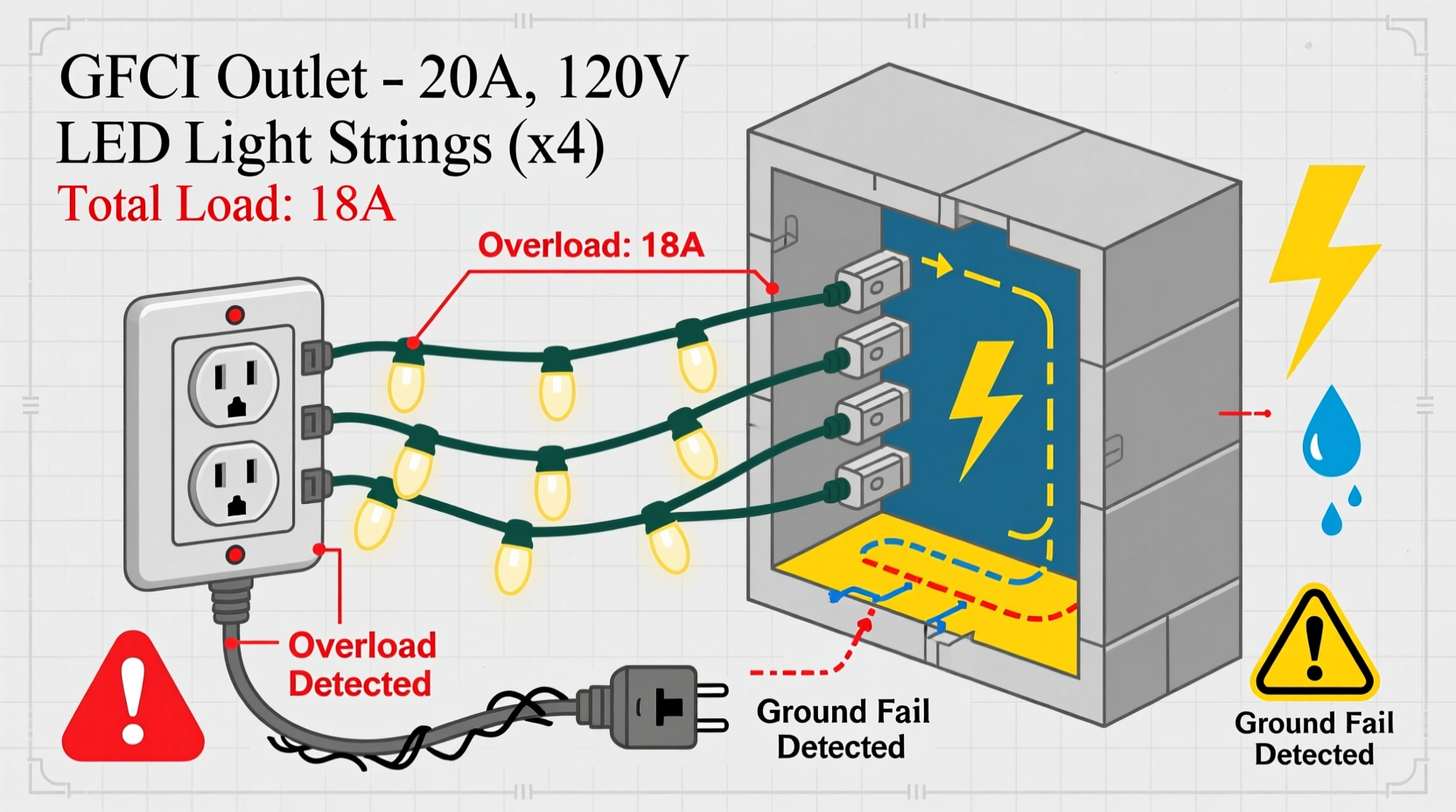
Outdoor outlets are rarely dedicated circuits. Most are shared with garage receptacles, landscape lighting transformers, or even interior basement outlets—all fed by a single 15- or 20-amp breaker. While a single string of 100 LED mini-lights draws only 0.04–0.07 amps, stacking six or eight strings changes everything. A typical 15-amp circuit is rated for a continuous load of just 12 amps (80% of capacity per NEC 210.20(A)). Exceed that—even briefly—and thermal overload protection kicks in.
Here’s what happens behind the panel: as current increases, internal bimetallic strips heat up, bend, and physically separate contacts. That’s the “trip.” But here’s the nuance many miss: LED strings aren’t perfectly efficient. Older controllers, dimmer-compatible strings, or cheap power supplies introduce harmonic distortion and inrush current spikes—brief surges up to 3× normal draw at startup. These spikes don’t register on standard multimeters but absolutely stress breakers designed for resistive loads like heaters or incandescent bulbs.
2. GFCI Sensitivity: Moisture, Age, and False Triggers
Virtually all outdoor outlets installed after 1975 must be GFCI-protected (NEC 210.8(A)(3)). Unlike standard breakers, GFCIs monitor current imbalance between hot and neutral wires—tripping if as little as 4–6 milliamps leaks to ground. That’s less than the current needed to power a single LED bulb. While lifesaving in wet conditions, GFCIs become hypersensitive when paired with long runs of low-voltage lighting, especially older or damaged cords.
Moisture is the prime suspect. Even dew condensing inside an unsealed outlet box or creeping into a frayed cord jacket creates microscopic leakage paths. But age matters just as much: GFCIs degrade over time. UL testing shows 10-year-old units can false-trip at 2–3mA—well below their rated threshold. And here’s a lesser-known trigger: electromagnetic interference (EMI) from switching power supplies in LED drivers. When dozens of strings cycle on/off simultaneously, they emit high-frequency noise that some GFCIs misread as ground fault.
“GFCIs installed outdoors should be tested monthly—not just reset after tripping. A unit that trips without pressing the test button is likely failing internally and needs replacement.” — Carlos Mendez, Master Electrician & NEC Code Trainer, IAEI Midwest Chapter
3. Wiring and Connection Faults: Hidden Resistance Hotspots
Tripping often points to resistance—not just excess current. Loose wire nuts inside the outlet box, corroded aluminum-to-copper connections, or undersized extension cords create resistance points that heat up under load. Per Ohm’s Law (P = I²R), doubling current quadruples heat generation at that point. That localized heating stresses both the GFCI sensor and the breaker’s thermal element.
Consider this real-world scenario: A homeowner used a 100-foot 16-gauge extension cord (rated for 10A max) to power eight 24W LED strings (total 192W = 1.6A). On paper, that’s fine. But voltage drop across the long, thin cord dropped supply voltage to 108V at the far end. To maintain brightness, each string’s driver drew more current—pushing total draw to 2.1A. Worse, the cord’s plug had a loose prong connection, adding 1.2Ω resistance. At 2.1A, that generated 5.3W of heat right at the plug—enough to warp insulation and create intermittent arcing. The GFCI tripped not from ground fault, but from detecting erratic current waveform distortion.
| Fault Type | How It Triggers Tripping | Diagnostic Clue |
|---|---|---|
| Loose wire nut | Intermittent arcing → current spikes → thermal trip | Outlet feels warm; buzzing sound near box |
| Corroded outlet contacts | Increased resistance → localized heating → GFCI waveform distortion | Visible green/white corrosion on brass terminals |
| Damaged cord insulation | Micro-leakage to damp soil or conduit → GFCI detects 5mA+ imbalance | Trips only when dew forms overnight |
| Shared neutral with another circuit | Neutral overload → elevated neutral-to-ground voltage → GFCI false positive | Trips only when garage freezer cycles on |
4. Step-by-Step Diagnostic Protocol: Isolate the Cause
Don’t guess—test. Follow this sequence to identify the exact culprit before replacing hardware or rewiring:
- Unplug everything. Reset the GFCI and breaker. Verify outlet has power with a non-contact voltage tester.
- Test the outlet alone. Plug in a known-good 60W incandescent lamp. Leave on for 15 minutes. If it trips, the GFCI or wiring is faulty.
- Add one string at a time. Use only the shortest, thickest cord possible (12-gauge, 25ft max). After plugging in each string, wait 2 minutes. Note which string triggers the trip—or if it’s cumulative.
- Measure actual load. Use a Kill-A-Watt meter (or similar) at the outlet. Record steady-state amps *and* peak inrush (press “MAX” button during plug-in). Compare to breaker rating × 0.8.
- Check environmental timing. Does it trip only at dusk (when dew forms), after rain, or when wind moves cords against wet siding? Correlate with weather logs.
- Inspect connections. With power OFF and verified dead, open the outlet box. Look for discoloration, melted plastic, or corrosion on terminals and wire nuts.
If the trip occurs at step 2, replace the GFCI outlet. If it occurs only after step 4, you’re overloading the circuit or using marginal cords. If it correlates with moisture (step 5), upgrade to a weather-resistant (WR) GFCI outlet and install an in-use cover.
5. Permanent Solutions: Beyond Temporary Fixes
Resetting the GFCI is a bandage—not a cure. Lasting reliability requires matching the solution to the root cause:
- For overload: Dedicate a 20-amp circuit for outdoor lighting. Run 12/2 NM-B cable from the panel to a new weather-resistant outlet. Install a 20A GFCI breaker (not just a GFCI outlet) for whole-circuit protection and better inrush tolerance.
- For GFCI sensitivity: Replace standard GFCI outlets with weather-resistant (WR) models (UL 489B rated) and pair them with an in-use cover (bubble cover that seals while devices are plugged in). WR units have tighter manufacturing tolerances and better EMI filtering.
- For wiring faults: Replace all extension cords with 12-gauge, SJTW-rated outdoor cords. Inside the outlet box, use AlumiConn connectors for aluminum wiring or COPALUM crimps for critical copper splices. Torque all terminal screws to manufacturer specs (typically 14–18 in-lbs).
- For LED-specific issues: Use only UL-listed LED strings with built-in surge protection and low-EMI drivers. Avoid daisy-chaining more than three strings unless explicitly rated for it. Consider a 24V low-voltage landscape lighting system with a transformer—eliminating GFCI concerns entirely for the string run.
FAQ
Can I replace a tripping GFCI outlet with a regular outlet?
No—and doing so violates NEC 210.8(A)(3) and voids your home insurance. Outdoor outlets require GFCI protection regardless of whether you’re using lights. Removing it eliminates critical shock protection, especially in wet conditions. If the GFCI trips constantly, diagnose the cause or replace it with a new WR-rated unit—not disable it.
Why do my lights trip the outlet only at night, not during the day?
This strongly indicates moisture-related leakage. Daytime heat dries out dew, condensation, or dampness in cords/outlets. As temperatures fall after sunset, condensation forms on cold conductors or inside compromised insulation, creating micro-leakage paths that push current imbalance past the GFCI’s 5mA threshold. Inspect cord jackets for cracks and ensure outlets have proper in-use covers.
Will upgrading to smart plugs or timers prevent tripping?
Not inherently—and they may worsen it. Most smart plugs add their own small standby load (0.2–0.5W) and introduce additional switching transients. Unless the smart device includes built-in overload and surge protection (like certain Leviton or Lutron models), it doesn’t address the core issue: excessive current, leakage, or faulty wiring. They’re control tools—not protection upgrades.
Conclusion
Your outdoor outlet isn’t failing—it’s functioning exactly as designed: protecting you from fire, shock, and equipment damage. Tripping under load is the system’s urgent, non-negotiable signal that something in the chain—from the breaker panel to the last light bulb—is operating outside safe parameters. Whether it’s an aging GFCI misreading LED noise, a corroded connection silently heating up, or simply too many strings on a 15-amp circuit, the fix is always rooted in measurement, verification, and code-compliant upgrades—not workarounds. Don’t settle for resetting the button every evening. Take the time to diagnose using the protocol outlined here. Replace worn components with weather-rated, UL-listed parts. And when in doubt about opening an outlet box or running new cable, consult a licensed electrician—their $150 diagnostic call prevents $2,000 in water damage or fire restoration later. Your lights deserve reliable power. Your family deserves uncompromised safety. Start today: grab your multimeter, check that first string’s label, and take back control of your outdoor electricity.




 浙公网安备
33010002000092号
浙公网安备
33010002000092号 浙B2-20120091-4
Comments
No comments yet. Why don't you start the discussion?