
Parrots are among the most intelligent and socially complex birds in the animal kingdom. Their ability to mimic human speech, household noises, and even melodies is often what draws people to keep them as companions. Yet, many parrot owners find themselves puzzled when their bird flawlessly repeats “Hello!” or the microwave beep—but completely ignores direct commands like “Step up” or “Go to your perch.” This behavior isn’t defiance or disinterest; it’s rooted in biology, psychology, and learned associations. Understanding the difference between mimicry and obedience is key to building a more responsive, trusting relationship with your feathered companion.
The Nature of Parrot Mimicry
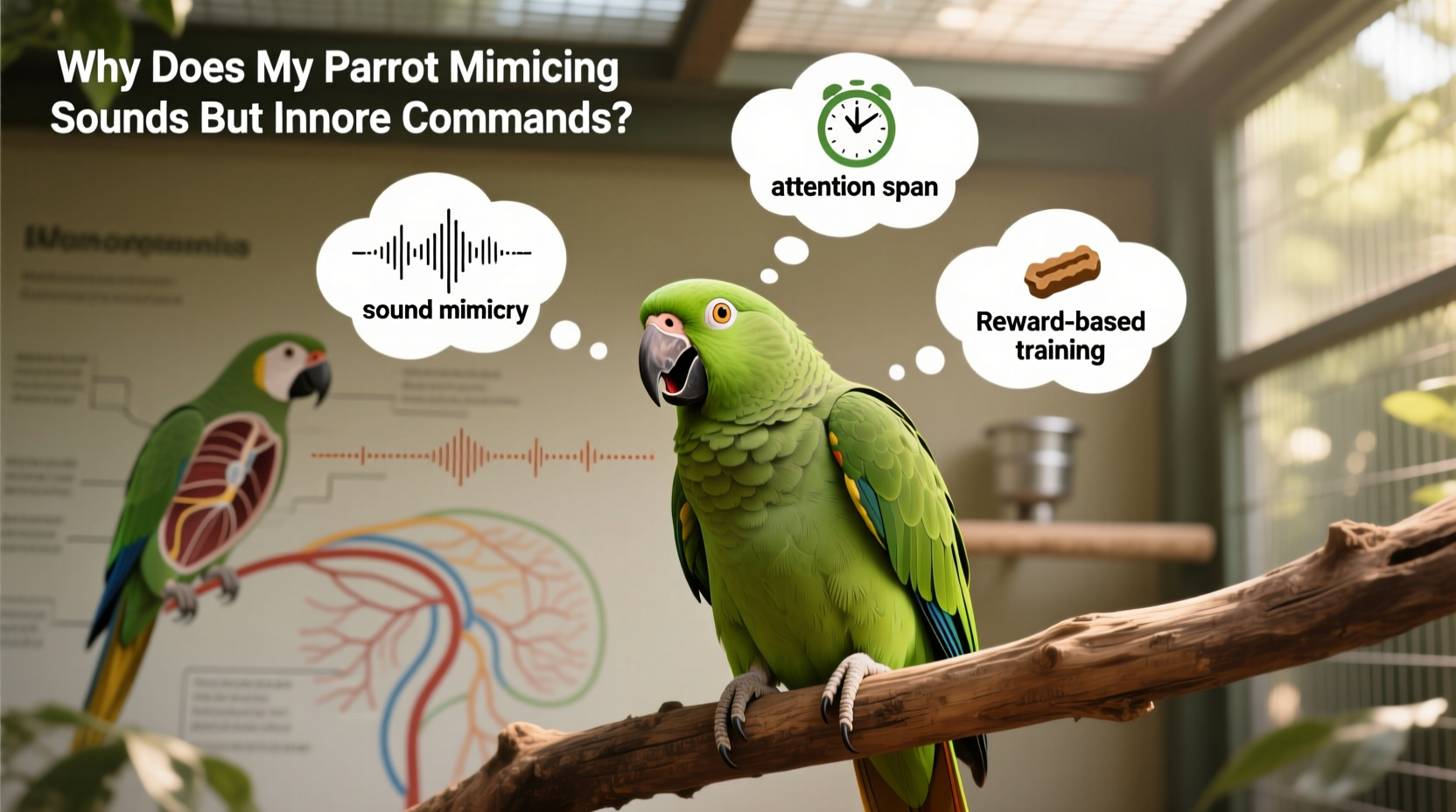
Mimicry in parrots is not random noise-making—it’s a deeply ingrained social behavior. In the wild, parrots use vocalizations to maintain flock cohesion, identify members, and signal safety or danger. When a parrot mimics sounds in a home environment, it’s attempting to integrate into its human-centered \"flock.\" The sounds that get repeated—doorbells, phones, phrases—are those that consistently elicit reactions from humans. Laughter, movement, or attention following a sound increases the likelihood of repetition.
Unlike command-following, which requires comprehension and voluntary action, mimicry is often an automatic or reward-driven behavior. A parrot may repeat “Good morning!” every day at 7:00 a.m. because it has learned this phrase precedes breakfast. However, this doesn’t mean the bird understands the words or feels obligated to respond to instructions.
Why Commands Are Ignored: The Cognitive Gap
Obedience requires a different cognitive process than mimicry. While mimicry relies on auditory memory and social reinforcement, responding to commands involves understanding cause-and-effect relationships, impulse control, and trust in the trainer. Many parrots ignore commands not because they can’t hear or comprehend, but because:
- The command lacks consistent context or reinforcement.
- The bird associates the command with negative experiences (e.g., being returned to a cage).
- There is no clear reward system in place.
- The bird hasn't been taught to focus on the handler amidst distractions.
Dr. Irene Pepperberg, a leading expert in avian cognition and researcher behind the famous African grey parrot Alex, explains:
“Parrots can associate words with objects, actions, and outcomes—but that doesn’t mean they automatically obey. Obedience must be trained separately from vocal learning, using principles of operant conditioning.” — Dr. Irene Pepperberg, Avian Cognition Researcher
This distinction is critical: mimicry is communication; obedience is cooperation. One comes naturally; the other must be cultivated.
Training vs. Imitation: Bridging the Divide
To shift from passive mimicry to active responsiveness, owners must implement structured training. Unlike mimicry, which thrives on environmental exposure, command-following requires deliberate shaping of behavior through positive reinforcement.
A Step-by-Step Guide to Teaching Basic Commands
- Choose a low-distraction environment. Start training in a quiet room where your parrot feels safe and can focus.
- Select one simple command. Begin with “Step up,” as it’s foundational for handling and trust-building.
- Use a target stick or finger as a visual cue. Gently press it against the bird’s lower abdomen to encourage stepping onto your hand.
- Immediately reward compliance. Offer a high-value treat (e.g., a sunflower seed or piece of fruit) within seconds of the desired behavior.
- Repeat consistently. Practice 5–10 minutes daily, always ending on a positive note.
- Add the verbal cue. Once the bird reliably steps up on the visual prompt, say “Step up” just before offering the cue. Over time, the word will become associated with the action.
- Phase out the physical prompt. Gradually reduce reliance on the stick or pressure, rewarding only responses to the verbal command.
Consistency is crucial. If family members use different words (“Up!”, “Come here!”, “Onto my hand!”), the bird becomes confused. Standardize language across all caregivers.
Common Training Pitfalls and How to Avoid Them
Even well-intentioned owners make mistakes that hinder progress. Below is a comparison of recommended practices versus common errors.
| Do’s | Don’ts |
|---|---|
| Use short, consistent training sessions (5–10 min) | Train for long periods when the bird is tired or agitated |
| Reward immediately after desired behavior | Delay treats or scold incorrect responses |
| Use high-value, bite-sized rewards | Withhold food to increase motivation |
| End each session positively | Force compliance or physically manipulate the bird |
| Practice commands in multiple locations gradually | Expect instant generalization across environments |
One of the most damaging misconceptions is that parrots should obey because they “love” their owner. While affection strengthens bonds, it doesn’t replace structured learning. Parrots are not dogs; they evolved as prey animals with strong self-preservation instincts. Trust must be earned through predictability and fairness.
Case Study: From Echo to Engagement
Sophia adopted a 3-year-old green-cheeked conure named Milo, who could say “I love you,” whistle TV themes, and mimic her phone ringtone—but refused to step onto her hand. Frustrated, she assumed he was stubborn. After consulting an avian behaviorist, she began a structured training plan.
For two weeks, Sophia practiced “Step up” during calm moments, using a small skewer as a target stick and offering millet sprays as rewards. She avoided forcing contact and instead built value in the command by pairing it with access to favorite activities—like flying around the living room or sitting near the window.
Within three weeks, Milo began stepping up voluntarily. By week six, he responded to the verbal cue 80% of the time, even with mild distractions. The turning point was consistency and reframing training as a game rather than a demand.
Milo still mimics sounds independently—sometimes interrupting training with a perfectly timed “Knock knock!”—but now he also chooses to engage when asked. The difference? He learned that listening leads to rewards, freedom, and deeper connection.
Environmental and Emotional Factors Influencing Responsiveness
A parrot’s willingness to follow commands is heavily influenced by its emotional state and surroundings. Birds in stressful or overstimulating environments may shut down or become hyperactive, neither of which supports learning.
Key factors include:
- Diet: Poor nutrition affects brain function. A diet rich in fresh vegetables, pellets, and limited seeds supports cognitive health.
- Sleep: Parrots need 10–12 hours of uninterrupted sleep. Sleep-deprived birds are irritable and less attentive.
- Cage setup: Overcrowded cages with excessive toys or mirrors can increase anxiety. Provide space, perches at varying heights, and quiet zones.
- Social interaction: Parrots left alone for long periods may become apathetic or overly dependent, both of which interfere with training.
Additionally, hormonal fluctuations—especially during breeding season—can cause temporary disinterest in commands. Males may become territorial; females may focus on nesting behaviors. During these times, maintain routine but reduce demands.
Checklist: Building a Responsive Parrot
Follow this actionable checklist to improve your parrot’s responsiveness over time:
- ✅ Establish a predictable daily routine including feeding, playtime, and sleep.
- ✅ Identify high-value treats unique to training sessions.
- ✅ Train in short bursts, once or twice daily, in a quiet space.
- ✅ Use consistent verbal cues and avoid mixed signals.
- ✅ Reward immediately and enthusiastically for correct responses.
- ✅ Gradually introduce distractions as mastery improves.
- ✅ Monitor body language—fluffed feathers, pinned eyes, or backing away indicate stress.
- ✅ Rotate toys and perches to prevent boredom without overstimulation.
- ✅ Involve all household members in using the same commands.
- ✅ Track progress in a journal to recognize patterns and setbacks.
Frequently Asked Questions
Can all parrots be trained to follow commands?
Most parrots can learn basic commands with patience and positive reinforcement, regardless of species. Success depends more on the owner’s consistency than the bird’s inherent ability. Even highly independent species like cockatiels or budgies can learn “Step up” or “Turn around” with proper technique.
My parrot mimics everything but won’t talk on command. Why?
Mimicry is spontaneous and socially motivated; “talking on command” is a trained behavior. To teach vocal responses, pair a specific phrase with a consistent trigger (e.g., saying “Want a nut?” before offering a treat). Over time, pause and wait for the bird to repeat it before giving the reward. This shapes intentional speech.
How long does it take to train a parrot to obey?
Basic commands can be learned in 2–6 weeks with daily practice. Complex behaviors or overcoming fear-based avoidance may take several months. Progress is rarely linear—setbacks are normal. Focus on small wins and sustained effort.
Conclusion: From Noise to Connection
A parrot that mimics sounds but ignores commands isn’t broken or disobedient—it’s communicating in the only way it knows how. Mimicry is its attempt to belong. Command-following, however, is a skill that must be taught with clarity, kindness, and consistency. By understanding the biological and emotional drivers behind both behaviors, owners can transform random echoes into meaningful interactions.
Start small. Celebrate effort, not perfection. Build trust before demanding compliance. Over time, your parrot won’t just repeat words—it will listen, respond, and choose to cooperate. That shift isn’t about control; it’s about partnership. And in that partnership lies the deepest form of companionship a parrot can offer.




 浙公网安备
33010002000092号
浙公网安备
33010002000092号 浙B2-20120091-4
Comments
No comments yet. Why don't you start the discussion?