
Parrots are among the most intelligent and socially complex birds in the animal kingdom. Their ability to mimic sounds—from human speech to household noises—is both fascinating and sometimes baffling. If you’ve ever called your parrot by name only to hear it respond with a perfect imitation of the microwave’s “beep-beep-beep,” you’re not alone. This common behavior raises an important question: why do these highly social creatures choose to repeat mechanical noises over personal interactions? The answer lies in a blend of biology, psychology, and environmental reinforcement.
Unlike humans, parrots don’t assign emotional or relational meaning to words in the same way. Instead, they respond to patterns, repetition, and perceived rewards. The microwave beep is short, high-pitched, consistent, and often followed by activity—making it stand out in a parrot’s auditory world. Your name, on the other hand, may be spoken infrequently, with variable tone, and without immediate consequence. To understand this selective mimicry, we need to explore how parrots learn, what motivates them, and how their environment shapes their vocal choices.
The Science Behind Parrot Vocal Learning
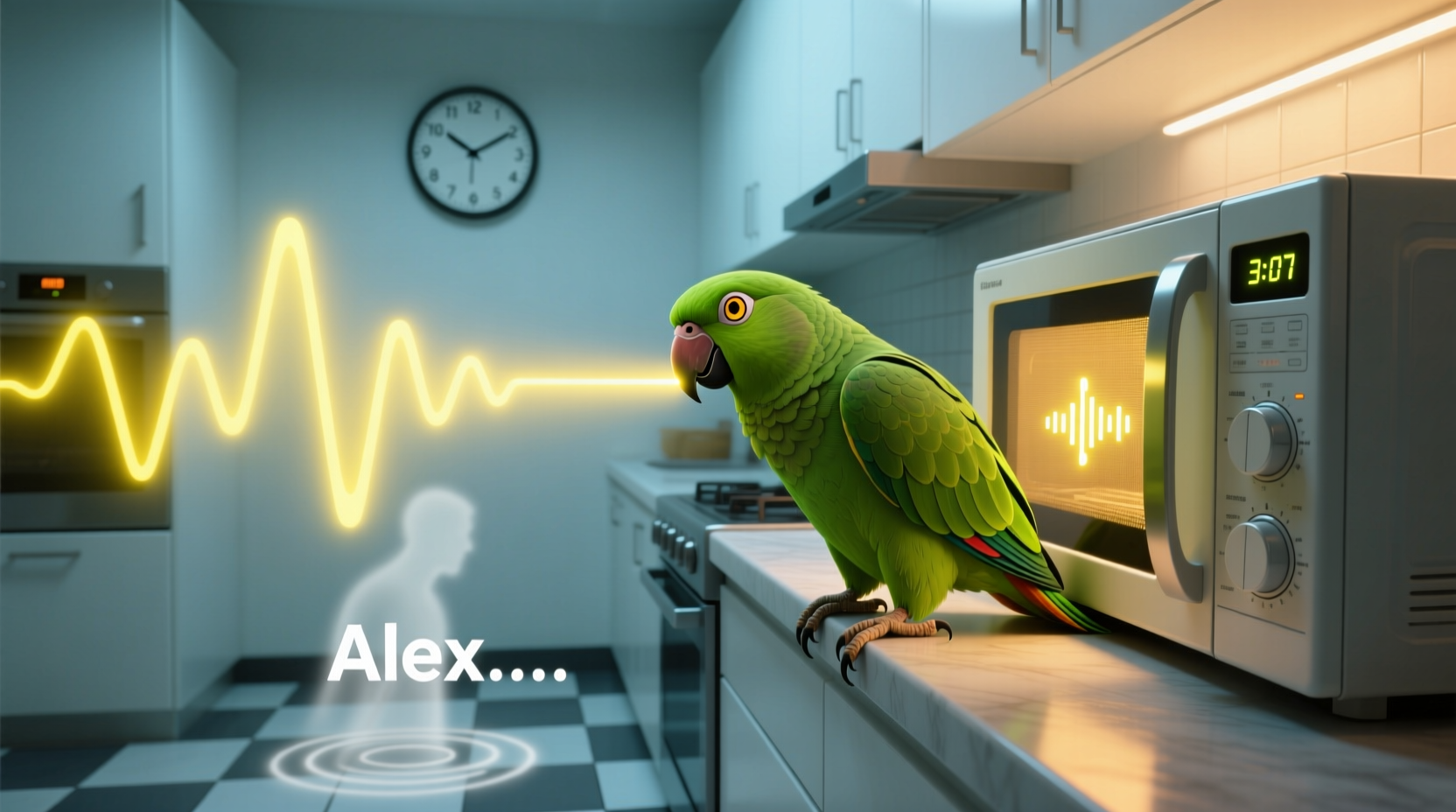
Parrots belong to a small group of animals capable of vocal learning—the ability to imitate sounds heard in their environment. This trait is shared with humans, some songbirds, dolphins, and bats. In the wild, parrots use vocal mimicry to strengthen social bonds within flocks. Each bird develops a unique contact call, much like a name, which helps individuals recognize one another across dense forests.
Dr. Irene Pepperberg, a leading expert in avian cognition and researcher behind the famous African grey parrot Alex, explains:
“Parrots aren’t just repeating sounds mindlessly. They’re processing auditory input, identifying patterns, and choosing which sounds to reproduce based on context and outcome.” — Dr. Irene Pepperberg, Avian Cognition Researcher
In captivity, the flock becomes the human household. But unlike wild contact calls, human names are often embedded in complex sentences or spoken inconsistently. A microwave beep, however, is isolated, repetitive, and frequently paired with change—someone opening the door, food appearing, movement occurring. These associations make it far more salient to a parrot’s attention.
Why the Microwave Wins Over Your Name
To a parrot, not all sounds carry equal weight. Several factors determine whether a sound will be mimicked:
- Repetition: The microwave beeps multiple times a day, every day. Your name might be said once during feeding or when calling the bird.
- Acoustic clarity: Beeps are sharp, tonal, and easy to reproduce. Human speech involves complex mouth movements and subtle intonations that are harder to replicate.
- Immediate reinforcement: The beep is almost always followed by action—food, attention, movement. Your name may not trigger any visible response.
- Novelty and surprise: Sudden, high-frequency sounds grab attention. Parrots are naturally alert to changes in their environment as a survival mechanism.
A 2020 study published in Animal Cognition found that captive parrots were significantly more likely to mimic short, frequent, and predictable sounds—even artificial ones—than longer, irregular utterances. This suggests that predictability and consistency outweigh emotional relevance in early vocal learning stages.
Creating Conditions for Meaningful Mimicry
Mimicking your name isn’t a sign of affection—it’s a learned behavior driven by association. To shift your parrot’s focus from appliances to people, you need to make your voice more rewarding and memorable than the beep.
Start by isolating the target word. Avoid saying “Here, Charlie!” or “Charlie, want a snack?” Instead, repeat “Charlie” clearly and distinctly, then immediately follow it with a high-value reward—a sunflower seed, a scratch under the chin, or enthusiastic praise. Do this multiple times a day in short sessions (2–3 minutes) to avoid overwhelming the bird.
Consistency is critical. Everyone in the household should use the same pronunciation and reward system. If one person says “Char-lie” while another says “Chaz,” the parrot receives mixed signals, slowing learning.
Step-by-Step Guide to Teaching Your Parrot Its Name
- Choose a quiet time: Train when the household is calm and distractions are minimal.
- Say the name clearly: Use a cheerful, moderate tone. Repeat it 3–5 times in succession.
- Pause and wait: Give the bird 5–10 seconds to respond. Even a slight head tilt or soft chirp can be rewarded.
- Immediately reward: Offer a treat or gentle praise the moment the bird makes any sound resembling the name.
- End on a positive note: Stop after 2–3 successful attempts to keep the experience enjoyable.
- Repeat daily: Practice 2–3 times per day for several weeks. Progress may be slow, but persistence pays off.
Over time, your parrot will begin to associate its name with positive outcomes. Once it starts vocalizing the sound spontaneously, reduce the frequency of treats and rely more on social reinforcement—like clapping or excited tones—to maintain the behavior.
Do’s and Don’ts of Parrot Vocal Training
| Do’s | Don’ts |
|---|---|
| Use clear, consistent pronunciation | Slur words or use nicknames interchangeably |
| Train in short, focused sessions | Force interaction when the bird is stressed or preening |
| Pick high-reward moments (feeding, play) | Yell the name when calling a runaway bird (creates negative association) |
| Pair sounds with gestures or eye contact | Repeat the name without purpose or reward |
| Be patient—learning takes weeks or months | Expect instant results or punish silence |
A Real-Life Example: From Beeps to Names
Sophia, a first-time parrot owner in Portland, adopted a young green-cheeked conure named Milo. Within weeks, Milo had mastered the microwave, toaster, and doorbell—but ignored his own name. Frustrated, Sophia reached out to a local avian trainer.
The trainer advised her to stop using “Milo” in long phrases and instead create a dedicated training window each morning before breakfast. For two weeks, she stood near Milo’s cage, said “Milo” three times in a bright tone, waited, and offered a millet sprig only if he made any vocal effort. She avoided using his name at other times to preserve its association with reward.
By week three, Milo began whistling a close approximation of “Milo” when he saw her enter the kitchen. By week six, he responded reliably to his name and even started using it in combination with other learned words, like “Milo want!” when asking for treats. The microwave remained part of his repertoire—but now, so did his identity.
When Mimicry Reflects Emotional State
It’s also worth noting that parrots don’t mimic randomly. Their vocal choices can reflect emotional states, routines, and even attempts at communication. A parrot that frequently imitates alarms or beeps may be experiencing stress or boredom. These sounds are often high-pitched and stimulating, providing sensory feedback when understimulated.
If your parrot fixates on non-social sounds, consider enriching its environment. Rotate toys weekly, introduce foraging puzzles, and increase direct interaction. A mentally engaged parrot is more likely to invest energy in social mimicry than mechanical repetition.
FAQ
Can all parrots learn to say their name?
Most parrot species have the physical and cognitive capacity to mimic human speech, but individual variation exists. Factors like age, species, socialization, and exposure play major roles. Younger birds typically learn faster, and species like African greys, budgies, and amazons are especially adept. However, some parrots prefer whistling or non-verbal communication—and that’s perfectly normal.
Is it bad if my parrot mimics appliances?
No, appliance mimicry is not harmful or a sign of poor health. It indicates that your parrot is attentive and learning. However, if it replaces all social vocalizations or is accompanied by signs of stress (feather plucking, aggression), consider evaluating enrichment and routine. Balance is key.
How long does it take for a parrot to learn its name?
There’s no fixed timeline. Some parrots begin responding in a few weeks; others take several months. Daily, consistent training improves odds. Remember: your parrot isn’t ignoring you—it’s prioritizing sounds that make sense in its world. With patience, you can shift those priorities.
Conclusion: Rewriting the Soundscape
Your parrot isn’t choosing the microwave over you—it’s responding to what stands out in its environment. The beep is loud, predictable, and tied to change. Your name may be lost in the noise of daily conversation. But this isn’t a failure of affection; it’s a challenge of conditioning.
By understanding how parrots learn, leveraging repetition and reward, and reshaping the auditory landscape of your home, you can guide your bird toward more meaningful communication. It won’t happen overnight, and progress may come in whispers rather than clear words. But each attempt is a bridge—an effort to connect across species using sound as a shared language.
Start today. Say your parrot’s name with intention. Pair it with joy. Make it matter. And one day, amid the beeps and whistles, you’ll hear something unmistakable: your name, called back to you in a voice that knows you.




 浙公网安备
33010002000092号
浙公网安备
33010002000092号 浙B2-20120091-4
Comments
No comments yet. Why don't you start the discussion?