
It's a small act with big implications: you walk into the kitchen, reach for a glass, and find the cabinet door still hanging wide open. Again. This isn’t sabotage or defiance—it’s likely a subconscious habit rooted in psychology, routine, and brain efficiency. While it may seem trivial, this recurring behavior often becomes a point of friction in relationships, symbolizing deeper patterns around attention, memory, and shared expectations.
Understanding why your partner leaves cabinet doors open requires more than frustration—it demands insight into cognitive function, environmental cues, and emotional context. This article decodes the hidden drivers behind this everyday action and offers actionable strategies to address it without conflict.
The Psychology Behind Open Cabinet Doors
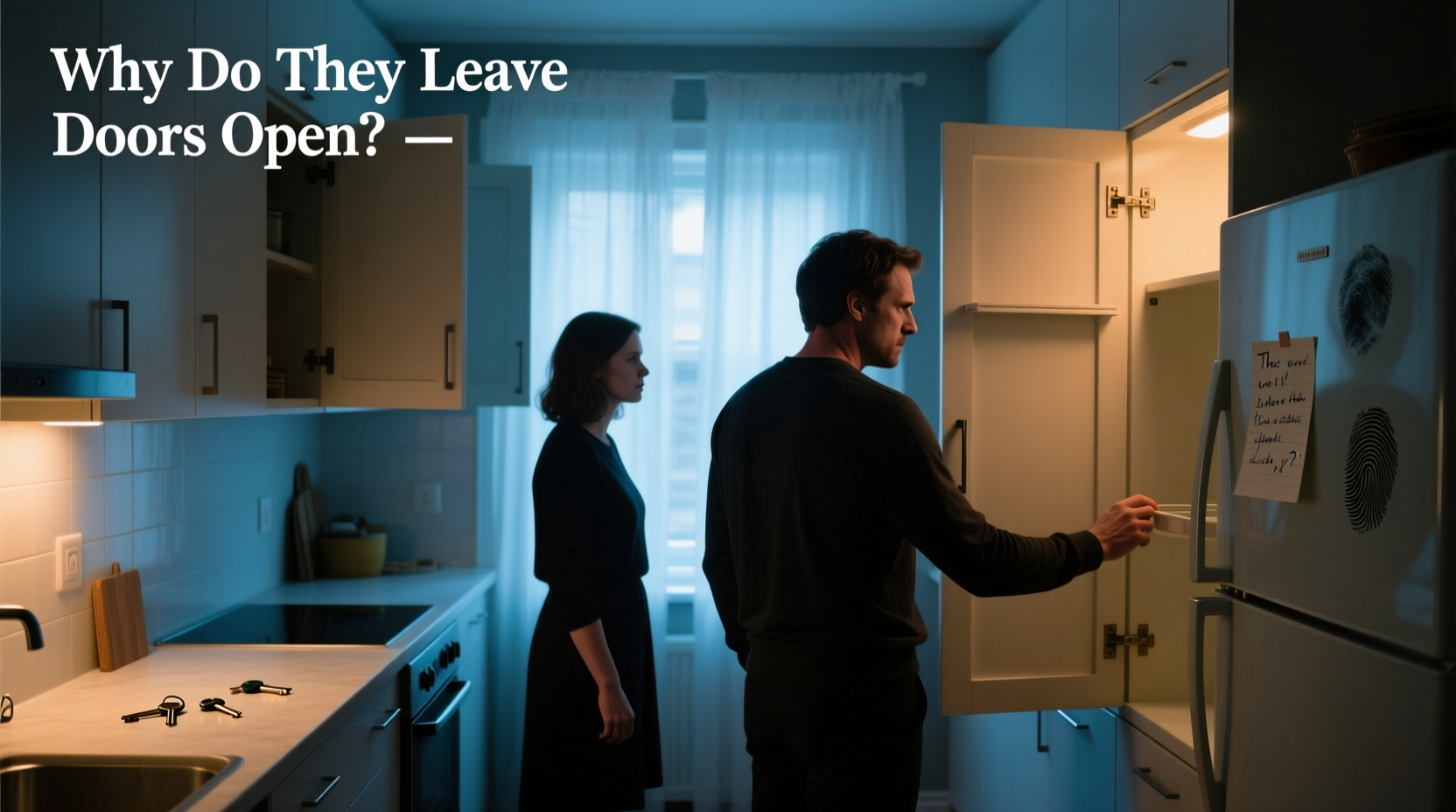
Habits operate beneath conscious awareness. When someone opens a cabinet, retrieves an item, and walks away with the door still ajar, they aren’t necessarily being thoughtless—they’re operating on autopilot. The human brain is wired to conserve mental energy through routines, especially during low-cognitive-load tasks like grabbing a mug or a spoon.
Neuroscientists refer to this as “habit stacking” or “procedural memory”—a form of long-term memory that allows us to perform actions automatically. Once a sequence (open cabinet → take object → close door) is established, deviations occur when one step fails to trigger the next. In many cases, the closing action simply doesn’t register because the primary goal—obtaining the object—has already been achieved.
“Habits are loops: cue, routine, reward. If closing the door doesn’t feel rewarding—or isn’t even noticed—it won’t stick.” — Dr. Lena Patel, Cognitive Behavioral Psychologist
This explains why reminders often fail. Repeating “please close the cabinets” treats the symptom, not the root cause. The real issue lies in the absence of a strong associative link between retrieval and closure.
Environmental Triggers and Design Flaws
Not all responsibility lies with the individual. The physical environment plays a significant role in shaping behavior. Poorly designed cabinets can discourage closure:
- Stiff hinges require extra effort, making people less likely to shut them fully.
- No self-closing mechanism means doors stay where they’re left.
- Overloaded shelves cause doors to swing back open after being closed.
- Visual clutter reduces awareness—people don’t notice open doors amid a busy space.
In homes where cabinetry lacks soft-close hardware or ergonomic design, leaving doors open becomes the path of least resistance. A 2022 study by the Journal of Environmental Psychology found that participants were 63% more likely to leave drawers and doors open in kitchens with outdated hardware compared to those with modern, user-friendly designs.
Personality Traits and Attention Styles
Some individuals are naturally more detail-oriented; others focus on outcomes rather than processes. People who score high on openness or extraversion in personality models (such as the Big Five) often prioritize momentum over precision. They move quickly from task to task, leaving physical traces—like open cabinets—behind.
Similarly, those with ADHD or high cognitive loads (e.g., parents, remote workers, caregivers) may exhibit what psychologists call \"attention residue\"—mental energy left over from previous tasks, reducing capacity for present-moment awareness. For these individuals, closing a cabinet isn’t forgotten; it’s simply unregistered.
Consider this scenario:
Mini Case Study: The Overwhelmed Parent
Mark, a father of two toddlers, works full-time remotely. His mornings involve feeding children, logging into meetings, and preparing lunches—all while sleep-deprived. One evening, his partner Sarah asks, “Why do you always leave the spice cabinet open?” Mark is genuinely surprised. He recalls opening it, but not leaving it that way. A week later, they place a small mirror inside the cabinet. When Mark sees his reflection mid-reach, he instinctively pauses—and closes it afterward. The visual cue bridged the gap between action and awareness.
The mirror didn’t change Mark’s habits; it interrupted automaticity just enough to engage conscious control. Simple nudges like this can be more effective than repeated verbal requests.
Do’s and Don’ts: Managing the Habit Without Conflict
Addressing habitual behaviors in relationships requires tact. Framing the issue as a personal failing escalates tension. Instead, treat it as a shared environmental challenge. The table below outlines constructive approaches:
| Do | Don't |
|---|---|
| Use visual cues (stickers, mirrors, colored tape) | Accuse or use sarcasm (“Still can’t remember, huh?”) |
| Install automatic-closing mechanisms | Make it a recurring argument topic |
| Pair closure with another habit (e.g., turning off a light) | Assume laziness or disrespect |
| Track progress non-judgmentally (e.g., checklist) | Keep score publicly or shamefully |
| Discuss during neutral moments, not mid-frustration | Bring it up only when angry |
Shifting the narrative from blame to collaboration increases the likelihood of lasting change.
Step-by-Step Guide to Reducing Open Cabinet Incidents
If this behavior disrupts household harmony, follow this six-step approach to rewire the habit loop:
- Observe Patterns: Track when and where cabinets are left open. Is it always the same person? Same cabinet? Same time of day?
- Identify Triggers: Determine if fatigue, distraction, or cabinet mechanics play a role.
- Add Cues: Place a small reminder inside the door—a sticker, note, or reflective surface.
- Modify the Environment: Install soft-close hinges or magnetic latches to make closure easier.
- Anchor the Habit: Link cabinet closing to another consistent action (e.g., wiping the counter, turning off under-cabinet lighting).
- Reinforce Gradually: Acknowledge improvements without over-praising. Positive reinforcement strengthens new neural pathways.
Consistency matters more than speed. Habits take an average of 66 days to form, according to research from University College London. Expect setbacks, especially during stressful periods.
FAQ: Common Questions About Subconscious Household Habits
Is leaving cabinet doors open a sign of disrespect?
Not necessarily. While it can feel dismissive, especially if one partner consistently cleans up after the other, the behavior is usually habitual, not intentional. Context matters—if the same person remembers important dates, helps with chores, and communicates openly, it’s more likely a cognitive gap than a relational one.
Can adults develop better spatial awareness at home?
Yes. Spatial and environmental awareness can improve with mindfulness practices and environmental nudges. Simple exercises like pausing for two seconds after using a cabinet, or doing a nightly “closure sweep,” train the brain to recognize overlooked actions. Over time, these become integrated into routine behavior.
What if my partner refuses to change?
Focus on influence, not control. You can modify the environment, introduce cues, and model behavior—but lasting change must come from within. If the issue reflects broader imbalance in household labor, consider a larger conversation about roles and expectations, not just cabinet doors.
Action Plan Checklist
Use this checklist to begin addressing the habit constructively:
- ☐ Observe frequency and pattern of open cabinets
- ☐ Assess cabinet functionality (hinges, weight, alignment)
- ☐ Add a visual cue inside 1–2 frequently used cabinets
- ☐ Discuss the issue during a calm, neutral moment
- ☐ Install soft-close hardware or magnetic catches
- ☐ Pair cabinet closing with an existing habit (e.g., turning off a light)
- ☐ Review progress weekly without judgment
Checklists reduce cognitive load and provide clarity. Post it somewhere discreet—like the fridge or a shared notes app—so both partners can engage without pressure.
When Small Habits Reflect Bigger Dynamics
While cabinet doors may seem insignificant, they often symbolize larger themes: reciprocity, attention, and mutual care. A single open door isn’t problematic. But when one partner repeatedly feels responsible for cleanup while the other appears indifferent, resentment builds.
The solution isn’t perfection—it’s balance. Ask: Are both partners contributing to shared spaces? Do both feel heard when raising concerns? Sometimes, fixing the cabinet hinge is easier than addressing communication gaps, but both matter.
As relationship therapist Miriam Chen notes:
“The kitchen is a microcosm of partnership. How we handle crumbs, dishes, and doors reflects how we handle presence, accountability, and teamwork.” — Miriam Chen, LMFT, Relationship Specialist
Conclusion: Closing the Door—Together
Your partner leaves cabinet doors open not because they don’t care, but because their brain prioritizes efficiency over completion. With empathy and smart interventions, this minor habit can become an opportunity for connection, not conflict.
Start small: install a magnetic catch, add a subtle cue, or anchor the closing action to something already routine. Avoid blame. Focus on systems, not willpower. And remember—no home is perfectly tidy, but every home can become a little more harmonious with understanding and thoughtful design.




 浙公网安备
33010002000092号
浙公网安备
33010002000092号 浙B2-20120091-4
Comments
No comments yet. Why don't you start the discussion?