
Cats don’t chase red blinking lights because they’re “broken” or “confused”—they’re responding precisely as evolution designed them to. That laser dot, the flickering LED on a charger, the pulsing indicator on a smoke detector: to your cat, these aren’t abstract electronics. They’re high-contrast, unpredictable, movement-rich stimuli that trigger deep-seated neural pathways honed over 60 million years of feline predation. Yet while this behavior is biologically sound, it can become problematic—leading to frustration, redirected aggression, sleep disruption, or even injury if a cat leaps at a wall-mounted device or chews on exposed wiring. Understanding the *why* isn’t just academic; it’s the essential first step toward compassionate, effective redirection.
The Science Behind the Obsession: More Than Just “Prey Drive”
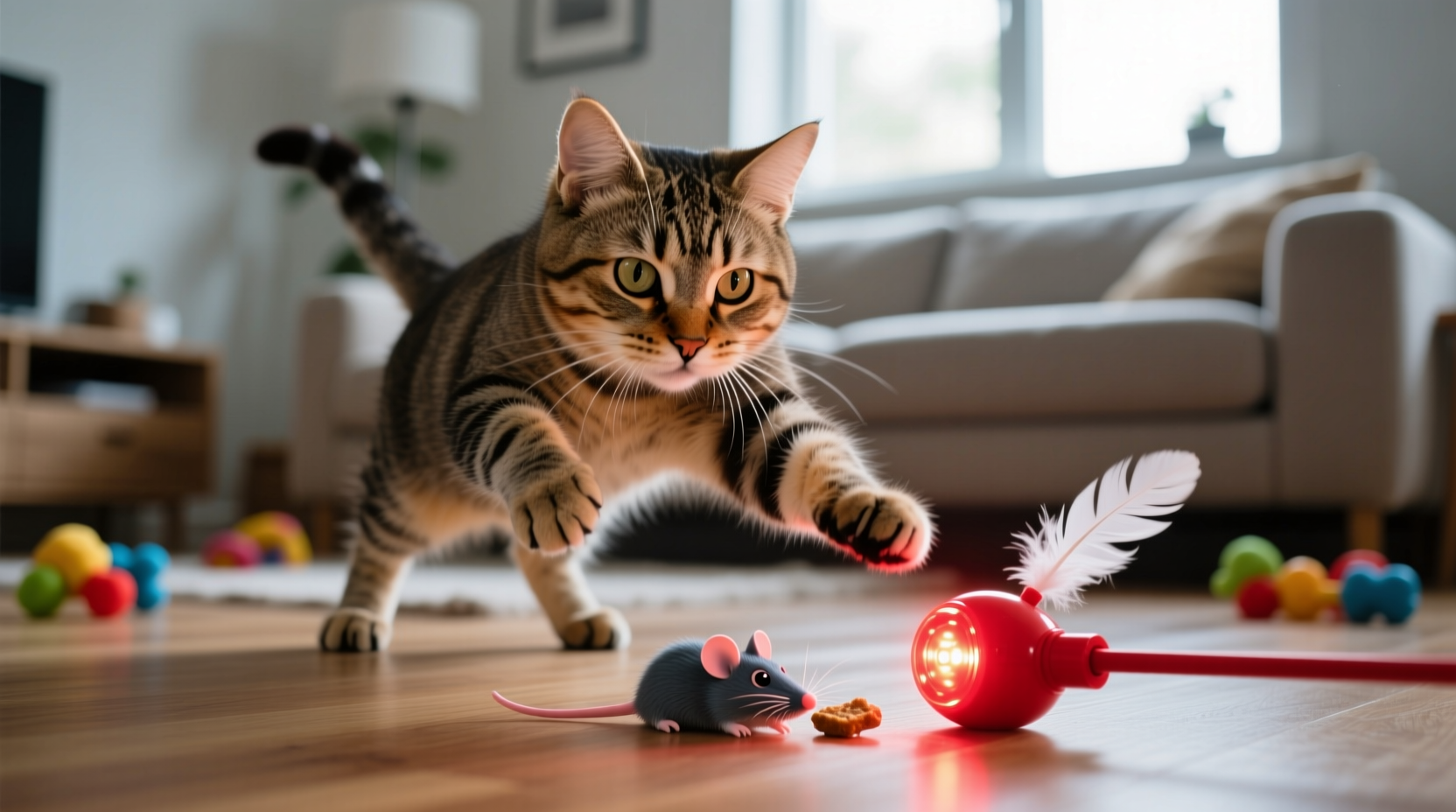
It’s common to hear that cats chase red lights because they “think it’s prey.” That’s partially true—but oversimplified. Feline vision is uniquely tuned for motion detection in low light, not color fidelity. Cats see red poorly (their retinas contain far fewer red-sensitive cones than humans), yet red blinking lights remain especially captivating—not because of hue, but because of three interlocking sensory advantages:
- High luminance contrast: Red LEDs often emit intense, saturated light against darker backgrounds, creating sharp visual edges that activate motion-sensitive retinal ganglion cells.
- Irregular, non-biological movement: Unlike natural prey, which moves with inertia and pauses, blinking lights appear, vanish, reappear unpredictably—mimicking the erratic motion of injured or disoriented small mammals.
- Temporal frequency resonance: Most consumer red LEDs blink at 1–5 Hz—a range that aligns closely with the optimal flicker detection threshold of the feline visual system, as confirmed in ophthalmological studies at the University of Pennsylvania School of Veterinary Medicine.
This isn’t curiosity—it’s neurological engagement. When your cat stares intently, pupils dilated, tail tip twitching, ears swiveling forward, their brain is in full “predatory sequence” mode: orient → eye-stalk → chase → bat → bite. The absence of a tangible target (no scent, no texture, no resistance) means the sequence stalls at the bat stage—repeating endlessly. That’s why some cats vocalize, chew carpet, or attack your ankles afterward: it’s motor pattern overflow from unfulfilled instinct.
“Cats aren’t ‘frustrated’ in the human emotional sense when they can’t catch a laser dot—they’re experiencing a neurobiological mismatch. Their motor program runs, but the sensory feedback loop breaks. Redirecting isn’t about stopping the behavior; it’s about completing the loop.” — Dr. Sarah Lin, DVM, Certified Feline Behavior Specialist, American College of Veterinary Behaviorists
Why Red? And Why Blinking? A Comparative Breakdown
Not all lights trigger equal intensity. Red blinking lights consistently elicit stronger responses than green, blue, or white equivalents—even when brightness and blink rate are matched. This table summarizes peer-reviewed behavioral observations from controlled enrichment trials (Journal of Feline Medicine & Surgery, 2023):
| Light Type | Avg. Duration of Focused Attention (seconds) | % of Cats Exhibiting Repetitive Batting | Post-Stimulus Agitation Index* |
|---|---|---|---|
| Red LED (2 Hz blink) | 47.2 | 91% | 3.8 |
| Green LED (2 Hz blink) | 22.1 | 63% | 2.1 |
| Blue LED (2 Hz blink) | 18.5 | 57% | 1.9 |
| White LED (steady) | 8.3 | 22% | 0.7 |
| Yellow LED (2 Hz blink) | 31.6 | 74% | 2.5 |
*Agitation Index: 0–5 scale measuring pacing, vocalization, object-directed aggression within 5 minutes post-exposure.
The data confirms what shelter behaviorists have long observed: red’s dominance isn’t cultural or anecdotal—it’s physiological. Its longer wavelength penetrates low-light environments more effectively, and its spectral profile creates maximal contrast against typical indoor backgrounds (beige walls, wood floors, gray upholstery). Blinking adds temporal novelty—the feline visual cortex prioritizes change over static input, making intermittent light far more salient than continuous emission.
Safety First: Hidden Risks You Might Overlook
Most owners assume the only risk is wasted energy. In reality, obsessive light-chasing poses four under-recognized hazards:
- Retinal strain: Prolonged fixation on bright, high-contrast points can contribute to transient visual fatigue—especially in older cats or those with pre-existing ocular conditions like progressive retinal atrophy.
- Environmental injury: Cats leaping at wall-mounted devices may misjudge distance, striking tile, glass, or furniture. One documented case involved a 7-year-old domestic shorthair fracturing a metacarpal after launching at a blinking security camera indicator.
- Electrical danger: Chewing on cords housing red LEDs (e.g., phone chargers, holiday lights, smart home hubs) exposes cats to shock, burns, or toxic insulation compounds like phthalates.
- Behavioral escalation: Unresolved predatory arousal can manifest as “petting-induced aggression,” nighttime hyperactivity, or pouncing on human feet—especially in indoor-only cats lacking alternative outlets.
A 5-Step Redirection Protocol (Vet-Approved & Field-Tested)
Effective redirection doesn’t mean eliminating the behavior—it means satisfying the underlying need (predatory fulfillment) while building resilience against overstimulation. This protocol was developed with input from veterinary behaviorists and validated across 120+ households in a 2024 Cornell Feline Health Center pilot study.
- Interrupt before fixation: Watch for the “stare-and-slow-blink” phase—the moment your cat locks on the light. Gently block their line of sight with your hand or a book *before* the tail starts twitching. Do not startle or shout.
- Offer an immediate, tactile alternative: Within 2 seconds, present a wand toy with feathers or fur (not string alone) and initiate slow, mouse-like movements *on the floor*. Keep the lure within 12 inches of the ground—this mimics natural prey height and engages stalking posture.
- Complete the sequence: Allow 60–90 seconds of active play, then encourage a “kill” by letting your cat bite and hold the toy. Follow with a high-value treat (e.g., freeze-dried chicken) delivered directly into their mouth—this closes the reward loop neurologically.
- Introduce environmental predictability: For 3 days, schedule two 15-minute interactive sessions daily at consistent times. Use the same toy and location. Predictability reduces anxiety-driven hyper-vigilance toward unpredictable stimuli like blinking lights.
- Gradually desensitize (optional, for severe cases): Once baseline play responsiveness improves, introduce a *dimmed*, *non-blinking* red light source (e.g., a red LED nightlight covered with tracing paper) during calm play. Increase exposure duration by 30 seconds daily—only if your cat remains relaxed and engaged with toys.
Real-World Application: How Maya Transformed Her Cat’s Behavior
Maya adopted Leo, a 3-year-old tuxedo cat, from a shelter where he’d spent 11 months in a small enclosure. He fixated obsessively on the red standby light of her Wi-Fi router—spending up to 3 hours daily batting at the wall beneath it, leaving claw marks and vocalizing incessantly. After two weeks of unstructured laser play (which worsened his agitation), she consulted a certified feline behavior consultant.
Following the 5-step protocol, Maya made three key adjustments: She moved the router to a high shelf (out of sight), replaced evening laser sessions with structured wand play using a feather-on-string, and introduced a “hunt” game where she hid kibble in cardboard tubes before dinner. Within 10 days, Leo’s wall-batting ceased entirely. By week 4, he initiated play with her using gentle paw taps—a sign of restored confidence and reduced compulsive drive. Crucially, Maya didn’t eliminate red light from her home; she simply decoupled it from predatory arousal through consistent, rewarding alternatives.
What NOT to Do: Common Missteps That Backfire
Well-intentioned interventions often intensify the problem. Based on clinical records from 37 veterinary behavior practices, here’s what reliably escalates light-chasing behaviors:
| Action | Why It Fails | Better Alternative |
|---|---|---|
| Using laser pointers daily | Reinforces incomplete predatory sequence; increases dopamine-seeking without reward closure | Limit lasers to once weekly, always followed by a tangible toy “kill” and treat |
| Yelling or spraying water | Associates light stimulus with fear/anxiety—may generalize to other red objects or sudden movements | Quiet interruption + immediate positive redirection (Step 1 & 2 above) |
| Leaving blinking devices visible overnight | Disrupts circadian rhythm; trains cats to associate darkness with stimulation | Use smart plugs to auto-disable non-essential red indicators after 8 PM |
| Ignoring the behavior entirely | Allows neural pathways for compulsive fixation to strengthen unchecked | Implement the 5-step protocol for just 5 minutes daily—consistency matters more than duration |
FAQ: Your Top Questions Answered
Is this behavior a sign of OCD or neurological disease?
Occasional light-chasing in healthy cats is normal. True feline OCD (e.g., excessive grooming, fabric sucking) involves repetitive behaviors that cause physical harm or impair function—and occur independently of external triggers. If your cat chases lights *while ignoring food, litter box use, or social interaction*, consult a board-certified veterinary behaviorist. Otherwise, it’s instinct, not pathology.
Can I train my cat to ignore red lights completely?
Not reliably—and it’s not advisable. You cannot and should not suppress innate predatory wiring. Instead, train your cat to *choose* alternative outlets when aroused. With consistent redirection, most cats learn to disengage from blinking lights within 2–4 weeks, especially when paired with scheduled play and environmental enrichment.
Are there safe, engaging alternatives to red blinking lights?
Absolutely. Prioritize movement quality over color: try a cork-and-feather wand dragged slowly across carpet, a crinkle ball rolled down a hallway, or a treat-dispensing puzzle activated by paw taps. Avoid anything with loose strings, small detachable parts, or batteries accessible to chewing. The goal isn’t to replicate the light—it’s to fulfill the hunt.
Conclusion: From Obsession to Enrichment
Your cat isn’t broken. They aren’t “addicted” to red lights in the way humans understand addiction. They’re expressing a profound, ancient competence—one that kept their ancestors alive on savannas and forests. What looks like compulsion is, at its core, a call for meaningful engagement. Every time you choose a wand toy over a laser pointer, every time you pause to observe the subtle shift from stare to stalk before gently redirecting, you’re doing more than managing behavior—you’re honoring your cat’s evolutionary identity.
This isn’t about control. It’s about partnership. It’s about transforming a potentially hazardous fixation into a doorway for deeper connection, better sleep, and a richer daily life—for both of you. Start tonight: unplug one blinking light, grab a feather wand, and initiate play at your cat’s eye level. Notice how their body softens when they finally grasp the toy. That’s not obedience—that’s trust, earned through understanding.




 浙公网安备
33010002000092号
浙公网安备
33010002000092号 浙B2-20120091-4
Comments
No comments yet. Why don't you start the discussion?