
Every year, veterinarians report a sharp rise in emergency visits during the holiday season—not from overindulgence in eggnog, but from pets suffering electrical burns, oral trauma, or gastrointestinal obstruction after chewing Christmas light cords. It’s not just inconvenient; it’s dangerous. Yet many pet owners respond with frustration or punishment, missing the root causes and overlooking compassionate, science-backed solutions. This isn’t about “bad behavior.” It’s about unmet needs—biological, developmental, emotional, and environmental—that manifest in destructive chewing. Understanding *why* your dog gnaws at that twinkle wire or your cat bats at a dangling cord is the first step toward lasting prevention. And crucially, effective intervention doesn’t require cage confinement, bitter sprays alone, or dominance-based corrections. It requires observation, empathy, and consistency.
The Real Reasons Pets Target Holiday Cords (It’s Not “Naughtiness”)
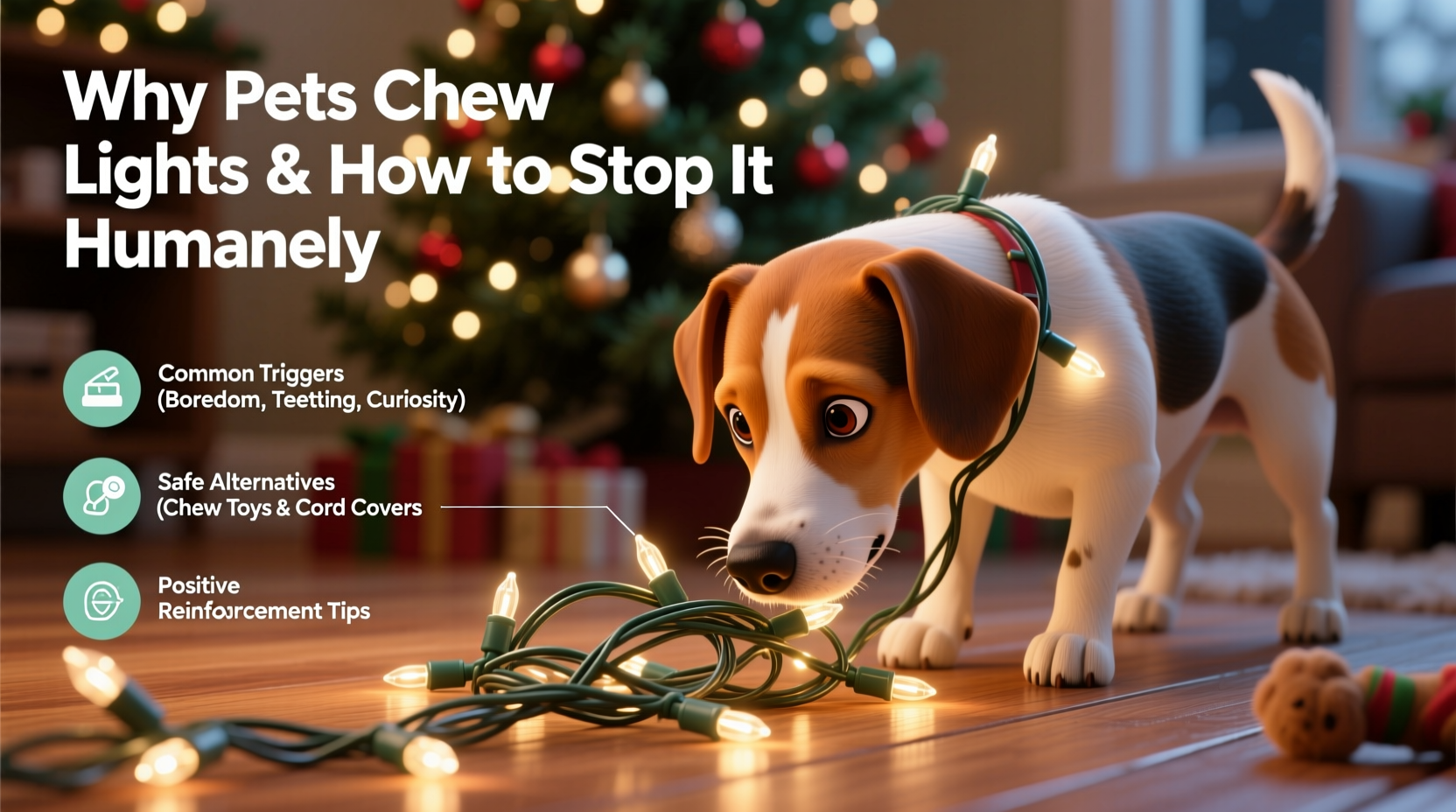
Chewing on electrical cords isn’t random mischief—it’s a signal. Veterinary behaviorists identify five primary drivers behind this specific hazard, each rooted in normal animal biology:
- Teething pain relief (especially puppies under 6 months): Emerging teeth cause intense gum inflammation. The firm, cool texture of insulated cords provides counterpressure that temporarily eases discomfort—similar to how human infants use teething rings.
- Sensory attraction: Many lights emit low-frequency vibrations (especially older incandescent strings), produce faint electromagnetic fields, or generate subtle warmth—all detectable by dogs’ and cats’ highly sensitive nervous systems. For some pets, the cord feels “alive,” triggering investigative or predatory biting.
- Boredom-induced displacement behavior: When mental stimulation is insufficient—particularly during quieter winter days or when household routines shift—pets redirect pent-up energy into repetitive, self-soothing actions. Chasing, biting, or tugging at moving or reflective objects (like blinking lights) becomes an accessible outlet.
- Anxiety or stress responses: The holidays bring noise, guests, altered schedules, and unfamiliar scents. For sensitive animals, chewing can be a coping mechanism—much like nail-biting in humans. A study published in Journal of Veterinary Behavior found that 68% of dogs exhibiting new destructive behaviors during December showed concurrent signs of situational anxiety (panting, pacing, hiding).
- Attention-seeking reinforcement: Even negative attention—yelling, chasing, or sudden movement—can unintentionally reward the behavior if it consistently follows cord interaction. Over time, the pet learns: “When I touch the shiny string, humans rush over and engage.”
Crucially, these motivations often overlap. A 4-month-old puppy may chew cords both to soothe teething pain *and* because the blinking lights trigger his prey drive—while also receiving accidental reinforcement when you drop your coffee mug in alarm.
Immediate Safety Measures: Protect Your Pet *Today*
Before addressing long-term behavior change, eliminate immediate risk. Electrical cords pose life-threatening hazards: electrocution can cause cardiac arrest, severe oral burns, pulmonary edema, or secondary infections. These steps are non-negotiable and take under 30 minutes to implement:
- Unplug all non-essential holiday lighting when unattended. Use smart plugs with timers or manual switches placed out of paw-reach (e.g., on high shelves or inside closed cabinets).
- Route cords vertically, not horizontally. Run wires up walls using cord clips or adhesive raceways—keeping them at least 18 inches off the floor. Pets rarely jump straight up to bite; they investigate ground-level temptations.
- Bundle and conceal with rigid conduits. Flexible plastic cord sleeves offer little protection. Instead, use rigid PVC conduit (½-inch diameter) or heavy-duty braided nylon sleeves designed for pet households. Secure ends with zip ties to prevent fraying.
- Create physical barriers. Place freestanding tree skirts with solid bases (not fabric) around the trunk. Use baby gates to block access to rooms where lights are displayed—especially if your pet is unsupervised for more than 15 minutes.
- Remove visual triggers. Turn off lights when your pet is in the room unless actively supervised. Blinking patterns and movement attract attention far more than static decorations.
A Humane, Step-by-Step Prevention Plan (7 Days to Safer Holidays)
Effective behavior change requires replacing the unwanted action with a better alternative—not suppressing it through fear or discomfort. This 7-day plan integrates veterinary behavior principles with practical holiday constraints:
| Day | Action | Why It Works |
|---|---|---|
| Day 1 | Observe and log cord interactions for 2 hours: note time, location, your pet’s activity before/after, and household activity. | Identifies patterns (e.g., chewing occurs only when children are playing nearby) and rules out medical causes like dental pain or nutritional deficiency. |
| Day 2 | Introduce two new chew alternatives: one frozen (e.g., frozen KONG stuffed with pumpkin + yogurt) and one textured (e.g., Himalayan yak chews). Rotate daily. | Provides species-appropriate oral stimulation while satisfying teething or anxiety needs. Cold items reduce gum inflammation; hard chews satisfy jaw pressure requirements. |
| Day 3 | Install one 10-minute “brain game” session: hide kibble in cardboard boxes or use snuffle mats before lights are turned on. | Redirects focus from visual stimuli to problem-solving, lowering baseline arousal and reducing impulsive biting. |
| Day 4 | Begin desensitization: place unplugged, coiled cord inside a clear acrylic box. Reward calm observation (no sniffing/biting) with high-value treats every 5 seconds for 2 minutes. | Breaks the association between “cord” and “chew target” by pairing it with positive outcomes and removing opportunity for reinforcement. |
| Day 5 | Add environmental enrichment: hang bird feeder outside window for cats; set up scent trails (using diluted lavender oil on cotton balls) for dogs to follow indoors. | Engages natural instincts (hunting, foraging) that otherwise fixate on novel holiday objects. |
| Day 6 | Practice “leave-it” with low-value items (e.g., paper towel roll), then progress to unplugged cord segment placed on floor. Reward eye contact and turning away. | Builds impulse control without confrontation—teaching your pet that ignoring the cord earns better rewards than engaging with it. |
| Day 7 | Test with one strand of *plugged-in* lights, fully secured and elevated. Supervise closely for 5 minutes. If no interest, extend time gradually. | Confirms whether interventions addressed motivation—not just access. Success here means underlying drivers have been mitigated. |
What *Not* to Do: Common Mistakes That Make It Worse
Well-intentioned interventions often backfire. Here’s what veterinary behavior specialists consistently advise against—and what to do instead:
| ❌ Don’t | ✅ Do Instead | Risk of “Don’t” |
|---|---|---|
| Yell or chase your pet when you catch them near cords | Quietly interrupt with a neutral “oops,” then immediately redirect to an approved chew or game | Increases arousal and reinforces the idea that cords predict exciting human interaction |
| Leave bitter-tasting sprays on live cords | Use taste deterrents *only* on unplugged, secured cords during desensitization—never as a standalone solution | Sprays can damage insulation, increasing electrocution risk; pets often learn to ignore them |
| Punish after the fact (e.g., rubbing nose in chewed cord) | Focus on preventing opportunity and enriching alternatives—punishment teaches fear, not safety | Causes confusion (pets don’t connect delayed consequences to actions) and damages trust |
| Assume it’s “just a phase” without intervention | Treat every incident as urgent—even minor chewing can erode insulation and create fire hazards | Reinforces neural pathways; increases likelihood of escalation to live wires or other dangerous objects |
Real-Life Example: How Maya Saved Her Rescue Dog’s Life
Maya adopted Leo, a 5-month-old terrier mix, in early December. Within days, he’d chewed through three sets of lights—once causing a circuit breaker trip and leaving burn marks on his gums. Frustrated, she initially tried bitter spray and crate confinement, but Leo began whining and destroying his crate padding. She consulted a certified veterinary behaviorist who observed Leo’s routine: he chewed most often between 4–5 p.m., right after her young children returned from school and created loud, unpredictable energy.
The behaviorist identified two overlapping drivers: teething discomfort *and* overstimulation from the chaotic after-school environment. Together, they redesigned Leo’s afternoon:
- At 3:45 p.m., Maya began a 10-minute “calm protocol”: dimmed lights, played soft classical music, and gave Leo a frozen bone broth cube to lick slowly.
- She installed vertical cord routing and added a puzzle toy filled with his dinner kibble—activated only during the 4–5 p.m. window.
- Children were taught to greet Leo with quiet petting (not excited play) and to toss tennis balls *away* from the tree area.
By Christmas Eve, Leo hadn’t approached the lights once. More importantly, his overall anxiety decreased: he slept soundly, stopped chewing shoes, and greeted visitors without panting. “It wasn’t about stopping the chewing,” Maya shared. “It was about giving him tools to feel safe when the world got loud.”
Expert Insight: What Veterinarians and Behaviorists Emphasize
“Chewing on cords is never ‘just bad manners.’ It’s either a cry for help—or an unmet biological need. Punishment doesn’t teach safety; it teaches secrecy. The most effective interventions address the *function* of the behavior: Is it pain relief? Stress reduction? Boredom? Once you know that, you can replace it with something safer, legal, and satisfying.”
— Dr. Lena Torres, DACVB, Board-Certified Veterinary Behaviorist, American College of Veterinary Behaviorists
“I’ve treated over 200 cases of holiday cord chewing in the past decade. In 92% of successful outcomes, owners didn’t change the pet—they changed the environment, the routine, and their own response. The pet was always ready to cooperate. We just had to speak their language.”
— Dr. Arjun Patel, DVM, Director of Preventive Care, Urban Animal Wellness Center
FAQ: Addressing Your Most Pressing Concerns
Can I use citrus peels or vinegar as a natural deterrent?
No. While citrus oils may mildly repel some pets, they offer zero protection against electrocution and can irritate mucous membranes or cause gastrointestinal upset if ingested. Vinegar lacks consistent efficacy and evaporates quickly. Rely on physical barriers and behavioral strategies—not temporary, unreliable deterrents.
My senior dog suddenly started chewing cords—could this be dementia?
Yes—new-onset destructive behavior in dogs over age 9 warrants immediate veterinary evaluation. Cognitive dysfunction syndrome (CDS) can cause confusion, disorientation, and repetitive behaviors like chewing non-food items. Rule out dental disease, arthritis pain, or metabolic issues first, as these also trigger oral fixation.
Will crate training solve this permanently?
Crate training helps manage unsupervised time but doesn’t resolve the underlying motivation. If your pet chews cords due to anxiety or boredom, confinement may worsen stress and lead to other destructive habits (e.g., chewing crate bars). Use crates *alongside* enrichment—not as a substitute for understanding why the behavior started.
Conclusion: Your Pet Deserves Safety—Not Sacrifice
Holiday traditions shouldn’t come at the cost of your pet’s well-being—or your peace of mind. Chewing Christmas light cords isn’t defiance. It’s communication. Every gnawed wire, every startled yelp, every vet bill tells a story about unmet needs: the puppy needing gum relief, the anxious cat seeking control in chaos, the bored dog craving purposeful work. When you respond with curiosity instead of correction—when you secure cords not just to protect wiring but to honor your pet’s sensory reality—you shift from crisis management to compassionate coexistence.
This season, choose solutions that strengthen your bond rather than erode trust. Replace punishment with patience. Swap quick fixes for thoughtful routines. Let your tree sparkle safely—not because you’ve suppressed your pet’s instincts, but because you’ve respected them enough to meet them with kindness, creativity, and care.




 浙公网安备
33010002000092号
浙公网安备
33010002000092号 浙B2-20120091-4
Comments
No comments yet. Why don't you start the discussion?