
Every December, thousands of pet owners face the same heart-stopping moment: a flash of movement near the tree, a faint sizzle, the unmistakable scent of burnt plastic—and a dog or cat calmly sitting beside a frayed cord, tail thumping, as if nothing happened. Chewing on Christmas lights isn’t just a seasonal nuisance—it’s a serious safety hazard with real physiological, behavioral, and environmental roots. Yet most well-meaning advice stops at “just unplug them” or “spray bitter apple,” ignoring why the behavior occurs in the first place—or how to resolve it without stress, punishment, or suppression.
This article draws on veterinary behavior science, certified canine and feline behaviorist protocols, and decades of clinical observation—not anecdote—to explain the *why*, clarify the risks beyond electrocution (including thermal burns, heavy metal toxicity from solder, and intestinal obstructions), and offer layered, species-specific solutions that respect your pet’s natural needs while safeguarding your home. No gimmicks. No guilt-tripping. Just practical, compassionate, and evidence-informed strategies you can implement starting today.
The Real Reasons Pets Chew Lights—It’s Not “Naughtiness”
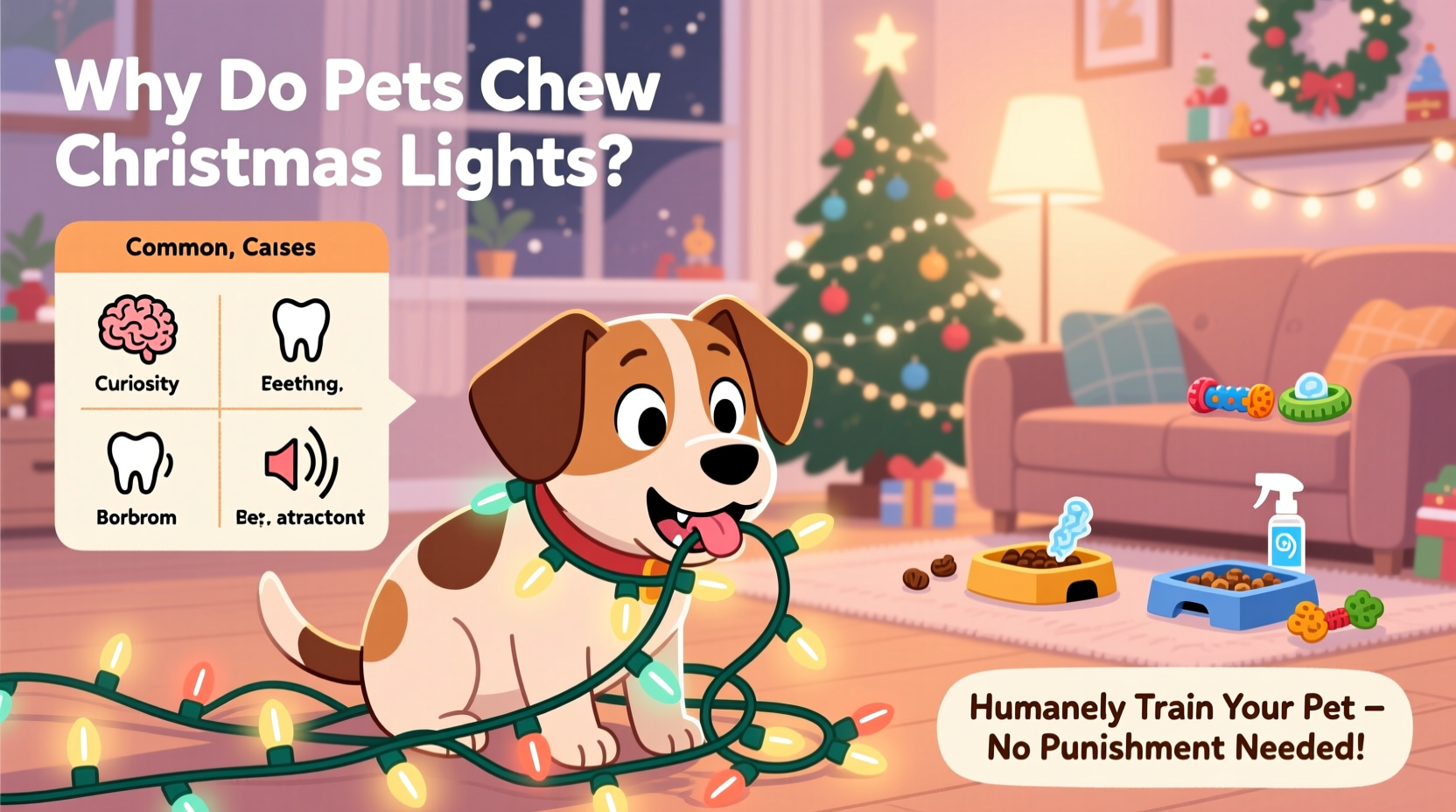
Labeling light-chewing as “bad behavior” misdiagnoses the problem. Animals don’t act out of spite or rebellion. Instead, they respond to unmet biological and psychological needs. Three primary drivers consistently emerge across dogs, cats, rabbits, and even small mammals like ferrets:
- Sensory-seeking behavior: The subtle vibration, faint warmth, and rhythmic hum of low-voltage LED strings mimic prey-like stimuli—especially for cats and high-drive dogs. This is not curiosity; it’s neurologically reinforcing.
- Oral fixation & developmental need: Puppies under 7 months and kittens under 5 months are in peak teething phases. But adult pets also chew to relieve anxiety, boredom, or oral discomfort—particularly those with limited enrichment, restricted movement, or underlying dental disease.
- Environmental mismatch: Holiday decor introduces novel textures (glossy wires, metallic tinsel, static-prone ribbons) into tightly controlled spaces. For indoor-only cats or apartment-dwelling dogs, these become the only available outlets for exploration and manipulation.
Veterinary behaviorist Dr. Lisa Radosta emphasizes this distinction:
“When a dog chews a light cord, he isn’t ‘testing boundaries’—he’s communicating that his environment isn’t meeting his species-specific needs for oral engagement, mental challenge, or physical outlet. Punishment doesn’t teach alternatives; it only teaches fear of the human or the tree—and often makes the behavior more secretive, not safer.” — Dr. Lisa Radosta, DVM, DACVB, founder of Florida Veterinary Behavior Service
Risks You Might Be Overlooking (Beyond Electrocution)
While electrocution is the most immediate danger—especially with older incandescent strings carrying up to 120 volts—the less-discussed hazards are equally urgent:
| Risk | How It Occurs | Signs to Watch For |
|---|---|---|
| Thermal burns | LEDs run cooler—but transformer units, dimmer switches, and damaged cords can overheat rapidly. Contact with skin or mouth tissue causes deep partial-thickness burns. | Drooling, pawing at mouth, reluctance to eat, red or blistered gums, foul breath |
| Heavy metal toxicity | Cord insulation contains lead, cadmium, and phthalates. When chewed, microscopic particles embed in gums or are swallowed. Chronic exposure damages kidneys and nervous systems. | Lethargy, vomiting, tremors, uncoordinated gait, anemia (pale gums) |
| Intestinal obstruction | Swallowed wire fragments, plastic casings, or solder beads can lodge in the esophagus, stomach, or intestines—requiring emergency surgery. | Repeated vomiting, abdominal pain, constipation or diarrhea, loss of appetite, hunched posture |
| Secondary trauma | A startled pet may bolt after chewing, knocking over the tree or entangling itself in cords—leading to falls, lacerations, or neck compression. | Limping, visible cuts, difficulty breathing, agitation |
Crucially, symptoms of heavy metal toxicity or internal injury may not appear for 24–72 hours—by which time irreversible damage has occurred. If your pet chews any part of a light string, contact your veterinarian immediately—even if no outward signs are present.
Humane Prevention: A Layered, Species-Specific Strategy
Effective prevention isn’t about making lights “less appealing.” It’s about making your pet’s world *more* satisfying—so lights simply fade into irrelevance. This requires stacking multiple layers of intervention, tailored to your pet’s species, age, temperament, and living conditions.
For Dogs
Dogs chew lights most often during unsupervised periods—typically when excitement peaks (guest arrivals, gift opening) or when routine fractures (travel, schedule changes). Prioritize predictability and oral outlets:
- Offer a frozen KONG stuffed with low-sodium broth and kibble 30 minutes before decorating or hosting.
- Rotate puzzle toys weekly to maintain novelty—dogs habituate quickly to static objects.
- Use baby gates to create a “light-free zone” around the tree, paired with a cozy bed, chew mat, and calming music playlist.
For Cats
Cats target lights for movement and texture—not taste. Their approach is stealthy and often nocturnal. Redirect their predatory drive:
- Install battery-operated laser pointers *away* from the tree—use them for 5-minute play sessions twice daily to satisfy hunting instincts.
- Hang dangling toys with crinkly fabric or silver mylar strips near windows (not the tree) to capture attention safely.
- Apply double-sided tape or aluminum foil around the base of the tree stand—cats dislike both textures, and this creates a non-punitive boundary.
For Small Mammals & Birds
Rabbits, guinea pigs, and parrots chew to wear down continuously growing teeth. Their access to holiday decor is often accidental—but consequences are severe. Prevention hinges on strict environmental control:
- Never place cages or enclosures within 6 feet of lit trees or garlands.
- Provide unlimited grass hay (for herbivores) or mineral blocks (for birds) to satisfy gnawing needs.
- Use cord covers made of rigid PVC—not soft rubber—since small teeth can pierce flexible materials.
Your 7-Day Light-Safe Holiday Plan
Start this plan two weeks before your tree goes up. Consistency matters more than intensity—small daily actions build lasting safety.
- Day 1: Audit all light strings. Discard any with exposed wires, cracked casings, or corroded plugs. Replace with UL-listed LED sets rated for indoor use only.
- Day 2: Install cord management tools: spiral wrap sleeves, adhesive-backed cord clips, and rigid PVC conduit where wires run along floors or baseboards.
- Day 3: Introduce your pet to the tree area *without lights*. Let them explore the bare tree, stand, and ornaments (non-breakable only) for 10 minutes. Reward calm sniffing with treats.
- Day 4: Add one strand of lights—unplugged—for 15 minutes. Observe closely. If your pet investigates, redirect to a chew toy. Repeat daily until no interest remains.
- Day 5: Plug in lights for 5 minutes while your pet is engaged elsewhere (e.g., eating a meal). Gradually increase duration over 3 days.
- Day 6: Set up motion-activated deterrents (e.g., PetSafe SSSCAT spray) *only* at the tree perimeter—not aimed at your pet directly—to create a neutral association with the space.
- Day 7: Establish a “tree time” ritual: 10 minutes of interactive play *before* entering the room with the lit tree. This fulfills energy needs proactively.
Mini Case Study: Luna, a 3-Year-Old Australian Shepherd
Luna began chewing lights the December she turned two—coinciding with her owner’s new work-from-home schedule. Her usual 90-minute morning hike was replaced by short backyard potty breaks. By mid-December, she’d destroyed three strands and received mild electrical burns on her tongue.
Her veterinarian ruled out dental pain and referred her to a certified behavior consultant. The assessment revealed two core issues: insufficient mental fatigue (herding breeds require problem-solving, not just exercise) and redirected arousal (she associated the tree with guests arriving).
The solution combined structure and stimulation: her owner added 15 minutes of “find-it” games using kibble hidden in cardboard boxes each morning, installed a window perch facing the street to satisfy her watchfulness, and used a baby gate to separate the tree room—opening it only during scheduled, supervised “calm presence” sessions with quiet music playing. Within 11 days, Luna ignored the tree entirely—even when left alone for 20 minutes. No sprays. No punishment. Just alignment between her biology and her environment.
Frequently Asked Questions
Can I use essential oil sprays to deter chewing?
No. Many essential oils—including citrus, peppermint, tea tree, and eucalyptus—are toxic to cats and dogs when inhaled, ingested, or absorbed through skin. They can cause respiratory distress, liver damage, or neurological symptoms. The ASPCA Animal Poison Control Center reports a 300% rise in holiday-related essential oil poisonings over the past five years. Stick to veterinarian-approved products only.
My pet only chews lights when I’m not home. Is separation anxiety involved?
Possibly—but not exclusively. While separation anxiety can manifest as destructive chewing, light-chewing specifically is more commonly linked to *under-stimulation* than distress. Record video of your pet’s behavior when alone. If chewing occurs within 2–5 minutes of your departure, anxiety is likely. If it happens 20+ minutes later—especially alongside other signs like pacing, vocalizing, or inappropriate elimination—consult a board-certified veterinary behaviorist for assessment before assuming causation.
Are battery-powered lights safer than plug-in ones?
Not inherently. Battery packs still contain lithium cells that pose ingestion risks, and low-voltage DC current can still cause oral burns or cardiac arrhythmias in small animals. The safest option is physical exclusion—using barriers, elevation, and supervision—regardless of power source. If using battery lights, secure the pack in a locked, ventilated box mounted high on the wall, away from climbing surfaces.
Conclusion: Safety Starts With Understanding
Your pet isn’t sabotaging the holidays. They’re navigating a world suddenly filled with irresistible sensory puzzles, unmet needs, and confusing boundaries. Stopping light-chewing isn’t about winning a battle—it’s about redesigning your shared environment so safety becomes effortless, not enforced. It means choosing a chew toy over a scolding, installing a cord sleeve over applying bitter spray, and observing your pet’s body language over assuming intent. These choices reflect deep respect—not just for your pet’s well-being, but for the quiet intelligence behind every lick, sniff, and paw-tap.
This season, give yourself permission to prioritize prevention over reaction. Start with one layer from this guide—whether it’s the 7-day plan, the species-specific tips, or simply swapping out damaged cords. Then notice what changes: the absence of panic when the doorbell rings, the relief of walking away from the tree without double-checking, the quiet pride in knowing your compassion extends even to the smallest, shiniest temptations.




 浙公网安备
33010002000092号
浙公网安备
33010002000092号 浙B2-20120091-4
Comments
No comments yet. Why don't you start the discussion?