
It’s a familiar holiday scene: you string the lights, plug them in, and just as the first warm glow flickers across the tree—your cat vanishes under the sofa, your dog retreats to the laundry room, or your rabbit freezes mid-hop, ears flattened tight against its skull. This isn’t grumpiness or indifference. It’s a genuine stress response—one rooted in biology, not behavior. Understanding why your pet hides when Christmas lights come on requires stepping outside human perception and into their sensory world: a world where light pulses like strobes, colors shift unpredictably, and every flicker carries potential threat. This article explains the neurobiological, evolutionary, and environmental drivers behind this reaction—and offers practical, veterinarian-endorsed solutions that respect your pet’s nervous system without sacrificing seasonal joy.
The Sensory Gap: How Pets See (and Hear) Light Differently
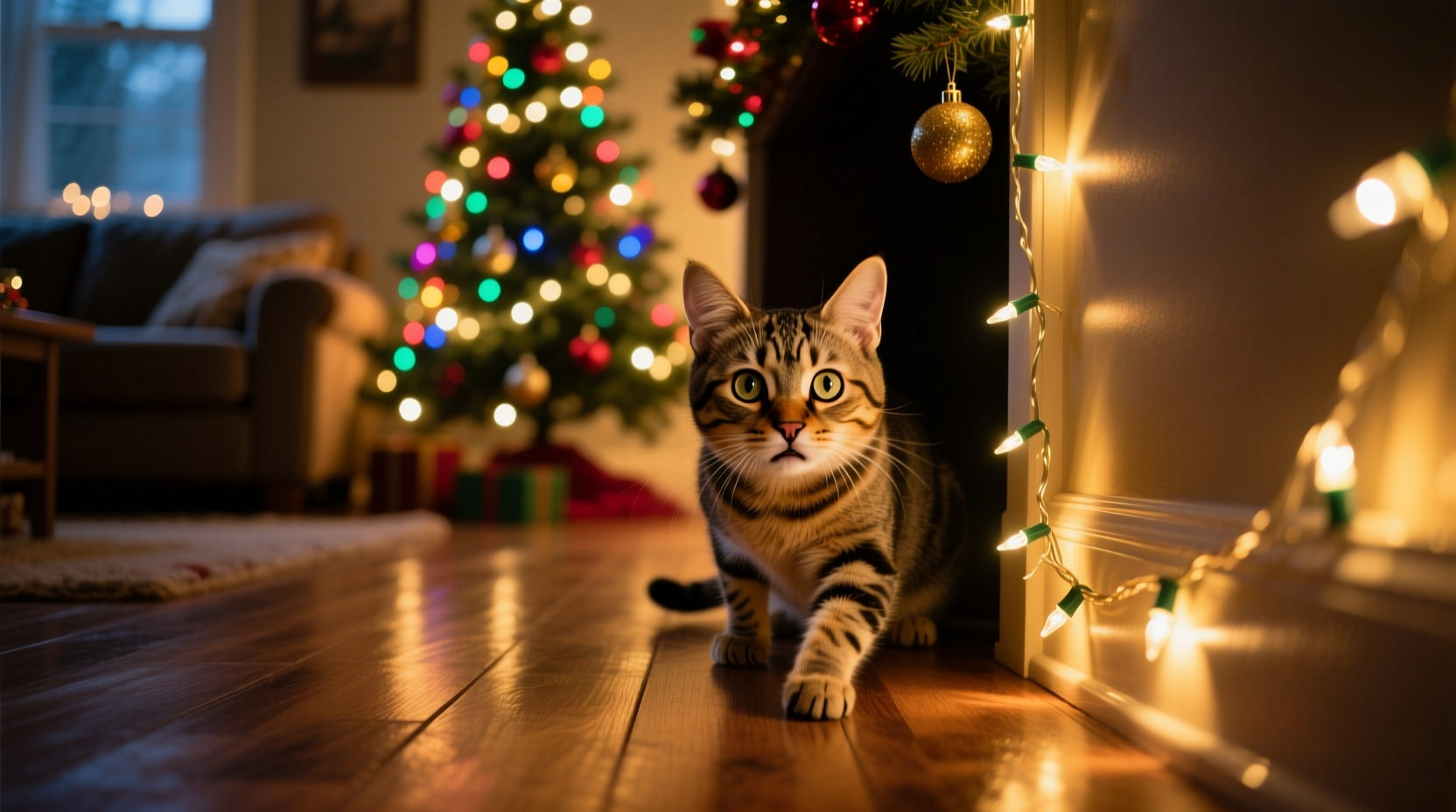
Humans perceive light as steady illumination. Most modern LED Christmas lights, however, operate on pulse-width modulation (PWM)—a rapid on-off cycling invisible to our eyes but detectable by animals with higher critical flicker fusion (CFF) thresholds. Cats have a CFF of 70–80 Hz; dogs, 60–75 Hz; humans, only 50–60 Hz. That means a light pulsing at 120 Hz appears smooth to us—but to your cat, it may register as a disorienting, stroboscopic flicker. Add to this their superior low-light vision: cats see six times better than humans in dim conditions thanks to a reflective layer behind the retina called the tapetum lucidum. This same adaptation amplifies glare and intensifies contrast—making bright, concentrated LED points appear painfully sharp or even painful.
Auditory input compounds the effect. Many inexpensive LED strings emit high-frequency electromagnetic noise (often 18–22 kHz), well within the hearing range of dogs (up to 45 kHz) and cats (up to 64 kHz). What sounds like silence to you may be a persistent, grating whine to them—especially near power adapters or dimmer switches. Combined, these stimuli create a multisensory overload: visual flicker + ultrasonic buzz + unpredictable movement (e.g., chasing lights on animated displays) = perceived danger.
Evolutionary Mismatch: Why Ancient Brains React to Modern Lights
Hiding is not avoidance—it’s survival programming. In the wild, sudden, erratic light changes signal immediate risk: fire, lightning, predator eyes reflecting moonlight, or the flash of wings during an ambush. A fox freezing at dusk doesn’t weigh options—it activates the freeze-flight-fight cascade instantly. Domestication hasn’t erased this reflex; it’s merely layered with learned associations. For a dog who once startled at a car headlight flare, the strobing pattern of twinkle-mode lights can reactivate that memory. For a rescue cat with limited positive exposure to artificial lighting, novelty itself triggers vigilance.
This instinct is further amplified by circadian disruption. Mammalian pineal glands regulate melatonin via light exposure. Sudden bursts of blue-rich white light (common in cool-white LEDs) suppress melatonin more aggressively than warm incandescents—even at low intensity. Studies show nocturnal species exposed to intermittent artificial light exhibit elevated cortisol, reduced REM sleep, and impaired immune response within 48 hours. Your pet may not “understand” Christmas—but their body registers the lights as a sustained biological stressor.
Light Physics & Pet-Specific Triggers: A Comparative Breakdown
Not all lights provoke equal reactions. The table below outlines how common holiday lighting features interact with pet physiology—and what alternatives reduce distress.
| Feature | Human Perception | Pet Impact | Safer Alternative |
|---|---|---|---|
| Flicker Rate | Imperceptible (steady glow) | Detected as rapid strobing → disorientation, anxiety | Incandescent bulbs or DC-powered LEDs with >3,000 Hz flicker frequency |
| Color Temperature | “Warm white” (2700K) feels cozy | Blue-rich light (>4000K) suppresses melatonin, increases alertness | Amber or soft-yellow LEDs (≤2200K); avoid cool white/blue modes |
| Light Intensity | Pleasant sparkle | Concentrated point sources cause glare-induced squinting/pain | Diffused lighting (e.g., lights inside frosted glass ornaments or behind sheer fabric) |
| Animation Mode | Fun, festive rhythm | Random flashing mimics predator movement → triggers hypervigilance | Static mode only; avoid chase, twinkle, or fade effects |
A Real Example: Luna the Rescue Cat’s Holiday Adjustment
Luna, a 3-year-old domestic shorthair adopted from a rural shelter, hid for 17 consecutive nights when her owners first installed programmable LED lights on their porch. She’d vanish at dusk, reappearing only at dawn—refusing food, litter box, and interaction. Her veterinarian ruled out medical causes and noted dilated pupils, flattened ears, and tail-tucking even in dim indoor rooms. The owners tracked her behavior: hiding began precisely when the porch lights activated at 4:30 p.m., not when indoor tree lights were on. They discovered the porch fixture used non-dimmable LEDs on a motion-sensor timer—causing abrupt, full-intensity flashes every time the sensor triggered.
Applying evidence-based adjustments, they replaced the fixture with warm-white, non-pulsing incandescents on a manual switch; added blackout curtains to the living room window facing the porch; and introduced “light desensitization” using a single low-wattage bulb on a dimmer—increasing brightness by 10% daily over 12 days. By December 15th, Luna sat calmly on the windowsill watching the porch lights—not hiding, not stressed, simply observing. Her recovery wasn’t about “getting used to it.” It was about reducing neurological threat signals until her autonomic nervous system could reinterpret the stimulus as neutral.
Science-Backed Strategies: A Step-by-Step Calming Protocol
Effective intervention requires consistency, patience, and physiological awareness. Follow this veterinarian-approved sequence over 10–14 days—starting *before* lights go up:
- Baseline Assessment (Day 1–2): Observe your pet’s normal behavior in dim lighting. Note resting spots, blink rate, ear position, and baseline respiration. Record any existing stress cues (panting, lip-licking, yawning).
- Light Audit (Day 3): Turn on *all* planned holiday lights one at a time. Watch for immediate reactions: pupil constriction/dilation, head turning away, muscle tension, or retreat. Map which fixtures trigger responses.
- Environmental Buffering (Day 4–5): Create two “safe zones”: one fully light-free (blackout curtains, no electronics), another with only warm, static, low-intensity lighting. Place food, water, bedding, and toys exclusively in these zones.
- Controlled Exposure (Day 6–12): Use a single, dimmable warm LED. Start at 5% brightness for 5 minutes twice daily. Increase brightness by 5% daily *only if* your pet remains relaxed (no avoidance, no increased respiration). If stress occurs, revert to previous level for 48 hours before retrying.
- Integration & Monitoring (Day 13–14): Introduce one additional light source (same specs) for 5 minutes. Continue observing for subtle signs: whisker twitching, brief blinking, redirected grooming. Never exceed 20 minutes total exposure per session. Stop immediately if ears flatten or tail tucks.
“Pets don’t ‘misbehave’ around lights—they communicate sensory overwhelm. Our job isn’t to desensitize them to discomfort, but to redesign the environment so safety is physiologically possible.” — Dr. Lena Torres, DVM, Veterinary Behavioral Specialist, Cornell University College of Veterinary Medicine
Practical Checklist: Before You Plug in the Lights
- ✅ Test flicker with your smartphone camera before installation
- ✅ Choose warm-white (≤2200K) or amber LEDs—avoid cool white, blue, or RGB modes
- ✅ Use static-only settings; disable twinkle, chase, fade, and music-sync modes
- ✅ Install lights away from primary pet zones (e.g., not above beds, litter boxes, or feeding areas)
- ✅ Add physical buffers: sheer curtains, frosted lampshades, or fabric diffusers to soften intensity
- ✅ Provide at least two light-controlled safe spaces with familiar scents and bedding
- ✅ Turn lights on only during waking hours—never overnight—to support natural circadian rhythms
- ✅ Monitor closely for 72 hours after first activation: watch for appetite changes, excessive grooming, or vocalization
FAQ: Addressing Common Concerns
Will my pet ever stop hiding—or is this permanent?
Hiding is rarely permanent if addressed early and compassionately. Most pets acclimate within 2–3 weeks using the step-by-step protocol. However, some—especially those with prior trauma, senior pets with declining sensory processing, or neurodivergent animals (e.g., dogs with noise phobia)—may always prefer minimal lighting. That’s not failure; it’s honoring their neurology. Focus on comfort, not conformity.
Can I use calming supplements or pheromones alongside light adjustments?
Yes—but only under veterinary guidance. Adaptil (for dogs) and Feliway (for cats) may reduce general anxiety but won’t override acute sensory distress from flicker or glare. Supplements like L-theanine or CBD require dose-specific vet approval and should never replace environmental modification. Think of them as supportive tools, not solutions.
What if my pet hides *only* when certain people are present with the lights on?
This suggests associative learning: your pet links the light onset with a person’s presence (e.g., a child who shouts while plugging in lights, or a guest who moves quickly near the tree). Address both elements—modify lighting *and* train household members to activate lights quietly, slowly, and while maintaining distance from the pet’s safe zone.
Conclusion
Your pet’s instinct to hide when Christmas lights come on isn’t stubbornness, fearfulness, or a “holiday quirk.” It’s a precise, biologically intelligent response to stimuli their nervous system evolved to treat as urgent. Recognizing this transforms frustration into empathy—and empathy into action. You don’t need to choose between festive cheer and your pet’s wellbeing. With thoughtful light selection, strategic placement, and patient, physiology-informed adjustment, you can create a holiday environment where wonder coexists with calm. Your cat can nap peacefully beside a softly glowing tree. Your dog can rest in the living room without flinching at every pulse. Your rabbit can explore its enclosure without freezing at reflected glints. These aren’t compromises—they’re acts of deep companionship. This season, let your decorations reflect not just joy, but respect: for the ancient senses your pet carries, and the quiet trust they place in your care.




 浙公网安备
33010002000092号
浙公网安备
33010002000092号 浙B2-20120091-4
Comments
No comments yet. Why don't you start the discussion?