
Every holiday season, millions of pet owners experience a familiar scene: the Christmas tree stands untouched for days—ignored by cats batting at ribbons or dogs sniffing at ornaments—until someone sits beneath it. Suddenly, the tree becomes the center of attention. A cat leaps onto a lower branch, a dog nudges a present toward the trunk, or both stare intently as if waiting for permission to act. This shift in behavior isn’t random. It’s rooted in animal psychology, social learning, and territorial awareness. Understanding why pets react this way allows owners to respond with empathy and effective redirection—without resorting to punishment or stress.
The Social Trigger: Why Presence Changes Behavior
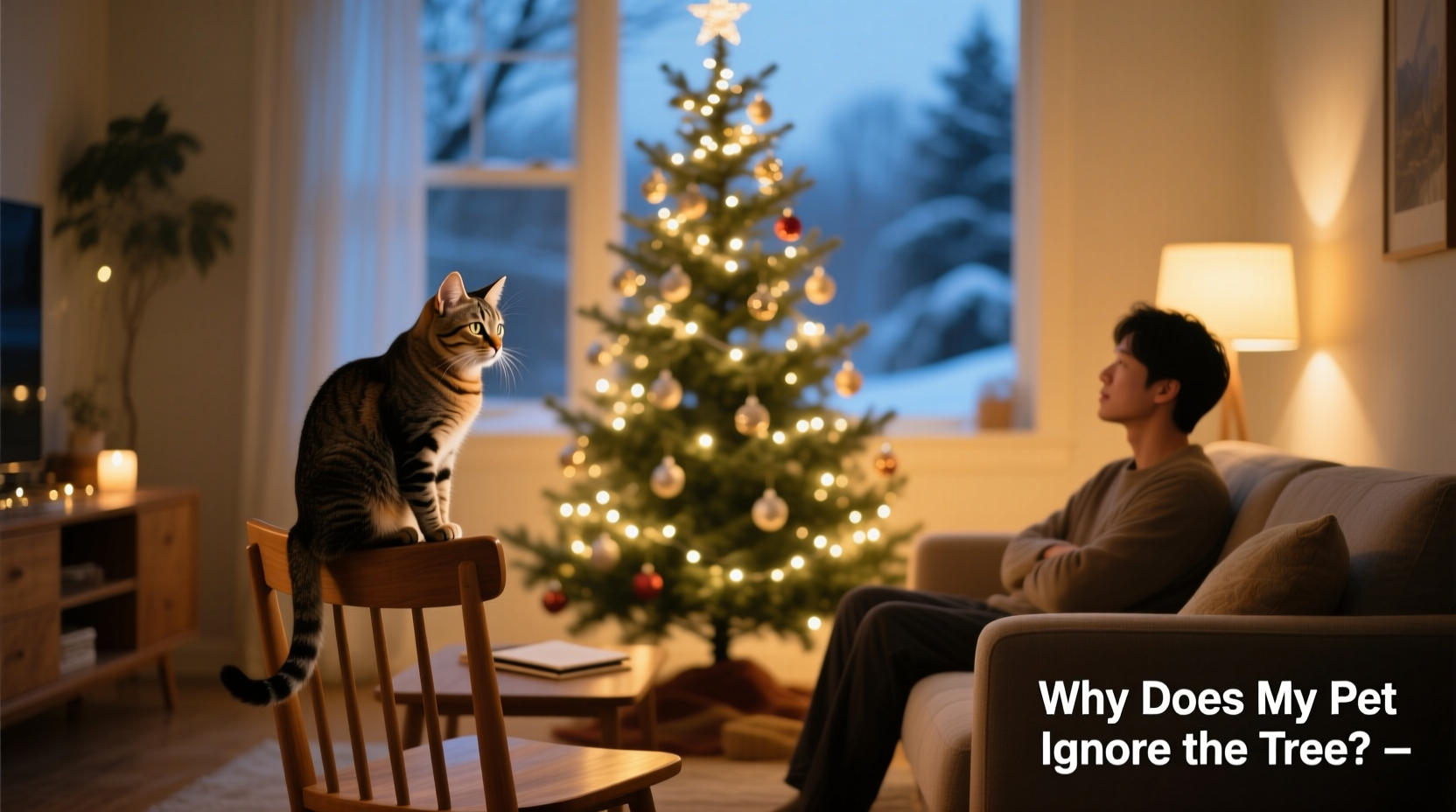
Pets, especially dogs and cats, are highly attuned to human presence and activity. They interpret body language, routines, and emotional states far more acutely than we often realize. When no one is near the tree, it remains just another piece of furniture—an object of mild curiosity but not immediate significance. But when a person sits beneath it, several psychological triggers activate in a pet’s mind:
- Novelty of Position: Humans sitting on the floor is unusual. Pets notice deviations from routine instantly.
- Perceived Value: If a human occupies a space, animals infer that the area has value or importance.
- Social Facilitation: The presence of a human can amplify a pet’s interest in an object through observational learning.
This phenomenon mirrors what researchers call \"local enhancement\"—a process where an animal pays attention to a location because another being (especially a trusted one) is interacting with it. In essence, your sitting under the tree signals: “This place matters now.”
“Animals don’t see environments the way we do. They see them through the lens of interaction. When you engage with a space, you make it relevant to them.” — Dr. Elena Torres, Animal Behavior Scientist, University of Edinburgh
Instinctual Roots: Territory, Play, and Predation
Beneath domestication lies instinct. Even well-socialized pets retain hardwired behaviors shaped by evolution. The sudden focus on the tree when you’re nearby may stem from deeper drives:
1. Territorial Monitoring
Dogs, in particular, monitor changes in their environment. A decorated tree introduces new scents, textures, and visual stimuli. While initially assessed and dismissed, the moment a human settles beneath it, the area becomes a focal point of potential social or territorial significance. Is this a new resting spot? A den? A resource worth guarding?
2. Predatory Curiosity
Cats are drawn to movement and reflective surfaces. Ornaments sway subtly, lights flicker, tinsel glimmers—all mimicking prey-like motion. When you sit still beneath the tree, your immobility contrasts sharply with the dynamic elements above and around you. To a cat, this creates a compelling hunting tableau: motion overhead, stillness below, and an opportunity to pounce.
3. Play Invitation
Dogs often interpret human proximity to toys or novel objects as an invitation to play. If you’re near the tree, especially if you’re smiling or speaking softly, your pet may believe it’s time for interaction. A nudge at a dangling ornament or a paw swipe at a low-hanging ball could be an attempt to initiate shared activity.
Gentle Redirection: Training Without Conflict
Correcting unwanted behavior around the tree after it occurs is less effective than shaping behavior proactively. Gentle redirection focuses on guiding pets toward acceptable alternatives rather than punishing curiosity. The goal is not suppression—it’s substitution.
Step-by-Step Guide: Redirecting Tree-Centric Behavior
- Establish a Positive Alternative Zone: Set up a cozy bed, mat, or designated play area near—but not too close to—the tree. Place high-value treats or favorite toys there daily so your pet associates the spot with rewards.
- Pair Presence with Calm Rewards: When you sit under the tree, toss a treat or toy toward the alternative zone. Do this before your pet approaches the tree. Over time, they learn that your presence predicts good things elsewhere.
- Use Verbal Cues Consistently: Introduce a cue like “settle” or “place” when your pet goes to their zone. Reward compliance immediately. Avoid using the command only when misbehavior starts.
- Interrupt Early, Not Late: If your pet begins moving toward the tree, redirect *before* contact. Stand up calmly, say their name, and guide them to their zone with a treat trail.
- Rotate Stimuli: Change out toys or puzzles in their zone every few days to maintain novelty and prevent boredom-driven tree exploration.
This method relies on positive reinforcement and environmental management—not dominance or correction. It respects the pet’s natural instincts while teaching them new associations.
Do’s and Don’ts: Managing the Holiday Environment
| Do | Don’t |
|---|---|
| Anchor the tree securely to prevent tipping | Leave electrical cords exposed or accessible |
| Use pet-safe decorations (e.g., paper chains, felt stars) | Hang edible ornaments like popcorn strings within reach |
| Supervise interactions when pets are near the tree | Yell or punish after the fact—this increases anxiety |
| Offer interactive toys during tree-sitting sessions | Allow unsupervised access to presents containing risky materials |
| Practice redirection daily, even without guests | Assume your pet will “learn” after one incident |
Real Example: How One Household Transformed Tree Time
In Portland, Oregon, Sarah and Mark adopted a rescue terrier mix named Milo. During his first Christmas, Milo became obsessed with the tree the moment either owner sat beneath it—barking, circling, and attempting to dig at the base. Frustrated, they considered gating off the living room entirely.
Instead, they consulted a certified dog behavior consultant who recommended a redirection plan. They placed a plush orthopedic bed five feet from the tree, stocked with stuffed Kongs and a soft deer-shaped squeaky toy Milo loved. Each evening, when they sat under the tree, one of them would quietly toss a treat onto the bed. Within three days, Milo began lying down on the bed as soon as someone approached the tree. By day seven, he stayed put even during video calls with extended family.
“We thought he was being stubborn,” Sarah said. “But really, he was just responding to our energy. Once we gave him a better option, he took it.”
Prevention Through Enrichment
Boredom magnifies problem behaviors. A pet left alone for long stretches may view the tree as the most stimulating object in the house. Environmental enrichment reduces the likelihood of fixation:
- Provide puzzle feeders or snuffle mats during holiday gatherings.
- Introduce new toys gradually—wrap them like gifts and let pets “uncover” them over several days.
- Use calming diffusers (like Feliway for cats or Adaptil for dogs) in rooms with high-stimulus decor.
- Ensure pets get adequate physical and mental exercise earlier in the day to reduce hyperarousal at night.
Enrichment doesn’t eliminate curiosity—it channels it productively. A mentally satisfied pet is less likely to seek stimulation in risky places.
FAQ: Common Questions About Pets and Christmas Trees
Why does my cat only climb the tree when I’m watching?
Cats often test boundaries when humans are present because they understand cause and effect. Your reaction—even surprise or laughter—can reinforce the behavior. Additionally, climbing when observed may be a form of social communication: “Look what I can do.” Redirect with vertical spaces of their own, like cat trees or shelves.
Is it safe to leave my dog alone with the tree?
It’s generally not recommended, especially during the first few weeks. Even pets accustomed to decor may knock over a poorly secured tree or chew on cords. If unsupervised access is necessary, consider using a baby gate or closing the door to the room.
Can I train my pet to stay away from the tree completely?
Yes, but it requires consistency and positive reinforcement. Use boundary training with clear markers (e.g., a ribbon on the floor) and reward your pet for staying outside the zone. Never rely solely on aversive methods like citrus sprays or noise deterrents—they can create fear-based associations with the entire room.
Conclusion: Harmony Over Control
The moment your pet notices the Christmas tree only when you sit beneath it isn’t defiance—it’s connection. It reflects their deep attunement to your actions and their desire to participate in your world. Rather than seeing this behavior as a nuisance, view it as an opportunity to strengthen trust and communication.
By understanding the behavioral roots of pet curiosity and applying gentle, consistent redirection, you create a holiday environment that’s safe for both animals and decor. You don’t need perfect obedience—just thoughtful guidance. With patience, most pets learn to coexist peacefully with seasonal changes, not because they’re forced to, but because they’ve been shown better ways to engage.




 浙公网安备
33010002000092号
浙公网安备
33010002000092号 浙B2-20120091-4
Comments
No comments yet. Why don't you start the discussion?