
Every year, millions of households bring home a Christmas tree, carefully decorate it, and step back to admire their festive centerpiece—only to have it toppled within hours by an enthusiastic cat or curious dog. If you've ever woken up to pine needles scattered across the floor and ornaments in disarray, you're not alone. Pets knocking over Christmas trees is one of the most common—and preventable—holiday mishaps. Understanding why this happens and how to stabilize your tree effectively can save your decorations, your sanity, and even your pet from injury.
The reasons pets interact with Christmas trees vary widely: some are drawn by movement, others by scent, and many simply can’t resist the temptation of batting at dangling ornaments. But beyond curiosity, there are behavioral and environmental factors at play. The good news? With a few strategic adjustments, you can enjoy a beautiful tree without risking a holiday disaster.
Why Pets Are Drawn to Christmas Trees
To effectively prevent tree-toppling, it’s essential to understand what motivates your pet. While dogs and cats react differently, both species are naturally inclined to investigate new objects in their environment—especially large, oddly shaped ones covered in shiny, moving items.
Cats, in particular, are climbers by instinct. A Christmas tree resembles a vertical jungle gym, complete with footholds (branches) and rewards (ornaments that swing and jingle). For kittens and young cats especially, the tree represents an irresistible challenge. Even adult cats with no prior climbing habits may be tempted by the novelty.
Dogs, on the other hand, may approach the tree out of curiosity, playfulness, or territorial behavior. The scent of real pine, water in the tree stand, or even hidden treats in certain ornaments can draw them in. Some dogs paw at the tree trying to retrieve a ball-shaped ornament, while others may bump into it during exuberant play.
In multi-pet homes, the risk increases. One pet may start investigating, prompting another to join in—turning a quiet corner into a festive wrestling ring.
“Pets perceive the Christmas tree as part of their environment—not as sacred holiday decor. Their interaction is rarely malicious; it’s driven by instinct and curiosity.” — Dr. Lena Patel, Veterinary Behavior Specialist
Simple Stabilization Hacks You Can Use Today
You don’t need expensive equipment or complex engineering to secure your tree. Many effective solutions use household items or low-cost hardware. The key is combining physical stability with behavioral deterrence.
1. Anchor the Tree to the Wall or Ceiling
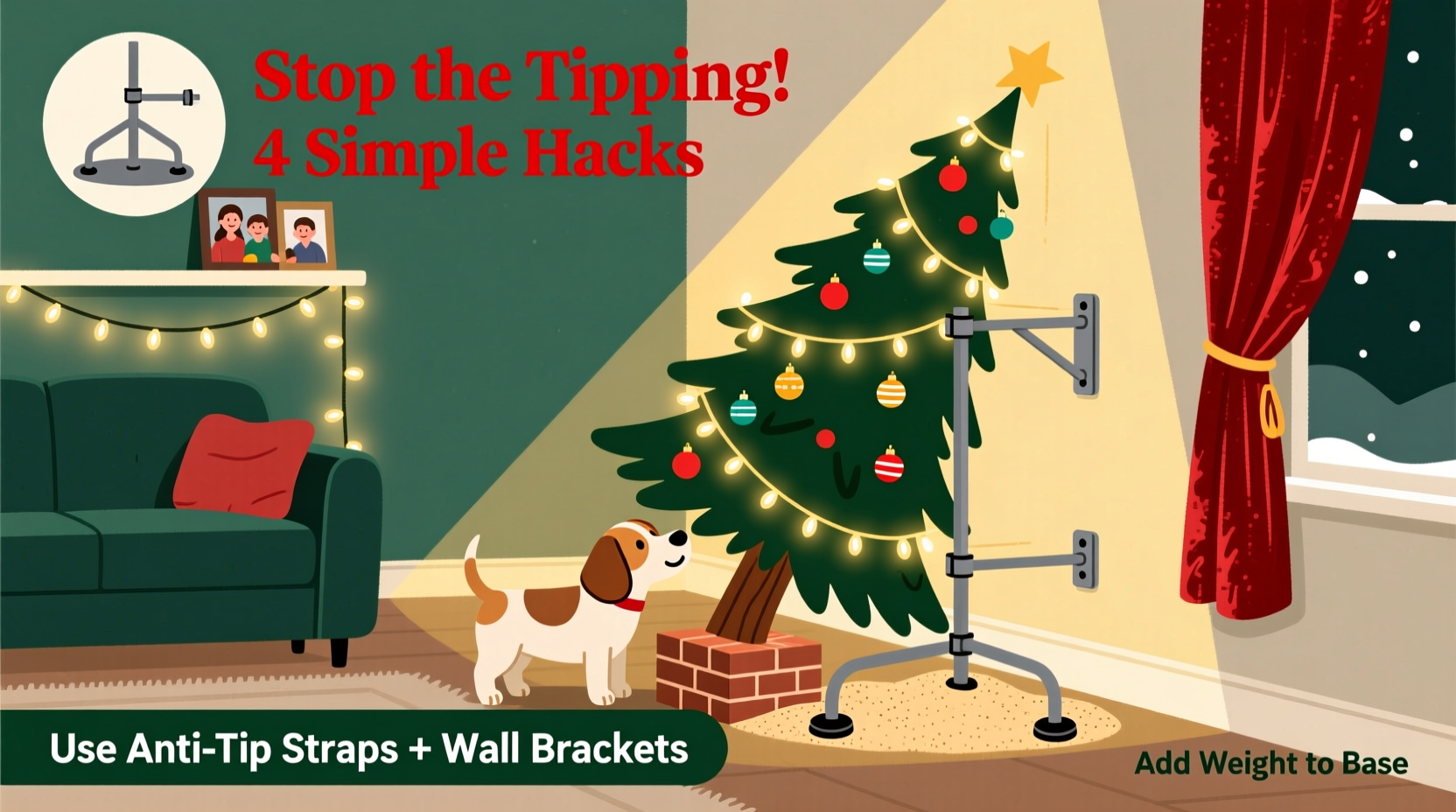
The most reliable method for preventing tree falls is anchoring. This doesn’t mean drilling holes in your ceiling—it can be as simple as using soft nylon cords or fishing line attached to an inconspicuous hook.
Secure the top third of the tree to a wall stud or ceiling joist using adjustable straps or ribbon tied firmly around a sturdy branch. Make sure the anchor point is strong enough to support the tree’s weight if pulled sideways.
2. Use a Heavy, Stable Base
Many tree stands are lightweight and prone to tipping. Upgrade to a commercial stand with a wide footprint and high water capacity (at least one gallon for six-foot trees). Metal stands are generally more stable than plastic.
If you already own a stand, increase its weight by filling empty spaces with sandbags, bricks wrapped in cloth, or sealed water bottles placed around the base inside the outer tray.
3. Create a Physical Barrier
Use baby gates, exercise pens (commonly used for puppies), or decorative room dividers to create a buffer zone around the tree. Even a 24-inch clearance can prevent direct contact while still allowing visibility.
For cats, consider placing aluminum foil or double-sided tape on the floor around the base. These textures are unpleasant underfoot and act as natural deterrents.
4. Reinforce from Within
Insert a single metal or wooden pole behind the trunk and secure it to both the floor and ceiling. This internal support acts like a spine, preventing lateral movement. A tension rod cut to size can work for ceilings without permanent fixtures.
5. Use Fishing Line as Invisible Support
Tie clear fishing line from the outer tips of the upper branches to hooks in the wall at three equidistant points. When properly tightened, these lines form a tripod effect, stabilizing the tree without being visible from a normal viewing angle.
Behavioral Strategies to Reduce Risk
Physical stabilization is only half the solution. Managing your pet’s behavior ensures long-term safety and reduces stress for both animal and owner.
Start by making the tree area less appealing. Avoid tinsel, which is attractive to pets but dangerous if ingested. Do not use edible ornaments—even pet-safe ones can encourage chewing. Keep lower branches free of ornaments, especially those that dangle, rattle, or resemble toys.
Redirect your pet’s attention with designated play zones. Place a cat tree or dog bed nearby with treats, toys, and familiar scents. Engage in regular play sessions to burn off excess energy that might otherwise be directed at the Christmas tree.
Supervision is crucial, especially during the first few days. Use baby monitors or pet cameras to keep an eye on the tree when you’re not in the room.
| Hack | Effectiveness | Cost | Installation Time |
|---|---|---|---|
| Wall Anchoring | ★★★★★ | Low | 15–20 min |
| Weighted Base | ★★★★☆ | Free–Low | 10 min |
| Barrier Fence | ★★★★☆ | Medium | 10–15 min |
| Fishing Line Support | ★★★☆☆ | Very Low | 20–30 min |
| Internal Pole | ★★★★★ | Medium | 30+ min |
Step-by-Step: Securing Your Tree in Under 30 Minutes
Follow this timeline to stabilize your Christmas tree quickly and effectively before holiday guests arrive.
- Minute 0–5: Clear the area around the tree. Remove loose rugs or cords that could cause tripping or pulling.
- Minute 5–10: Inspect your tree stand. Ensure it’s filled with water and tightened securely. Add weights if necessary.
- Minute 10–15: Choose an anchor point on a nearby wall or ceiling. Install a small screw hook into a stud.
- Minute 15–20: Cut and tie a soft cord from the hook to a strong upper branch. Repeat on opposite sides for balanced support.
- Minute 20–25: Set up a low barrier using a baby gate or pen. Cover the floor near the base with foil or textured matting.
- Minute 25–30: Decorate mindfully. Keep fragile or tempting items high up. Test stability by gently nudging the tree.
Real Example: How the Thompson Family Saved Their Tree
The Thompsons in Portland, Oregon, had given up on having a real Christmas tree after three consecutive years of feline sabotage. Their two-year-old Maine Coon, Loki, had a habit of scaling the tree like a redwood and bringing it down in a glittering crash.
After consulting a local pet behaviorist, they implemented a combination of strategies: anchoring the tree to the ceiling with nearly invisible fishing line, adding sandbags to the base, and setting up a puppy exercise pen around the perimeter. They also placed Loki’s favorite perch directly opposite the tree, stocked with treats and a heated pad.
The result? Their tree remained upright throughout the entire holiday season—with only minor needle loss from normal shedding. “We finally have photos of our tree that aren’t mid-fall,” said Sarah Thompson. “And Loki just watches it now, like it’s a TV show.”
Checklist: Pre-Tree Setup Safety Review
- ✅ Choose a stable location away from high-traffic areas
- ✅ Use a heavy-duty tree stand with adequate water capacity
- ✅ Secure the tree to wall or ceiling with soft ties
- ✅ Add weight to the base (sandbags, water bottles, etc.)
- ✅ Install a physical barrier if pets are highly curious
- ✅ Avoid tinsel, edible ornaments, and small detachable parts
- ✅ Keep electrical cords out of reach or cover with cord protectors
- ✅ Supervise initial interactions and reinforce boundaries
Frequently Asked Questions
Can I use a fake tree to reduce pet risk?
Artificial trees can still be knocked over, but they eliminate risks associated with real tree hazards like toxic sap, moldy water, and falling branches. However, their lighter frames often make them *more* prone to tipping unless properly secured.
Is it safe to use citrus sprays around the tree?
While citrus scents naturally repel many cats and dogs, some essential oils can be toxic if ingested or inhaled in large quantities. Instead of sprays, place cotton balls with a drop of lemon or orange extract around the base—out of reach—to deter approach without health risks.
What should I do if my pet drinks the tree water?
Tree water may contain preservatives, mold, bacteria, or sap that can cause vomiting, diarrhea, or lethargy. Always cover the reservoir with a lid or place a mesh guard over the top. If ingestion occurs, contact your veterinarian immediately.
Final Thoughts: Peace of Mind for a Pet-Friendly Holiday
A Christmas tree doesn’t have to be a hazard to coexist with pets. With thoughtful preparation, most incidents are entirely avoidable. The goal isn’t to exclude your pet from holiday joy—but to create a space where both tradition and safety thrive.
Start with structural stability, then layer in behavioral guidance. Monitor early interactions closely, and adjust your setup as needed. Remember, every pet is different: what works for a cautious senior dog may not deter a fearless kitten, so flexibility is key.




 浙公网安备
33010002000092号
浙公网安备
33010002000092号 浙B2-20120091-4
Comments
No comments yet. Why don't you start the discussion?