
If you've noticed your pet rabbit selectively nibbling only the red Christmas tree bulbs while ignoring green or blue ones, you're not imagining things — and it's not just random behavior. This peculiar habit offers a fascinating window into how rabbits see the world, their evolutionary instincts, and the limitations and strengths of rodent-like vision. While rabbits aren't rodents (they’re lagomorphs), they share many visual traits with species like rats and mice, making this behavior relevant to broader discussions about small mammal perception.
This selective chewing isn’t merely whimsical; it’s rooted in biology. Understanding why your rabbit targets red decorations can help improve pet safety, inform better home setups during holidays, and deepen your appreciation for how animals experience color differently than humans.
The Science Behind Rabbit Vision
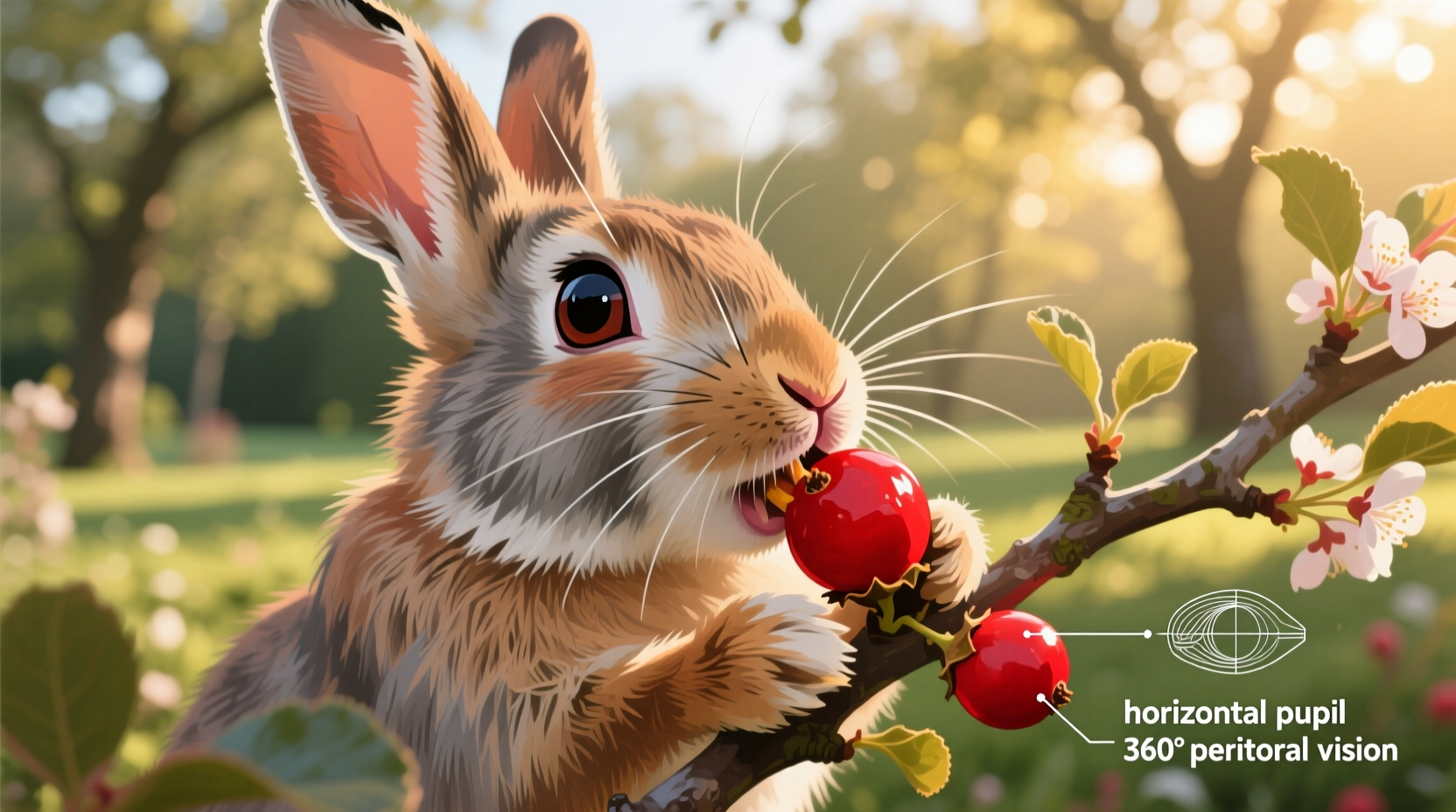
Rabbits have evolved as prey animals, and their visual system reflects adaptations for survival rather than aesthetic appreciation. Their eyes are positioned on the sides of their heads, giving them nearly 360-degree panoramic vision — excellent for spotting predators but poor for depth perception and fine detail.
More importantly, rabbits are **dichromatic**, meaning they possess only two types of cone photoreceptors in their retinas, compared to the three found in most humans (trichromatic vision). These cones are sensitive primarily to blue and green wavelengths of light. They lack the long-wavelength-sensitive cones that allow humans to perceive reds vividly.
So, if rabbits can’t see red well, why would they target red bulbs?
The answer lies not in vibrant red appearing “bright” to them, but in contrast. Red objects often stand out against green foliage because, to a dichromatic eye, red may appear as a dark or yellowish tone — creating high contrast against a green background. In other words, your rabbit isn’t drawn to red because it looks “red”; it’s drawn because the bulb creates a stark visual anomaly in its environment.
“Many mammals, including rabbits, rely more on motion and contrast than hue. What we interpret as color preference is often a response to luminance differences.” — Dr. Lena Torres, Comparative Vision Biologist, University of Alberta
Color Perception in Lagomorphs vs. Rodents
Though rabbits belong to the order Lagomorpha and not Rodentia, their visual systems are functionally similar to those of rodents such as mice and rats. Most rodents are also dichromatic, lacking sensitivity to red light. However, research shows that some species, like certain squirrels, have retained trichromatic vision, suggesting variation even within non-primate mammals.
A 2017 study published in *The Journal of Experimental Biology* tested behavioral responses in domestic rabbits when presented with colored discs. The results showed no significant attraction to red stimuli based on hue alone. Instead, rabbits were more likely to approach objects that created strong contrast against their surroundings — especially yellowish or dark-toned items set against green or blue backgrounds.
This explains why red Christmas ornaments — typically glossy, reflective, and darker in perceived luminance — become focal points. Your rabbit isn’t choosing red because it likes the color; it’s reacting to an object that visually \"pops\" in its field of view.
Behavioral Drivers Beyond Vision
Vision is only one part of the equation. Rabbits are naturally curious, oral explorers. Chewing is instinctual — it helps wear down their continuously growing teeth and allows them to investigate novel objects. A dangling, smooth-surfaced ornament offers both tactile and visual stimulation.
Moreover, rabbits use their mouths almost like hands. If something catches their attention — whether due to movement, texture, or contrast — they’ll often nudge or chew it to assess its nature. A red bulb swaying slightly in a draft might mimic plant movement, triggering investigative behavior.
Additionally, some ornaments emit faint chemical odors from plastics, dyes, or metal coatings. While undetectable to humans, these scents may be noticeable to rabbits, whose sense of smell is highly developed. Even if the red bulb doesn’t smell appetizing, its novelty could prompt investigation.
Real Example: Bella the Ornament Investigator
Bella, a 3-year-old Holland Lop, lived in a household where the family decorated a live Christmas tree each year. Over two consecutive Decembers, her owners observed her consistently removing only the red baubles — never the gold, green, or silver ones. Concerned about toxicity and electrical hazards, they consulted a veterinary behaviorist.
Video monitoring revealed that Bella didn’t immediately go for the red balls. She would sit beneath the tree for several minutes, watching. The red ornaments, being darker and more reflective, caught ambient light differently than others. When a breeze caused them to swing slightly, Bella reacted — first with ear twitching, then cautious approaches, followed by targeted chewing.
After replacing the red bulbs with frosted white ones (lower contrast against lights and branches), Bella lost interest entirely. This case illustrates how environmental contrast, not color preference, drives the behavior.
Do’s and Don’ts for Holiday Safety with Pet Rabbits
| Action | Do | Don't |
|---|---|---|
| Decoration Placement | Keep all ornaments above 3 feet or behind barriers | Hang low-hanging or floor-level decorations |
| Material Choice | Use paper, fabric, or unbreakable plastic ornaments | Use glass, metal, or toxic-coated materials |
| Lighting | Use cool LED lights; secure cords with conduit | Use hot incandescent bulbs or exposed wires |
| Tree Type | Secure real trees to prevent tipping; sweep needles daily | Leave tree water basin accessible (contains harmful additives) |
| Supervision | Allow short, monitored visits near the tree | Leave rabbit unsupervised in room with tree |
Understanding Dichromatic Vision: A Closer Look
To grasp why red stands out despite poor red-light detection, consider how dichromatic vision processes color. Humans with normal vision perceive red, green, and blue through separate cone cells. Rabbits, however, have cones tuned to short (blue) and medium (green-yellow) wavelengths.
As a result:
- Blue objects appear relatively bright.
- Green and yellow hues are moderately visible.
- Red objects fall outside optimal sensitivity and may appear dark gray, brown, or dull yellow.
But here’s the key: while red isn’t seen as “red,” it often absorbs more light than green foliage, making it appear darker. Against a bright green backdrop (like tinsel or pine branches), a dark-red ornament creates a high-contrast silhouette — exactly the kind of visual stimulus that captures a prey animal’s attention.
This phenomenon is known as **luminance contrast detection**. It’s why security cameras sometimes use infrared (invisible to humans) but detectable by sensors — different systems respond to different properties of light. For rabbits, it’s not color but contrast, shape, and movement that matter most.
Step-by-Step Guide: Making Your Home Rabbit-Safe During Holidays
- Assess Visual Triggers: Walk around your living space at rabbit eye level. Identify shiny, swinging, or high-contrast objects near the floor.
- Remove or Relocate Ornaments: Replace red or glossy bulbs with matte, neutral-colored ones. Move favorites higher up on the tree.
- Secure Electrical Cords: Use cord protectors or PVC tubing to prevent chewing. Never rely on bitter sprays alone — they wear off and aren’t foolproof.
- Block Access Strategically: Use baby gates or playpens to create safe zones. Ensure ventilation and enrichment within enclosed areas.
- Provide Alternatives: Offer willow balls, cardboard tubes, or untreated wood blocks to redirect chewing instincts.
- Monitor Behavior: Use a camera or scheduled checks to observe interactions with new environments.
- Gradual Reintroduction: After holidays, reintroduce removed items slowly to prevent overstimulation.
FAQ: Common Questions About Rabbit Vision and Behavior
Can rabbits see any colors at all?
Yes, but limited to blue and green-yellow ranges. They likely perceive the world in muted tones, with blues appearing brighter and reds appearing dark or indistinct.
Is my rabbit attracted to red because it looks like food?
Unlikely. Red fruits like apples or berries may be detectable due to brightness and scent, but artificial red ornaments don’t emit food signals. The attraction is more likely visual contrast than mistaken identity.
Are all rabbits the same in their color preferences?
No. Individual temperament, past experiences, and breed tendencies influence behavior. Some rabbits are bolder investigators; others ignore decorations entirely. Neutered/spayed rabbits often show reduced exploratory chewing.
Expert Insight: Bridging Vision and Environment
“We tend to project human aesthetics onto animals. But a rabbit doesn’t care if a bulb is festive — it cares if it moves, reflects, or contrasts. Designing safe spaces means seeing the world through their sensory lens, not ours.” — Dr. Arjun Patel, Animal Behavior Consultant, Vancouver Exotics Clinic
This perspective shift — from human-centric design to species-appropriate environments — is crucial for responsible pet ownership. Recognizing that your rabbit reacts to physical properties rather than symbolic meaning allows you to anticipate risks before they become emergencies.
Conclusion: From Curiosity to Care
Your rabbit’s fixation on red Christmas bulbs isn’t quirky randomness — it’s a logical interaction between evolutionary biology and modern household design. By understanding the mechanics of dichromatic vision, the role of contrast, and the innate curiosity of lagomorphs, you gain powerful tools to create safer, more enriching environments.
This knowledge extends beyond the holiday season. Whether arranging toys, selecting cage accessories, or designing play areas, always consider how objects appear from your rabbit’s vantage point. What seems subtle to you might scream “investigate me!” to them.
Start today: crouch down to your rabbit’s eye level and scan your living space. Identify potential visual triggers. Make one change to reduce risk or enhance enrichment. Small adjustments, informed by science, lead to meaningful improvements in animal well-being.




 浙公网安备
33010002000092号
浙公网安备
33010002000092号 浙B2-20120091-4
Comments
No comments yet. Why don't you start the discussion?