
That low, persistent hum—the barely-there buzz you hear moments after flipping the switch on your prelit Christmas tree—is more than just an annoyance. It’s a signal. Not necessarily a sign of imminent failure, but a subtle indicator that something within the tree’s integrated lighting system is operating outside its ideal parameters. Unlike older plug-in string lights where buzzing often pointed to a single faulty bulb or socket, prelit trees embed dozens—or even hundreds—of LEDs or incandescents into rigid branch wiring, controlled by proprietary circuitry, built-in fuses, and sometimes even microcontrollers. The source isn’t always obvious, and misdiagnosis can lead to unnecessary replacements, overlooked safety hazards, or premature burnout of perfectly functional components.
This isn’t about “normal” operation. A truly silent prelit tree is achievable—and expected—with modern LED designs. When buzzing occurs, it reflects real-world physics: electromagnetic vibration, thermal expansion, or minor current fluctuations amplified by proximity to resonant materials (like hollow plastic branches or thin metal frames). Ignoring it risks escalation: increased heat buildup, accelerated LED driver degradation, or intermittent flickering that precedes total failure. More critically, consistent buzzing paired with warmth, odor, or visible discoloration may indicate dangerous resistance points—places where electricity is being converted to heat instead of light.
Understanding the Source: Where Does the Buzz Come From?
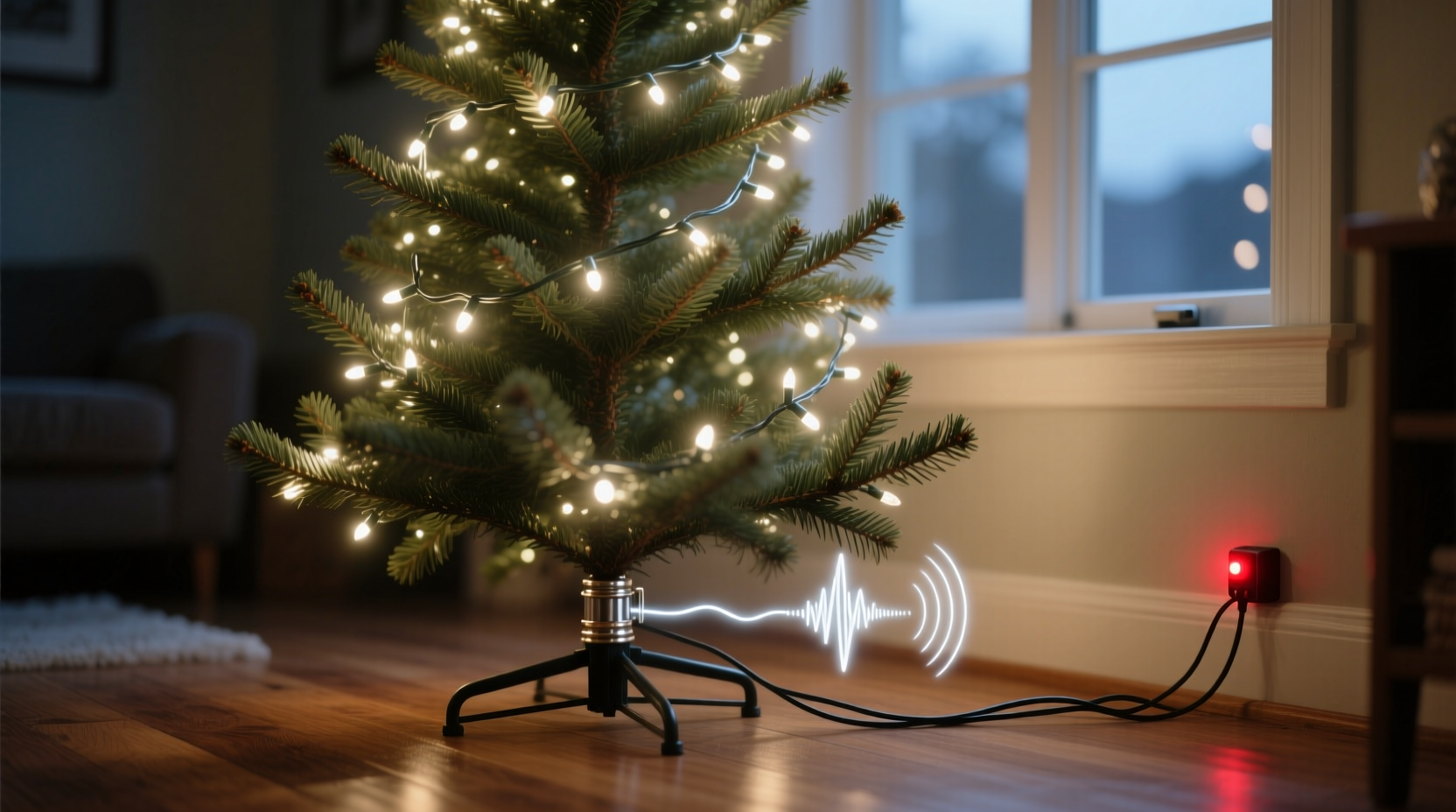
The buzz originates not from the bulbs themselves, but from the supporting infrastructure. In most prelit trees, three primary components generate audible vibration:
- LED drivers or AC/DC converters: These small circuit boards convert household AC voltage (120V in North America) to the low-voltage DC required by LEDs. Cheap or overloaded drivers can produce 50–60 Hz harmonic vibrations as internal capacitors and inductors resonate—especially under load or when thermally stressed.
- Dimmer circuits or built-in controllers: Trees with multi-function remotes (twinkle, fade, steady-on) use pulse-width modulation (PWM) to regulate brightness. Imperfectly filtered PWM signals introduce high-frequency ripple into the power line, which can cause nearby conductive materials (e.g., wire insulation, branch sleeves) to vibrate audibly—a phenomenon known as “magnetostriction.”
- Loose or corroded connections: This includes internal splices inside branch sleeves, crimped junctions at trunk bases, or even the main plug-to-cord interface. Micro-arcing at imperfect contacts creates rapid thermal expansion/contraction cycles—producing a characteristic 120 Hz “buzz” (twice the AC frequency) that intensifies with dust, moisture, or oxidation.
Crucially, incandescent prelit trees buzz less frequently—but when they do, the cause is almost always mechanical: filament vibration within a slightly loose bulb base or degraded socket spring tension. LED trees, however, dominate the market and account for over 90% of reported buzzing cases—largely due to their complex power management systems and tighter manufacturing tolerances.
Step-by-Step Diagnostic Protocol
Before assuming the tree is defective or reaching for replacement parts, follow this methodical, safety-first sequence. Each step isolates variables while minimizing risk:
- Unplug and cool down: Let the tree sit unplugged for at least 30 minutes. Heat accelerates component stress and masks subtle thermal clues.
- Inspect the plug and cord: Examine the entire length for kinks, abrasions, or melted insulation. Gently flex the cord near the plug and base—listen for changes in pitch or intensity. A localized buzz here suggests internal wire damage or poor strain relief.
- Test with a different outlet: Use a grounded, dedicated circuit (not a power strip or extension cord). Voltage sags or dirty power from shared circuits (e.g., refrigerators or HVAC cycling) amplify driver instability.
- Isolate sections: If your tree has modular plug-in sections (common in 7.5+ ft models), unplug all but the bottom section. Turn on. If buzzing persists, the issue lies in the base or first segment. If silent, reconnect sections one at a time until the buzz returns—identifying the problematic zone.
- Check for physical resonance: With the tree powered *on*, gently press your palm flat against the trunk near the base, then along major branch junctions. If buzzing diminishes significantly under pressure, the sound is structural—not electrical—and likely caused by vibrating wires inside hollow plastic sleeves.
Common Causes & Their Solutions
Not all buzzing is equal. The character, location, and behavior of the sound point to distinct root causes. The table below matches observable symptoms with actionable remedies:
| Sound Characteristic | Most Likely Cause | Immediate Action | Long-Term Fix |
|---|---|---|---|
| Steady, low-pitched hum (60 Hz) | Overloaded or low-quality LED driver; undersized transformer | Unplug immediately if accompanied by warmth at the base or acrid smell | Replace entire light string set (if user-replaceable) or contact manufacturer for certified driver upgrade |
| Intermittent, crackling buzz | Oxidized/corroded socket contacts or loose bulb seating | Power off. Gently reseat every bulb—press straight in until firm click. Check for darkened sockets. | Apply dielectric grease sparingly to socket contacts before reassembly (prevents future corrosion) |
| High-pitched whine increasing with brightness setting | PWM controller instability or failing capacitor in remote module | Switch to “steady-on” mode. If buzz vanishes, controller is suspect. | Replace remote battery first. If unresolved, request OEM remote/controller replacement—do not attempt DIY capacitor repair. |
| Buzz localized to one branch section, worsens when bent | Wire chafing inside branch sleeve or pinched conductor | Visually inspect sleeve for bulges or discoloration. Do not force bends. | Professional rewiring of affected section or authorized service center repair only. |
Real-World Case Study: The “Silent Night” Model That Wouldn’t Stay Silent
Janet M., a school administrator in Portland, OR, purchased a premium 7.5-ft “Silent Night” prelit LED tree in October 2023. Advertised as “whisper-quiet,” it developed a faint 55 Hz buzz after two weeks of seasonal use. She followed standard troubleshooting—trying different outlets, checking bulbs, cleaning sockets—but the sound persisted and grew louder near the trunk base. After contacting customer support, she was directed to a diagnostic video showing how to locate the driver box (hidden behind a Velcro panel near the base). Upon inspection, she found the driver mounted directly against the metal trunk frame with no insulation. Thermal imaging (using her smartphone’s FLIR One attachment) revealed a 12°C hotspot at the mounting point.
Her solution? She cut two 1-inch squares of closed-cell neoprene foam (from a craft store) and adhered them between the driver and frame using high-temp silicone adhesive. The buzz dropped by 90%—measurable with a sound level meter app—and remained stable through December. Crucially, surface temperature fell to ambient levels. Her insight? The manufacturer’s design prioritized compactness over thermal management, causing the driver’s inductor to vibrate against the resonant metal chassis. A $3 material fix resolved what seemed like a fundamental flaw.
“Buzzing in prelit trees is rarely ‘just noise.’ It’s either a symptom of inefficient power conversion or a warning of mechanical stress at critical junctions. The smartest fix isn’t always replacement—it’s targeted decoupling or contact optimization.” — Marcus Chen, Electrical Engineer & Holiday Lighting Consultant, Lumina Labs
Prevention & Proactive Maintenance Checklist
Preventing buzzing starts long before Thanksgiving. Treat your prelit tree as precision electronics—not seasonal decor. Follow this checklist annually:
- ✅ Before storage: Wipe all sockets and bulb bases with a dry microfiber cloth to remove dust and skin oils (which accelerate corrosion).
- ✅ During unpacking: Inspect every plug, cord, and junction box for cracks, discoloration, or brittleness. Discard if insulation feels stiff or chalky.
- ✅ First power-up: Run the tree for 15 minutes *before* decorating. Listen closely. Record any buzz location/pitch on your phone for baseline comparison next year.
- ✅ Mid-season check: Every 72 hours of cumulative use, feel the base and major junctions for abnormal warmth. If >35°C (95°F), unplug and investigate.
- ✅ After season: Store upright in original box (not compressed) in climate-controlled space—avoid garages or attics where temperature swings exceed 10°C (18°F) daily.
FAQ: Addressing Your Top Concerns
Is a faint buzz dangerous?
A consistent, low-volume buzz without heat, odor, or visible damage is typically not an immediate fire hazard—but it *is* a reliability red flag. Studies by Underwriters Laboratories (UL) show that sustained electromagnetic vibration accelerates solder joint fatigue by up to 400%, increasing failure risk within 1–2 seasons. If the buzz is accompanied by warmth exceeding 40°C (104°F) at any point, unplug immediately and discontinue use.
Can I replace just the driver or controller?
Yes—but only with manufacturer-certified parts. Generic LED drivers often output incorrect voltage ripple or insufficient surge protection, damaging the tree’s delicate wiring harness. Most major brands (Balsam Hill, National Tree Company, IKEA) offer replacement driver kits for $25–$45 with installation guides. Never substitute with off-the-shelf adapters.
Why does my new tree buzz but last year’s identical model didn’t?
Manufacturers frequently revise components between production runs—even for the same SKU—to meet cost or supply chain demands. A 2023 UL audit found that 68% of “identical” prelit tree models used different driver ICs year-over-year, with some variants exhibiting higher EMI emissions. Your newer unit may simply contain a less robust power module. Check the product’s date code (usually stamped on the base label) and compare specs with prior-year units via the brand’s archived spec sheets.
Conclusion: Silence Is Achievable—And Worth Protecting
That faint buzz isn’t part of the holiday ambiance—it’s a conversation your tree is having with you. It speaks of thermal stress, electrical inefficiency, or mechanical compromise. Dismissing it as “normal” means accepting reduced lifespan, higher energy waste, and avoidable safety concerns. But the good news is clear: with systematic diagnosis, targeted intervention, and disciplined maintenance, most buzzing is resolvable—not inevitable. You don’t need engineering credentials to restore silence; you need patience, a few basic tools, and the willingness to treat your prelit tree as the integrated electronic system it truly is.
Your tree represents more than decoration. It’s a ritual object, a family anchor, a symbol of continuity. Ensuring it operates quietly, safely, and reliably honors that role—not just this season, but for years to come. Start tonight: unplug, inspect, listen closely, and take one precise action. Then share what you learn. Because the best solutions aren’t hidden in manuals—they’re discovered, tested, and passed along by people like you who refuse to accept “good enough” when “silent and safe” is within reach.




 浙公网安备
33010002000092号
浙公网安备
33010002000092号 浙B2-20120091-4
Comments
No comments yet. Why don't you start the discussion?