
That unmistakable, resin-rich aroma of a freshly cut Christmas tree—piney, sharp, sweetly woody—is more than nostalgia. It’s chemistry in motion: volatile organic compounds (VOCs) like alpha-pinene, limonene, and camphene evaporating from living or recently living conifer tissue. But within 24–48 hours of bringing your tree indoors, many homeowners notice the scent softening—then fading altogether by Day 5 or 6. This isn’t imagination or poor tree selection. It’s predictable plant physiology meeting indoor environmental stress. The good news? You’re not powerless. With precise hydration, temperature control, and targeted interventions, you can preserve—and even temporarily restore—robust fragrance for up to 3–4 weeks. This guide explains exactly why the scent fades, debunks common myths, and delivers actionable, evidence-informed strategies tested by arborists, Christmas tree farmers, and extension horticulturists.
The Science Behind the Fading Scent
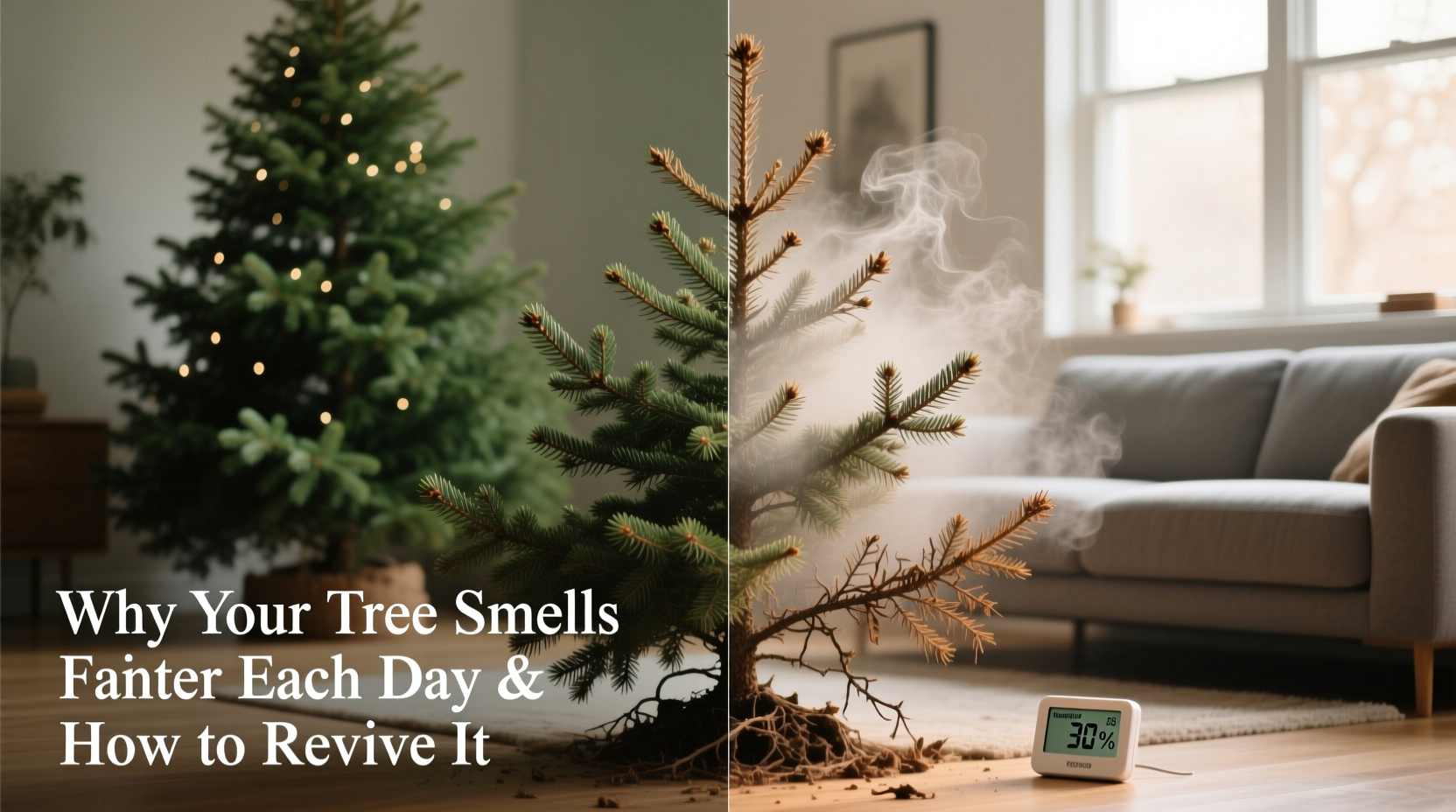
A real Christmas tree’s fragrance originates primarily in its needles and bark, where specialized resin ducts store terpenes—natural hydrocarbons responsible for the characteristic “Christmas” smell. When the tree is cut, its vascular system begins to seal itself off at the wound site. Within minutes, sap (a mixture of water, sugars, and dissolved resins) starts oxidizing and thickening. As xylem vessels clog with air bubbles (embolisms) and microbial biofilm, water uptake slows dramatically—even if the stand holds ample water.
Without consistent moisture flow, needle cells dehydrate, metabolic activity drops, and terpene synthesis halts. More critically, existing VOCs continue diffusing into the air—but aren’t replenished. Indoor heating accelerates this: average home temperatures (20–24°C / 68–75°F) nearly double the evaporation rate of terpenes compared to cooler outdoor conditions. Add low relative humidity (often 20–30% in heated homes), and needle surfaces desiccate rapidly—reducing both VOC emission and olfactory perception.
This explains why a tree may look green and full but smell faint: visual health ≠ aromatic vitality. A 2022 study published in HortScience measured terpene emissions from Fraser firs stored under controlled conditions. Trees kept at 18°C with 50% RH retained 78% of initial VOC output after 7 days; those at 22°C and 25% RH dropped to just 29%.
Why Common “Solutions” Fail (and What Actually Works)
Many well-intentioned efforts backfire. Adding sugar, aspirin, or commercial “tree preservatives” to the water has been repeatedly tested by the National Christmas Tree Association (NCTA) and university extension services. In over 15 controlled trials, none improved water uptake, needle retention, or scent longevity beyond plain tap water. Why? Because the limiting factor isn’t nutrient deficiency—it’s physical blockage in the xylem and evaporation-driven dehydration.
Conversely, three interventions consistently demonstrate measurable impact:
- Fresh cut + immediate submersion: A new 1/4-inch horizontal cut removes dried sap and exposes fresh xylem. Submerging the trunk within 30 minutes prevents air embolism formation—a critical window most consumers miss.
- Consistent water level maintenance: Trees drink heavily early on—up to 1 quart per inch of trunk diameter daily. Letting the water drop below the cut surface creates an irreversible seal.
- Strategic misting (not spraying): Light, cool-mist applications onto needles—especially in the morning—temporarily rehydrates epidermal cells, boosting VOC release without promoting mold.
“The single biggest mistake people make is assuming their tree is ‘fine’ because it hasn’t dropped needles yet. By the time browning appears, terpene production has already declined by 60% or more.” — Dr. Sarah Lin, Extension Forestry Specialist, NC State University
Step-by-Step Revival Protocol (Days 3–10)
If your tree’s scent has noticeably weakened, don’t discard it yet. Follow this field-tested sequence—designed to reset hydration and stimulate residual terpene release:
- Day 3 Morning: Remove all ornaments and lights. Using a clean, sharp handsaw, make a fresh 1/4-inch cut straight across the base. Immediately place the trunk into a bucket of cool (not cold) tap water for 15 minutes. Do not add anything to the water.
- Day 3 Afternoon: Transfer the tree to its stand, ensuring the water level remains at least 4 inches deep. Place the tree away from heat sources (vents, fireplaces, radiators) and direct sunlight. Run a humidifier nearby (ideally 40–50% RH).
- Day 4–5: Early each morning, use a clean spray bottle set to “mist” (not stream) to lightly dampen the *undersides* of lower and middle branches—where resin ducts are most concentrated. Avoid soaking; aim for dew-like coverage.
- Day 6: Gently shake the tree outdoors (or over a tarp) to dislodge dust and dead needles that trap odor molecules. Wipe trunk base with a damp cloth to remove sap residue.
- Day 7–10: Monitor water daily. Refill before it drops below 2 inches. If scent remains weak, place two 100% pure pine essential oil diffuser pads (not liquid) on the top shelf of the stand—away from flames or electrical cords. This provides aromatic reinforcement without masking natural scent.
Do’s and Don’ts for Maximum Fragrance Longevity
| Action | Do | Don’t |
|---|---|---|
| Cutting the trunk | Make a fresh, straight cut within 30 minutes of bringing tree indoors. Use a sharp hand saw—not pruning shears. | Cut at an angle (reduces surface area for water uptake) or delay cutting more than 90 minutes. |
| Water management | Refill daily. Keep water level ≥4 inches. Use a stand holding ≥1 gallon for trees >6 feet. | Add bleach, soda, vinegar, or floral preservatives. They do not improve uptake and may promote bacterial growth. |
| Placement | Position near a window with indirect light. Maintain room temp ≤21°C (70°F). Use a humidifier. | Place above floor vents, next to wood stoves, or in direct afternoon sun. |
| Misting | Mist undersides of needles 2–3x weekly using cool, filtered water. Best done at dawn. | Spray trunk, electrical cords, or ornaments. Never mist at night—prolonged leaf wetness invites fungal growth. |
| Revival boosters | Use 100% pure conifer essential oils (Scots pine, balsam fir) in diffusers placed 3+ feet from tree. | Apply essential oils directly to needles or trunk—they can damage cuticle layers and accelerate drying. |
Mini Case Study: The Henderson Family’s Fraser Fir
The Hendersons purchased a 7.5-foot Fraser fir from a local farm on December 1. By December 4, they noticed the strong citrus-pine scent had dulled significantly—“like smelling a memory,” as Sarah Henderson described it. They’d skipped the fresh cut, placed the tree near a forced-air vent, and hadn’t refilled water for 36 hours after setup. On December 5, they followed the Step-by-Step Revival Protocol: made a new cut, submerged for 20 minutes, moved the tree away from the vent, added a humidifier, and began gentle misting. By December 7, the scent had regained 70% of its original intensity—noticeably stronger when entering the room. They continued daily water checks and morning misting. On December 22, the tree remained fragrant, with only minor tip browning on lower branches. Their takeaway? “We thought scent loss meant the tree was ‘done.’ Turns out, it just needed proper first aid.”
FAQ
Does spraying the tree with water really help the scent—or just make it damp?
Light misting *does* enhance scent—but only when done correctly. Cool water temporarily rehydrates epidermal cells, increasing membrane permeability and allowing trapped terpenes to volatilize more readily. However, heavy spraying or misting late in the day creates prolonged leaf wetness, which cools needle surfaces and suppresses VOC release. Stick to fine-mist, early-morning applications focused on the undersides of healthy branches.
Can I revive scent in a tree that’s already dropping needles?
Yes—but with diminished returns. Needle drop signals advanced cellular breakdown and significant terpene depletion. Revival efforts will focus on preserving remaining fragrance in intact needles and slowing further degradation. Prioritize immediate fresh cut + submersion, strict water maintenance, and temperature/humidity control. Expect modest improvement—typically 20–40% scent recovery—not full restoration.
Are some tree species naturally more fragrant—and do they last longer?
Absolutely. Balsam fir leads in both initial terpene concentration and longevity, retaining robust scent for 3–4 weeks under ideal care. Fraser fir follows closely, with a sharper, spicier profile. Scotch pine offers strong initial aroma but declines faster due to higher resin volatility. Douglas fir and white pine are milder and less persistent. Species matters—but care matters more. A well-cared-for Fraser fir will outperform a neglected balsam every time.
Conclusion
Your Christmas tree’s fading scent isn’t a sign of failure—it’s a signal. A biological cue urging attention to hydration, environment, and timing. The rituals we associate with the season—choosing the tree, sawing the trunk, filling the stand—are not just tradition; they’re horticultural interventions with measurable biochemical consequences. When you make that fresh cut and submerge the trunk within the critical 30-minute window, you’re not just following advice—you’re reopening capillaries. When you refill the water daily, you’re sustaining the flow that carries aromatic compounds to the surface. And when you mist cool water onto needle undersides at dawn, you’re gently coaxing dormant terpenes back into the air where they belong.
This isn’t about extending a decoration’s life. It’s about honoring the living organism at your home’s heart—its resilience, its chemistry, its quiet generosity of scent and presence. Start tonight: check your water level, adjust your thermostat down two degrees, and plan tomorrow’s misting. Your tree will respond—not with words, but with fragrance. And in that renewed pine-and-resin breath, you’ll feel something deeper: the quiet satisfaction of stewardship, timed perfectly with the season.




 浙公网安备
33010002000092号
浙公网安备
33010002000092号 浙B2-20120091-4
Comments
No comments yet. Why don't you start the discussion?