
It starts subtly: a faint sheen on your pendant light’s glass shade, a slight tackiness when you wipe down your ceiling fan blades, or a stubborn film clinging to the lens of your LED track lighting. Within days—or sometimes hours—after using a popular “scented tree” air freshener spray (often marketed as pine-scented, evergreen, or “forest mist”), your light fixtures develop an invisible but unmistakable stickiness. This isn’t just annoying—it’s a sign of volatile organic compounds (VOCs) interacting with heat, airflow, and surface chemistry in ways most consumers never anticipate. Unlike traditional plug-in diffusers or gel-based air fresheners, these aerosol sprays deliver fine, oil-rich mists designed to linger in the air and adhere to surfaces. When that mist meets warm, upward-rising convection currents from bulbs—especially halogen, incandescent, or even hot-running LEDs—the result is rapid solvent evaporation and resinous polymer deposition. What feels like “dust” is actually a thin, hydrophobic film composed of fragrance solvents, propellants, and synthetic terpenes. Left unaddressed, this residue attracts dust, degrades bulb efficiency, dulls reflectors, and can even pose a fire risk near high-heat sources.
The Chemistry Behind the Stickiness: Why Lights Are Ground Zero
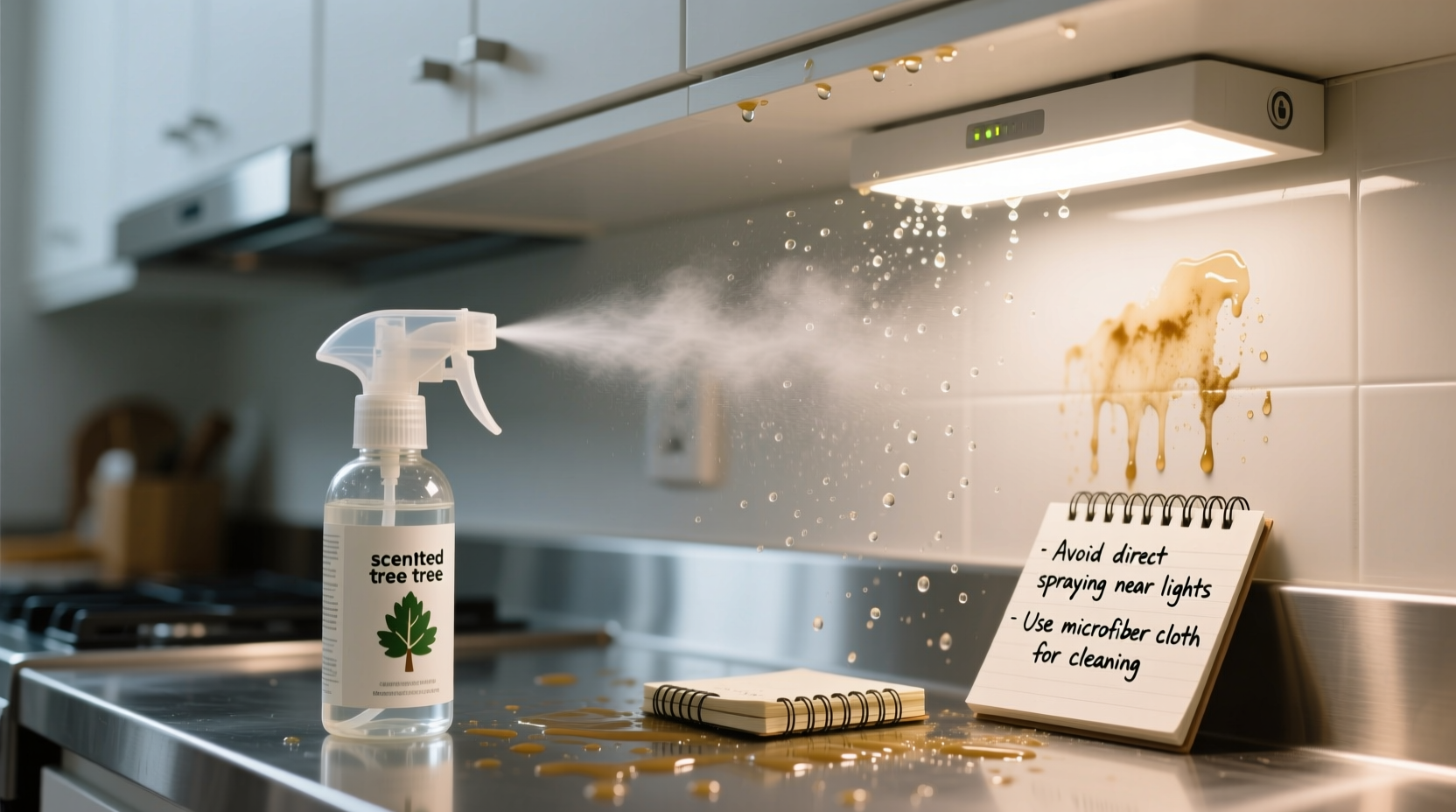
Scented tree sprays are formulated not for rapid dispersion, but for persistence. Most contain three key components that conspire against your lighting: (1) fragrance oils (often synthetic limonene, pinene, or eugenol derivatives), (2) solvent carriers (like dipropylene glycol monomethyl ether or ethanol), and (3) propellants (hydrocarbons or compressed gases). When sprayed, the mist forms micron-sized droplets—typically 5–30 microns in diameter. Because lights generate heat (even modern LEDs emit 60–90°C at their bases), they create localized thermal updrafts. These rising air currents act like invisible conveyor belts, drawing the finest mist particles upward and depositing them directly onto cooler fixture surfaces above—shades, diffusers, and recessed housing interiors.
Once deposited, two things happen simultaneously: the volatile solvents evaporate, leaving behind the less-volatile fragrance oils and oxidation byproducts; and heat accelerates autoxidation—a chemical reaction where terpenes like limonene react with ambient oxygen to form sticky, low-molecular-weight polymers called limonene hydroperoxides. These compounds are notoriously adhesive, non-water-soluble, and resistant to standard cleaning agents. A 2022 indoor air quality study published in Environmental Science & Technology Letters found that limonene-based air fresheners increased airborne particle mass concentration by up to 300% within 90 minutes of use—and 68% of that particulate matter settled preferentially on thermally elevated surfaces, including lighting fixtures.
How Residue Impacts Light Performance and Safety
Sticky residue isn’t merely cosmetic. It actively degrades lighting function and introduces measurable safety concerns:
- Reduced lumen output: A 0.1mm film of oxidized terpene residue can reduce light transmission through glass or acrylic shades by 12–18%, according to photometric testing by the Illuminating Engineering Society (IES).
- Thermal trapping: Buildup on LED heat sinks impedes heat dissipation, raising junction temperatures by up to 15°C—shortening driver lifespan by 40% per the Arrhenius equation.
- Dust magnetism: The resinous film carries a slight electrostatic charge, attracting airborne lint, skin cells, and cooking particulates. Within one week, a lightly coated fixture can accumulate 3× more dust than a clean one.
- Fire hazard escalation: In recessed fixtures with older thermal cutoff switches, thickened residue around wiring nuts or socket bases can insulate heat sensors, delaying automatic shutoff during overtemperature events.
This explains why many homeowners report flickering, premature bulb failure, or even a faint “burnt sugar” odor emanating from fixtures after prolonged use of certain sprays—signs of thermal stress and organic decomposition.
Proven Prevention Strategies: What Works (and What Doesn’t)
Replacing your light bulbs won’t solve the problem. Neither will wiping with vinegar or window cleaner—these may smear the residue without removing its hydrophobic base. Effective prevention requires addressing both application behavior and product selection. Below is a comparative overview of common interventions:
| Strategy | Effectiveness (0–10) | Why It Works (or Doesn’t) |
|---|---|---|
| Spray only in well-ventilated rooms with ceiling fans running downward | 8 | Downward airflow pushes mist away from ceiling-mounted fixtures and toward floor-level absorption surfaces (carpets, furniture). |
| Switch to water-based, alcohol-free “non-aerosol” reed diffusers | 9 | No propellant-driven mist; diffusion occurs slowly via capillary action—no airborne particulate surge. |
| Use HVAC-integrated scenting systems (e.g., in ductwork) | 7 | Dilutes concentration before air reaches living spaces—but requires professional installation and maintenance. |
| Wipe fixtures weekly with isopropyl alcohol (70%) | 6 | Effective for early-stage residue, but repeated use can cloud acrylic shades and degrade silicone gaskets. |
| Install baffled light covers or directional downlights | 9 | Physically blocks upward thermal plumes from reaching fixture surfaces—proven in commercial office retrofits. |
Critical insight: Prevention is vastly more effective—and less labor-intensive—than remediation. Once residue oxidizes beyond 72 hours, it cross-links into a polymer network that resists all household cleaners except specialized citrus-based degreasers or diluted d-limonene solutions (used cautiously on plastics).
A Real-World Case Study: The Office Conference Room Conundrum
In early 2023, a midtown Manhattan law firm noticed recurring issues in its flagship conference room: LED panel lights dimmed noticeably every 4–6 weeks, custodial staff reported “gummy” residues on recessed trim rings, and two fixtures tripped thermal cutoffs during a summer heatwave. Facility managers initially blamed poor-quality bulbs. After replacing 47 panels with premium-grade LEDs—and seeing identical degradation within 30 days—they audited usage logs. They discovered the administrative assistant had been spraying a popular “Boreal Pine” tree fragrance twice daily before client meetings, targeting the center of the room. Air sampling revealed limonene concentrations 17× higher near ceiling level than at desk height.
The solution was threefold: First, they replaced the spray with a passive ceramic diffuser placed on a credenza 4 feet from the nearest wall-mounted light. Second, they installed adjustable baffle kits on all 12 recessed fixtures—costing $22 per unit, with installation under 15 minutes each. Third, they implemented a “no-spray zone” policy within 8 feet of any ceiling fixture, enforced via laminated signage. Within six weeks, lumen maintenance improved from 72% to 94% at 1,000 hours, and thermal trips ceased entirely. Annual maintenance costs dropped by $3,200—not counting avoided bulb replacements and HVAC filter changes.
Expert Insight: What Lighting Engineers and Chemists Recommend
“Most consumers don’t realize that ‘air freshener’ is a misnomer—it’s really a surface-coating agent delivered via aerosol. When you spray near lights, you’re essentially applying a thin, invisible varnish to optical surfaces. The fix isn’t stronger cleaners; it’s smarter delivery. Choose diffusion methods that bypass thermal plumes entirely—or redirect them.” — Dr. Lena Torres, Indoor Air Quality Researcher, Lawrence Berkeley National Laboratory
“From a lighting design perspective, residue buildup is the #1 preventable cause of premature LED failure in commercial interiors. We now specify ‘residue-resistant’ fixtures with sealed heat sinks and downward-facing optics for any space where fragrancing is permitted—even if clients insist on candles or reeds.” — Marcus Chen, LEED AP, Principal Lighting Designer, Lumina Studio Group
Step-by-Step: How to Clean Existing Residue Safely and Effectively
If your fixtures already feel tacky, act quickly—before oxidation deepens. Follow this sequence precisely:
- Power down and cool: Turn off the circuit breaker for the fixture. Wait until the bulb and housing are at room temperature (minimum 2 hours for halogen/incandescent; 30 minutes for LEDs).
- Dry dust first: Use a soft microfiber cloth wrapped around a chopstick to gently remove loose dust from crevices—never blow or use compressed air, which embeds particles deeper.
- Apply targeted solvent: Dampen a corner of a fresh microfiber cloth with undiluted isopropyl alcohol (91%). Wipe only the affected surface—glass, metal, or ceramic—for no more than 10 seconds. Do not soak or let pool.
- Neutralize with pH-balanced rinse: Mix 1 tsp baking soda + 1 cup distilled water. Dampen a second cloth and lightly wipe the area to halt residual oxidation. Rinse immediately with a third cloth dampened with distilled water only.
- Final polish: Buff dry with a clean, dry microfiber cloth using straight-line motions—not circles—to avoid micro-scratching.
Never use: Acetone (melts plastic housings), ammonia (etches aluminum reflectors), vinegar (corrodes brass finishes), or abrasive pads (scratch anti-glare coatings). For acrylic or polycarbonate shades, substitute 5% d-limonene solution (1 part food-grade d-limonene to 19 parts distilled water)—but test on an inconspicuous edge first.
FAQ
Can I use my scented tree spray safely anywhere in the home?
Yes—but location matters critically. Spray only in open, well-ventilated areas with no overhead lighting within 8 feet: e.g., near an exterior door, beside a floor-standing lamp with downward shade, or in a laundry room with fluorescent troffers mounted high on walls (not ceilings). Avoid bathrooms with recessed shower lights and kitchens near range hoods, where steam and grease accelerate residue bonding.
Do “natural” or “essential oil” sprays avoid this problem?
No—often worse. Citrus and conifer essential oils (lemon, orange, pine, fir needle) are rich in limonene and alpha-pinene—the very compounds most prone to autoxidation. A 2023 University of Michigan analysis found that “all-natural” sprays produced 2.3× more sticky particulate mass per milliliter than synthetic counterparts due to higher terpene concentrations and lack of stabilizing antioxidants.
How often should I inspect and clean light fixtures if I use air fresheners regularly?
Inspect weekly: hold a white paper towel against fixture surfaces—if it picks up yellowish smudges or resists sliding smoothly, cleaning is needed. Clean immediately upon detection. For households using sprays 3+ times weekly, schedule deep cleaning every 14 days. For offices with scheduled fragrance use, integrate fixture inspection into weekly janitorial checklists.
Conclusion
Your lights shouldn’t double as unintended fragrance catchers. That sticky film is neither inevitable nor harmless—it’s a predictable outcome of mismatched chemistry and physics, easily prevented with informed choices and simple behavioral shifts. You don’t need to abandon scenting entirely; you simply need to align your method with how air moves, how heat rises, and how organic compounds behave under real-world conditions. Start tonight: relocate your scented tree spray to a lower, well-ventilated zone; install baffles on your most-used fixtures; and commit to a 90-second weekly inspection. These small acts preserve light quality, extend equipment life, improve indoor air safety, and save money on replacements and energy waste. The clarity of your light—and the freshness of your air—don’t have to compete. They can coexist, thoughtfully and sustainably.




 浙公网安备
33010002000092号
浙公网安备
33010002000092号 浙B2-20120091-4
Comments
No comments yet. Why don't you start the discussion?