
It’s a familiar experience: you step into the shower, turn on the hot water, and within moments, the flimsy plastic curtain begins creeping toward you, clinging like an unwanted guest. This seemingly trivial annoyance has puzzled many bathers—but it's not magic or faulty design. It’s physics. The phenomenon of a shower curtain sticking to your body is rooted in fluid dynamics, pressure differentials, and thermodynamics. Understanding the science behind it doesn’t just satisfy curiosity—it empowers you to prevent it.
This article breaks down the exact mechanisms that cause your shower curtain to billow inward, examines real-world factors that intensify the effect, and provides practical, science-based solutions to keep your curtain where it belongs—on the outside.
The Bernoulli Effect: A Key Player
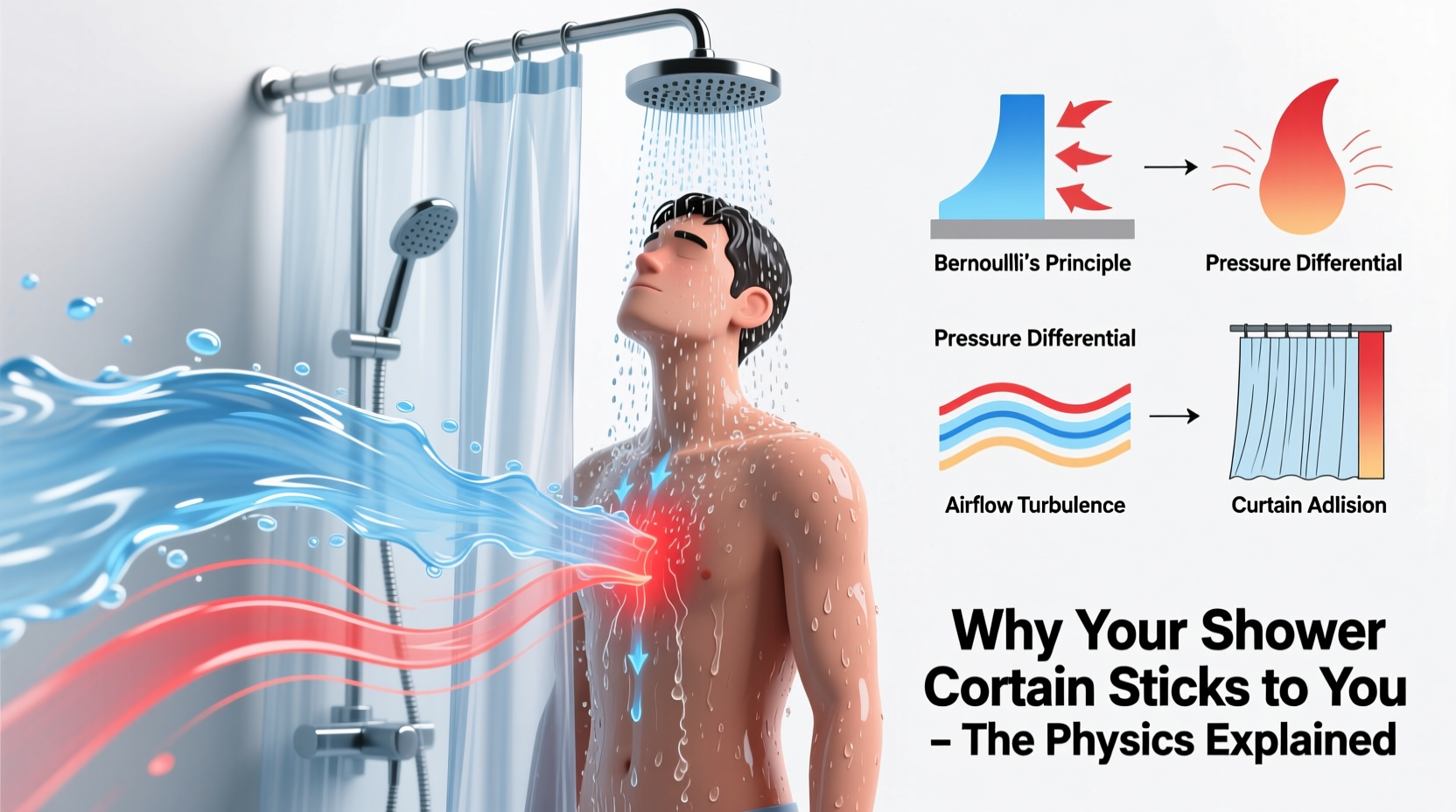
One of the primary explanations for the inward pull of a shower curtain is the **Bernoulli Effect**, a principle in fluid dynamics named after Swiss mathematician Daniel Bernoulli. The effect states that as the speed of a fluid (like air or water) increases, its pressure decreases.
Inside your shower, hot water from the showerhead creates steam and rapidly moving air. As water droplets spray downward, they drag surrounding air with them, creating a fast-moving vertical current along the inside of the shower stall. This airflow reduces the air pressure inside the shower relative to the stiller, higher-pressure air outside.
Because nature seeks equilibrium, the higher-pressure air outside pushes the lightweight curtain inward—toward the low-pressure zone. This is similar to how airplane wings generate lift: faster-moving air over the top creates lower pressure, causing upward force. In the shower, the force is horizontal, pulling the curtain toward your legs.
Convection Currents and the Stack Effect
Beyond Bernoulli, another physical process contributes: **convection**. Hot water heats the air inside the shower, making it less dense. Warm air rises, creating an upward current. As it moves up and escapes over the top of the curtain, cooler air from outside rushes in at floor level to replace it.
This circulation forms a convection loop. The incoming cool air pushes against the bottom of the curtain, while the rising warm air pulls the middle and upper sections inward. This is sometimes referred to as the “stack effect” in building physics—where temperature-driven airflow causes movement through vertical spaces.
The combination of rising hot air and inflowing cooler air enhances the curtain’s tendency to bow inward, especially noticeable in taller showers or when the bathroom door is closed, restricting balanced airflow.
“Air behaves like any fluid—it flows from high to low pressure. In a shower, heat and motion create a mini-weather system.” — Dr. Alan Reyes, Fluid Dynamics Researcher, MIT
Boundary Layer and Airflow Disruption
A third contributing factor involves the **boundary layer effect**. When air flows past a surface—like the inside of your shower stall—it doesn’t move uniformly. Closest to the wall or curtain, air moves slowly due to friction, forming a thin boundary layer. But in the center of the shower, air moves faster.
This differential in velocity creates shear forces. If the airflow becomes turbulent (which happens easily with spray from a showerhead), vortices or small whirlpools of air can form. These swirling eddies can generate localized low-pressure zones that suck the curtain inward unpredictably.
Additionally, if the showerhead sprays directly onto the curtain, it physically pushes the material inward, compounding the aerodynamic effects. This mechanical push, combined with pressure imbalances, makes the cling even more pronounced.
Comparative Factors That Influence Curtain Suction
Not all showers suffer equally from this issue. Several variables affect the intensity of the inward pull. The table below outlines key factors and their impact:
| Factor | Increases Suction? | Why? |
|---|---|---|
| Hot water temperature | Yes | Higher heat increases air convection and steam production, amplifying pressure differences. |
| Showerhead pressure | Yes | High-pressure sprays create stronger air currents and more turbulence. |
| Curtain weight | No (lighter = worse) | Light materials are more easily moved by small pressure changes. |
| Bathroom ventilation | No (better ventilation reduces effect) | Open windows or fans help equalize pressure and reduce steam buildup. |
| Ceiling height | Yes (higher = worse) | Taller spaces allow stronger convection currents to develop. |
| Door position | Yes (closed = worse) | A closed door traps air, preventing equalization and enhancing low-pressure zones. |
Practical Solutions Based on Physics
Knowing the causes is only half the battle. The real value lies in applying that knowledge to eliminate the problem. Here are seven effective, physics-informed strategies to stop your shower curtain from sticking to you:
- Use a heavier or double-layer curtain: Heavier materials resist airflow better. Consider a dual-curtain setup—one decorative outer curtain and a weighted inner liner.
- Install magnets or weights: Many liners come with built-in magnets at the bottom hem. These attach to metal tub edges, holding the curtain in place. Alternatively, sew small weights into the hem.
- Leave the shower door or bathroom door open: Allowing air to circulate prevents pressure buildup and disrupts convection loops.
- Use a curved shower rod: A dome-shaped or outward-bowed rod positions the curtain farther from your body at the center, reducing contact even if it bows inward slightly.
- Improve bathroom ventilation: Run an exhaust fan during and after your shower to remove humid air and stabilize pressure.
- Aim the showerhead away from the curtain: Adjust the angle so water doesn’t hit the fabric directly, minimizing both mechanical push and steam generation near the barrier.
- Choose non-porous materials: Thicker vinyl or PEVA curtains are stiffer and less prone to fluttering than ultra-thin plastics.
Real-World Example: The Boston Apartment Dilemma
Consider Sarah, a resident of a historic Boston brownstone. Her bathroom features a clawfoot tub with a standard straight shower rod and a lightweight plastic liner. Every morning, she battles her curtain, which clings to her legs within seconds of turning on the hot water.
Frustrated, she tried taping the curtain to the wall—ineffective and damaging. She then replaced the liner with a magnetic-bottom version. While better, the suction remained strong enough to lift the magnets off the tub edge.
After researching the physics involved, Sarah implemented two changes: she installed a curved shower rod, increasing the distance between her body and the curtain at its center point, and began leaving the bathroom door open during showers. These adjustments reduced inward pressure and allowed air exchange. The result? No more clinging—just a peaceful, uninterrupted shower.
Sarah’s case illustrates that while individual fixes may help, combining multiple physics-based solutions delivers lasting results.
Step-by-Step Guide to Eliminate Curtain Suction
If you’re tired of wrestling with your shower curtain, follow this actionable sequence:
- Assess your current setup: Note water temperature, curtain type, rod shape, and ventilation.
- Switch to a weighted or magnetic liner: Invest in a high-quality liner designed to resist movement.
- Upgrade to a curved shower rod: These are affordable, easy to install, and highly effective.
- Adjust your showerhead: Redirect spray away from the curtain to reduce turbulence and direct force. <5> Optimize airflow: Open the bathroom door or window, or run an exhaust fan before and during use.
- Test and refine: Try one change at a time and observe results over several showers.
- Maintain your curtain: Clean it monthly to prevent mildew, which can make fabric sticky and more prone to clinging.
Common Myths Debunked
Several misconceptions surround this phenomenon. Let’s clarify them:
- Myth: Static electricity causes the curtain to stick.
Reality: While static can play a minor role in dry environments, the primary driver is air pressure imbalance, especially with hot showers. - Myth: Only cheap curtains do this.
Reality: Even high-end fabrics will move if physics conditions are met. Material helps, but design and environment matter more. - Myth: Closing the curtain tighter prevents suction.
Reality: Over-tightening can worsen the effect by creating a sealed chamber that amplifies pressure differences.
FAQ
Can cold showers prevent the curtain from sticking?
Yes. Cold water produces less steam and doesn’t heat the air significantly, minimizing convection and pressure differentials. However, most people prefer hot showers, so combining heat with other fixes (like a curved rod) is more practical.
Do shower enclosures eliminate this problem?
Generally, yes. Glass doors or full enclosures prevent airflow across the shower boundary, stopping the Bernoulli effect and convection loops. They’re more expensive but offer a permanent solution.
Is there a scientific experiment I can try at home?
Absolutely. Tape strips of tissue paper around the inside and outside of your shower curtain. Turn on the hot water and observe which way the paper moves. You’ll see the inward draft clearly, confirming the low-pressure zone inside the shower.
Conclusion: Take Control with Science
The shower curtain that sticks to you isn’t broken—it’s responding precisely to the laws of physics. From the Bernoulli Effect to convection currents, the forces at play are natural, predictable, and manageable. By understanding these principles, you shift from passive frustration to active control.
Implementing even one or two of the solutions outlined here—such as using a weighted liner or installing a curved rod—can transform your daily routine. No more awkward shoving the curtain away mid-shower. No more damp floors from misaligned barriers.




 浙公网安备
33010002000092号
浙公网安备
33010002000092号 浙B2-20120091-4
Comments
No comments yet. Why don't you start the discussion?