
This isn’t a glitch—it’s a deliberate behavior rooted in design logic, safety protocols, and layered automation. When your living room lights pulse during a thunderstorm alert, your kitchen bulbs strobe during an alarm test, or your bedroom lights flash rapidly after a motion-triggered scene activates, and your Spotify playlist cuts out mid-chorus, the silence feels jarring and unexplained. Yet behind that abrupt muting lies a confluence of intentional engineering choices: accessibility safeguards, emergency response priorities, voice assistant interference prevention, and legacy integration quirks. Understanding why this happens—and how to resolve it without sacrificing functionality—is essential for anyone building a responsive, reliable, and truly human-centered smart home.
The Core Culprit: Audio Ducking for Accessibility & Safety
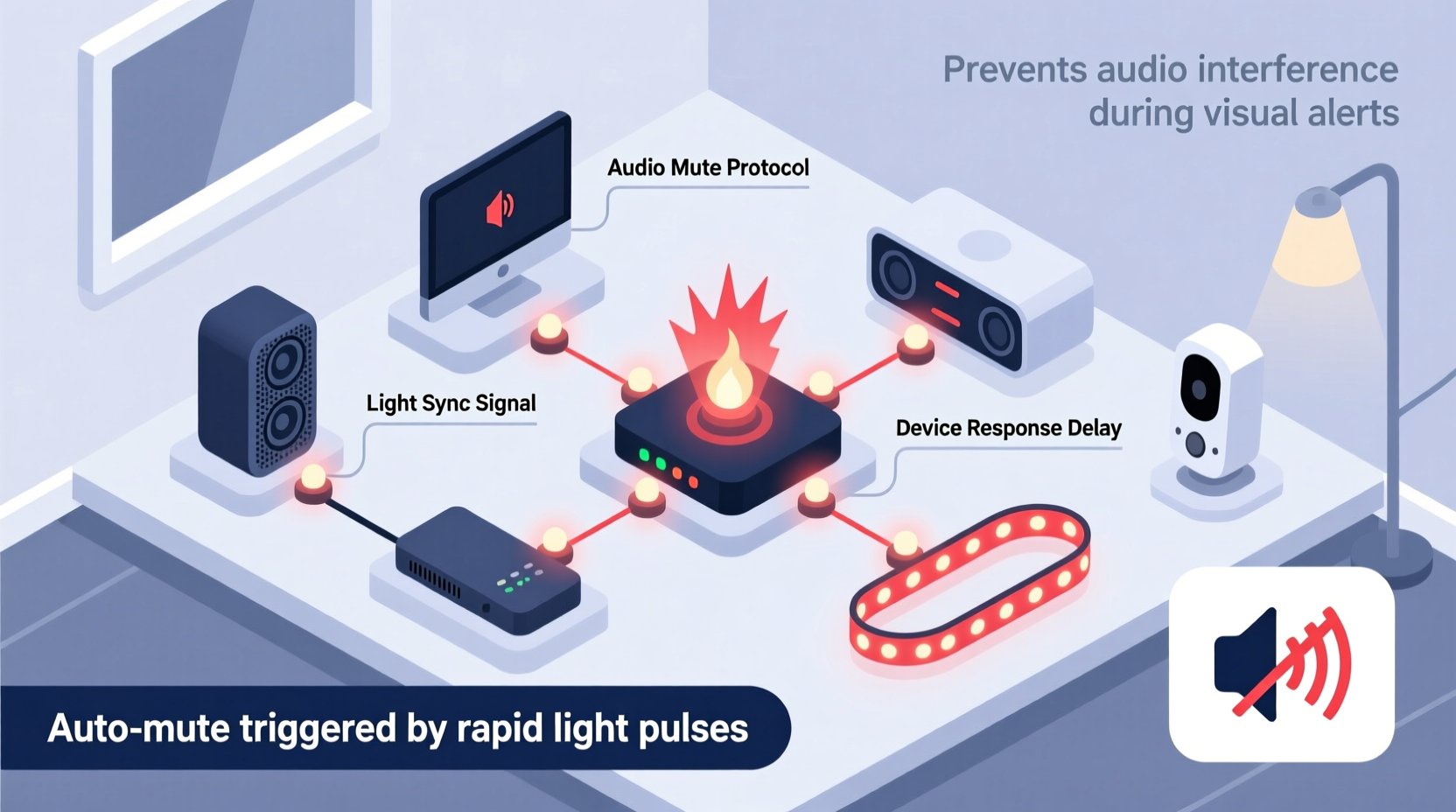
Most modern smart home platforms—including Apple HomeKit, Google Home, Amazon Alexa, and Samsung SmartThings—implement a feature called audio ducking. This isn’t exclusive to music apps; it’s a system-level behavior designed to ensure critical auditory information is never drowned out. When lights flash in patterns associated with alarms (e.g., fire, carbon monoxide, security breach), the platform interprets those flashes as high-priority events. In response, it automatically lowers or mutes background audio—including streaming services, podcasts, and even white noise machines—to prevent masking spoken alerts, siren tones, or voice assistant responses.
This behavior originates from WCAG (Web Content Accessibility Guidelines) and ADA-aligned design principles. Flashing lights often serve users who are deaf or hard of hearing, while audible alerts serve those with visual impairments. Audio ducking ensures both modalities remain effective simultaneously. As Dr. Lena Torres, Senior Accessibility Architect at the Consumer Technology Association, explains:
“Smart home systems don’t ‘choose’ between sight and sound—they orchestrate them. When a light sequence signals urgency, suppressing competing audio isn’t suppression—it’s prioritization. It’s the digital equivalent of dimming overhead lights before delivering a verbal emergency briefing.” — Dr. Lena Torres, Senior Accessibility Architect, Consumer Technology Association
Crucially, this ducking can trigger even if no actual alarm is active—especially when automations replicate emergency lighting patterns (e.g., “flash red 3x on motion” or “pulse blue every 2 seconds during door unlock”). The system sees the pattern, not the intent.
Automation Conflicts: When Scenes Override Your Audio Intent
Many users unknowingly create conflicting automation hierarchies. Consider this common setup: a “Goodnight” scene turns off lights, locks doors, and starts a sleep soundscape—and a separate “Security Alert” scene triggers flashing lights and chimes. If both scenes share overlapping triggers (e.g., a door sensor tripping after 10 p.m.), the system may execute them in rapid succession, causing the lighting command to interrupt the audio stream.
Worse, some platforms process automations asynchronously but apply audio controls synchronously—meaning the mute command from the lighting action fires *after* the audio has already started playing, resulting in a jarring cutoff rather than a fade-out.
Platform-Specific Behaviors: A Comparative Breakdown
Different ecosystems handle audio-light interactions with distinct logic and thresholds. Below is a comparison of how major platforms interpret and respond to flashing light commands:
| Platform | Triggers Audio Ducking | Duration of Mute | Override Options |
|---|---|---|---|
| Apple HomeKit | Any light with EmergencyLighting characteristic activated (including custom HomeKit Secure Video alerts) |
Until light returns to steady state OR 90 seconds max | Disabled only via Shortcuts app using “Set Volume” action post-flash; requires iOS 17.4+ and HomePod mini (2nd gen) or later |
| Amazon Alexa | Flashing enabled via Routines (e.g., “Flash lights when doorbell rings”) + simultaneous audio playback | Mutes instantly; resumes after final flash ends (no grace period) | Can be disabled per Routine under “Advanced options” > “Don’t mute audio during this routine” |
| Google Home | Only during verified emergency events (e.g., Nest Guard alarm, smoke detector integration); ignores user-created flash sequences | Resumes within 5 seconds of event clearance | No user-facing toggle—requires disabling emergency device integrations to bypass |
| Samsung SmartThings | Any light set to “Strobe” or “Alarm” mode via Device Handler or Edge Driver | Persistent until strobe stops or manual volume restore | Requires custom Edge driver modification or third-party app (e.g., SharpTools.io) to decouple audio control |
Note: Third-party hubs like Hubitat and Home Assistant behave differently—they don’t enforce ducking by default unless explicitly programmed. That flexibility comes with responsibility: misconfigured rules here cause more subtle, harder-to-diagnose interruptions.
Real-World Case Study: The “Party Mode” Paradox
In Portland, Oregon, Sarah K., a UX researcher and smart home enthusiast, spent three weeks troubleshooting why her Sonos system muted every time her Philips Hue lights pulsed during a custom “Dance Floor” routine. She’d configured six Hue bulbs to flash in sync with bass drops using IFTTT and a BPM-sensing web app. Each flash triggered a 0.8-second mute—even though no alarm was present.
Her investigation revealed two overlooked factors: First, IFTTT’s Hue integration sent each flash command as a discrete “emergency strobe” API call (a legacy behavior from early Hue firmware). Second, her Home Assistant hub—running an outdated Edge driver—interpreted all rapid-fire setEffect(\"strobe\") calls as security-mode activation, triggering its built-in audio suppression module.
Sarah resolved it in stages: she replaced IFTTT with Home Assistant’s native Hue integration, added a 150ms delay between flash commands, and updated her driver to version 2.5.2, which introduced configurable strobe sensitivity. Total resolution time: 47 minutes of targeted configuration—not hardware replacement.
Step-by-Step Diagnostic & Resolution Protocol
Follow this actionable sequence to isolate and eliminate unwanted muting—without disabling safety features:
- Reproduce the trigger precisely. Note exact timing: Does muting happen on first flash? After third pulse? Within 200ms of light state change?
- Check your automation logs. In Home Assistant: Settings > System > Logs > Enable debug logging for light.* and media_player.*. In Apple Home: Open Shortcuts app > tap “My Automations” > select relevant automation > scroll to “Log” section.
- Isolate the platform layer. Temporarily disable third-party integrations (e.g., IFTTT, Stringify, Homebridge plugins). Test with native app controls only.
- Verify light device capabilities. Some bulbs (e.g., older LIFX models, certain Govee strips) report “strobe” as a supported effect—even when firmware doesn’t actually implement it safely. Check manufacturer docs for “emergency mode” flags.
- Implement graceful volume transitions. Replace mute commands with dynamic volume scaling: e.g., instead of “mute,” use “set volume to 10% for duration of flash sequence,” then “restore to 75%.” Most platforms support this via scripting or advanced routines.
- Test with non-music audio. Play a podcast or weather alert. If muting persists, the issue is system-wide ducking—not Spotify-specific. If only music apps mute, check individual app permissions (e.g., Spotify’s “Pause on Interruption” setting).
Do’s and Don’ts for Conflict-Free Lighting & Audio Coexistence
- DO use dedicated “ambient” or “mood” light groups for non-critical animations (e.g., “Living Room Mood Lights”)—and reserve “Alert” or “Security” groups strictly for verified emergencies.
- DO configure flash duration and intervals above platform-defined emergency thresholds (e.g., avoid pulses faster than 2Hz or shorter than 100ms unless intentionally simulating alarms).
- DO label automations clearly: “Kitchen Flash – Motion Alert (Audio Ducking Enabled)” vs. “Kitchen Flash – Party Mode (Audio Preserved)”.
- DON’T use generic “flash all lights” commands in multi-room setups—this forces ducking on devices not involved in the event.
- DON’T rely on voice assistants to “unmute”—they often re-trigger the same conflict loop when asked to resume playback.
- DON’T disable emergency ducking globally. Instead, segment your environment: keep ducking active in bedrooms and hallways, but disable it in dedicated entertainment zones via location-based rules.
FAQ
Can firmware updates cause this behavior to appear suddenly?
Yes—especially after major OS upgrades (e.g., iOS 17.2, Android 14 QPR2, or SmartThings v2024.1). Platform vendors frequently tighten emergency protocol compliance to meet new regulatory standards (like EU’s Radio Equipment Directive 2022/2380). If muting began after an update, check release notes for “enhanced audio ducking” or “emergency lighting prioritization” language.
Why does my Bluetooth speaker mute but my Chromecast Audio doesn’t?
Because audio ducking operates at the platform abstraction layer, not the physical output layer. Bluetooth speakers connect directly to the controlling device (phone/tablet/hub) and inherit its ducking policy. Chromecast Audio uses Google’s Cast protocol, which handles audio interruption independently—and only ducks for verified Google Nest or Pixel-integrated alerts, not generic light flashes.
Is there a way to get notified when ducking occurs?
Not natively—but Home Assistant users can create a binary sensor that triggers on media_player.*.state == 'paused' coinciding with light.*.effect == 'strobe', then log or push a notification. Apple Shortcuts can’t detect mute state directly, but you can build a “volume snapshot” routine that runs pre-flash and restores post-flash—effectively creating an audit trail.
Conclusion
Your smart home isn’t malfunctioning—it’s interpreting your lighting commands through a lens of safety, accessibility, and layered intent. That sudden silence isn’t a failure of technology; it’s evidence of thoughtful architecture trying to protect you, even when you don’t realize protection is needed. The real mastery lies not in disabling these safeguards, but in designing around them: choosing precise triggers, grouping devices by function, respecting platform thresholds, and treating audio and light as interdependent channels—not competing features. With the diagnostic steps, platform-specific insights, and coexistence strategies outlined here, you now hold the tools to transform disruptive muting into seamless, intentional harmony. Your home shouldn’t choose between atmosphere and awareness—it should deliver both, elegantly and reliably.




 浙公网安备
33010002000092号
浙公网安备
33010002000092号 浙B2-20120091-4
Comments
No comments yet. Why don't you start the discussion?