
It’s a familiar holiday frustration: you’ve carefully arranged your outdoor display, scheduled your smart plug to power up at dusk—and with a sharp click, the entire circuit goes dark. The breaker has tripped. You reset it, try again, and within seconds, it trips once more—especially when the lights first ignite. This isn’t random failure or faulty hardware. It’s physics meeting outdated infrastructure—and it’s far more predictable (and fixable) than most homeowners realize.
Smart plugs themselves rarely cause breaker trips. Instead, they act as the messenger—revealing an underlying electrical mismatch between what your lights demand, what your circuit can safely supply, and how modern LED strings behave in real-world conditions. Understanding this dynamic is essential—not just for restoring your holiday lights, but for preventing overheating, reducing fire risk, and avoiding damage to both your smart devices and your home’s wiring.
How Smart Plugs Interact With Electrical Loads
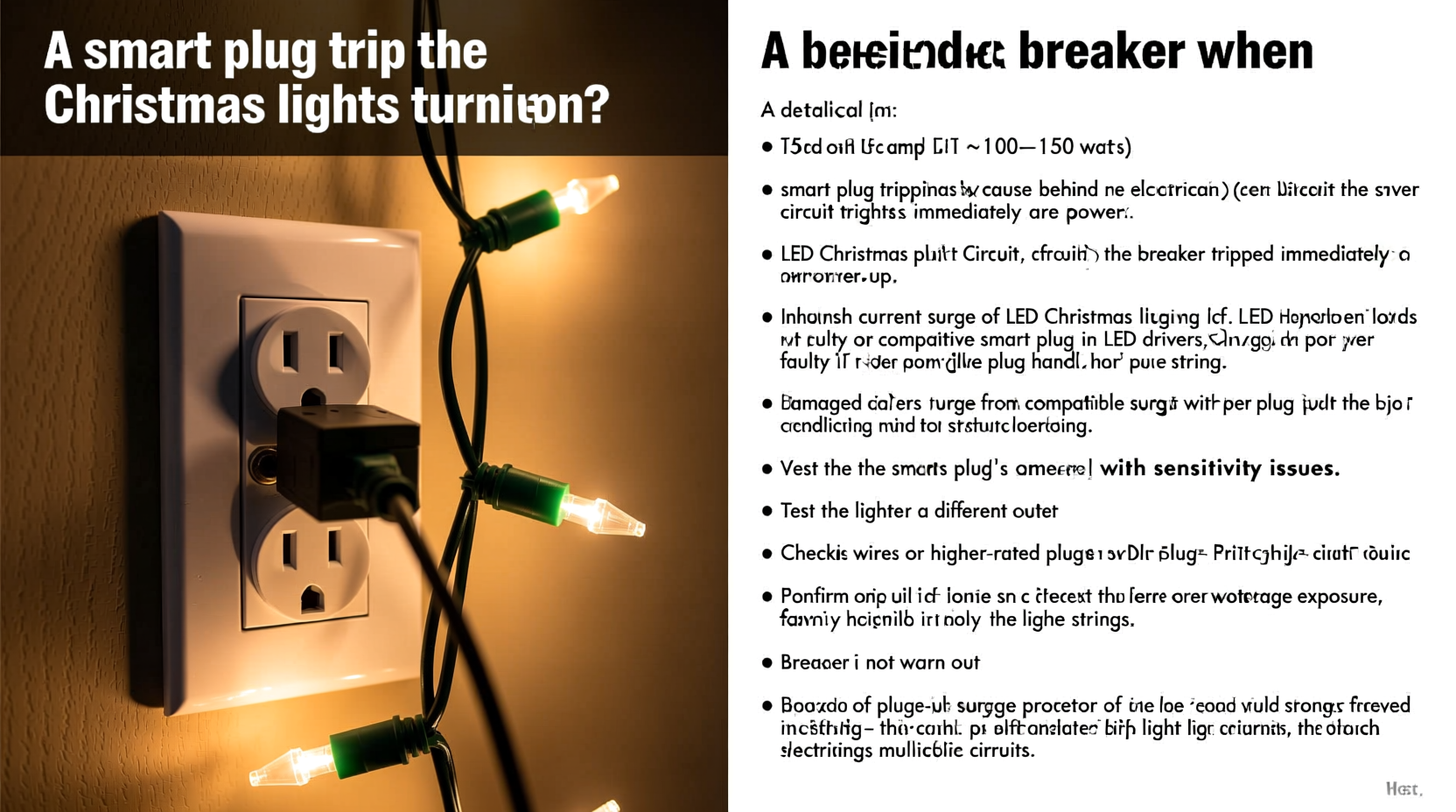
A smart plug is fundamentally a remotely controlled switch with built-in current monitoring. Unlike a basic mechanical switch, it measures amperage flowing through its internal relay and may shut off automatically if it detects sustained overloads—or simply pass through the overload until the upstream circuit breaker reacts. Most residential smart plugs are rated for 15 amps (1,800 watts at 120V), matching standard U.S. branch circuits. But that rating assumes ideal conditions: steady-state load, clean power, and no inrush spikes.
Christmas light strings—especially older incandescent sets or even some budget LED models—generate a brief but intense surge of current known as inrush current when first powered. This spike can be 5–10 times higher than the normal operating current and lasts only milliseconds. While breakers are designed to tolerate short surges, repeated or stacked inrush events across multiple strings—especially when triggered simultaneously by a smart plug’s timed activation—can push a marginal circuit past its thermal-magnetic threshold.
The Real Culprits: Five Common Causes
Breaker tripping isn’t caused by one single flaw—it’s usually the result of layered vulnerabilities. Below are the five most frequent contributors, ranked by prevalence in post-2015 homes:
- Circuit Overload (Most Common): Your outlet shares a 15-amp circuit with other loads—refrigerator compressors, garage door openers, or even Wi-Fi routers—that draw power intermittently. When lights activate, the combined load exceeds 15A.
- Inrush Current Stacking: Multiple light strings wired in series or daisy-chained into one smart plug create cumulative inrush spikes. Even if each string draws under 1A normally, their simultaneous startup overwhelms the breaker’s instantaneous trip curve.
- Diminished Breaker Sensitivity: Breakers degrade over time. A 20-year-old thermal-magnetic breaker may trip at 13.5A instead of 15A due to spring fatigue and contact wear—making it hypersensitive to minor surges.
- Ground Fault or Moisture Intrusion: Outdoor outlets, extension cords, or light strings exposed to rain or condensation can develop low-level ground faults. These don’t always trigger a GFCI—but they increase leakage current, heating the breaker’s bimetallic strip and lowering its effective trip threshold.
- Smart Plug Relay Limitations: Some budget smart plugs use undersized relays or lack robust arc-fault suppression. Repeated high-inrush cycling causes micro-welding on contacts, increasing resistance, heat buildup, and eventual thermal shutdown—or worse, arcing that stresses the circuit.
Diagnosing the Issue: A Step-by-Step Load Audit
Before replacing hardware or calling an electrician, perform this 10-minute audit to isolate the root cause. No tools required beyond a pen, paper, and your smartphone.
- Identify the Circuit: Turn off the tripped breaker. Test every outlet and light on that circuit using a lamp or phone charger. Map which rooms and devices share the same breaker.
- List All Connected Loads: Note all permanently wired devices (garbage disposal, dishwasher, HVAC blower) and plug-in loads (coffee maker, space heater, entertainment center). Estimate wattage using nameplate labels or online databases (e.g., ENERGY STAR product database).
- Calculate Total Steady-State Load: Convert all wattages to amps using A = W ÷ V. At 120V, a 1,200W heater draws 10A; a 60W LED string draws 0.5A. Sum all loads—including your lights.
- Test Inrush Behavior: Plug in only *one* light string to the smart plug. Power it on manually (bypassing scheduling). If the breaker holds, add a second string. Continue until it trips. Note the exact number of strings that triggers failure.
- Isolate Timing: Use your smart plug’s app to set lights to turn on 5 seconds apart instead of simultaneously. If the breaker no longer trips, inrush stacking is confirmed.
This process reveals whether you’re dealing with chronic overload (step 3 sum > 12A), inrush sensitivity (step 4 fails at low string count), or timing-dependent interaction (step 5 success).
Do’s and Don’ts: Safe Holiday Lighting Practices
Many well-intentioned habits actually increase risk. The table below distills National Fire Protection Association (NFPA) 101 and Underwriters Laboratories (UL) guidance for residential holiday lighting:
| Action | Do | Don’t |
|---|---|---|
| Outlet Use | Use only GFCI-protected outdoor outlets rated for wet locations. Verify GFCI test/reset buttons function monthly. | Plug into indoor-only outlets, ungrounded two-prong outlets, or power strips not rated for outdoor/dimmable loads. |
| String Connections | Follow manufacturer’s maximum string count limit (e.g., “connect up to 3 sets end-to-end”). Use UL-listed connectors. | Daisy-chain more than the labeled limit—even if they “fit.” Never splice wires with tape or wire nuts outdoors. |
| Smart Plug Deployment | Use smart plugs rated for inductive loads (look for “motor load” or “high inrush” certification). Place them *upstream* of extension cords—not at the end of a 100-ft cord. | Use generic smart plugs marketed for “smart home” without verifying electrical ratings. Avoid plugging multiple smart plugs into one power strip. |
| Cord Management | Elevate cords off wet grass or snow using plastic hooks or conduit. Inspect for cracks, fraying, or exposed copper before each season. | Run cords under rugs, through doorways, or beneath furniture where they’ll be pinched or abraded. |
Real-World Case Study: The Suburban Porch Cascade
Mark, a homeowner in Ohio, experienced repeat tripping every December for three years. His setup included: one 15-amp circuit powering the front porch, garage opener, and two exterior outlets; eight 25-foot LED light strings (each rated 48W/0.4A); a $25 smart plug; and a 50-ft heavy-duty extension cord.
His audit revealed the issue wasn’t the lights’ steady draw (8 × 0.4A = 3.2A) but timing and hidden load. The garage door opener cycled its motor every 8–12 minutes—and its 6A inrush coincided with his smart plug’s 5 p.m. schedule. Combined with the lights’ 3A inrush spike, total instantaneous demand hit 9.2A. That was within spec—until he added a new Wi-Fi mesh node near the breaker panel. Its 0.8A standby draw raised the baseline load to 12.4A. Now, the 9.2A spike pushed the circuit to 21.6A peak—well above the breaker’s 15A thermal limit.
Mark fixed it in one afternoon: he moved the Wi-Fi node to a different circuit, replaced the smart plug with a model certified for 20A inductive loads, and staggered light activation by 3 seconds per string. No rewiring. No electrician. Trips ceased immediately.
“Modern holiday lighting doesn’t fail because it’s ‘too powerful’—it fails because we treat electricity like water pressure instead of a dynamic system with inertia, resistance, and timing dependencies. A breaker trip is your home’s most honest diagnostic tool.” — Carlos Mendez, PE, Senior Electrical Inspector, International Association of Electrical Inspectors (IAEI)
FAQ: Quick Answers to Critical Questions
Can I replace my 15-amp breaker with a 20-amp one to fix this?
No—and doing so is dangerous. Breaker amperage must match the wire gauge in your walls. Standard 14-gauge NM-B cable (used in most 15-amp circuits) can safely carry only 15 amps. A 20-amp breaker on 14-gauge wire creates a fire hazard, as the wire will overheat before the breaker trips. Upgrading requires rewiring with 12-gauge cable and professional inspection.
Why do my lights trip the breaker only when it’s cold outside?
Cold temperatures increase the resistance of copper wiring slightly—but more critically, they thicken lubricants in older breakers and stiffen internal springs. This reduces the breaker’s ability to absorb brief surges. Additionally, moisture condenses inside outdoor outlets when temperatures swing, creating micro-shorts that elevate leakage current. Always use weatherproof covers rated for freezing conditions.
Are “smart” LED lights safer than traditional smart-plug setups?
Not inherently. Integrated smart lights (like Wi-Fi-enabled string lights) still draw inrush current—and many use lower-grade internal drivers that generate more electrical noise. Their advantage is granular control: you can fade lights on over 2 seconds instead of snapping them on instantly, eliminating inrush entirely. But they don’t reduce total circuit load. Prioritize load management over device type.
Conclusion: Take Control—Not Just Convenience
Your smart plug isn’t the problem. It’s the first piece of technology in your home to make invisible electrical stress visible. Every trip is data—a signal that your holiday cheer is running up against physical limits: aging breakers, shared circuits, misunderstood inrush behavior, or overlooked moisture paths. Fixing it isn’t about buying more gadgets; it’s about applying deliberate, informed choices—staggering activation, auditing loads, selecting properly rated hardware, and respecting the physics of alternating current.
Start tonight. Pull up your breaker panel. Map one circuit. Calculate the real load—not the label, not the marketing, but the actual amps flowing when your coffee maker kicks on *and* your lights ignite. That 10 minutes of attention prevents next year’s frustration, protects your home’s integrity, and transforms your smart plug from a point of failure into a tool of precision control.




 浙公网安备
33010002000092号
浙公网安备
33010002000092号 浙B2-20120091-4
Comments
No comments yet. Why don't you start the discussion?