
Smart speakers have transformed the way we interact with technology at home. From setting alarms to controlling lights, these devices are designed to respond seamlessly to voice commands. But when your smart speaker starts echoing your voice—repeating your words back in a robotic tone or triggering unintended responses—it can quickly shift from helpful assistant to frustrating distraction. This phenomenon, sometimes referred to as \"glitch mode,\" is more common than users realize and often stems from misconfigured settings, environmental interference, or firmware bugs. Understanding the root causes and knowing how to resolve them ensures you get the most out of your device without disruptive audio loops.
Understanding Voice Echo: What’s Happening?
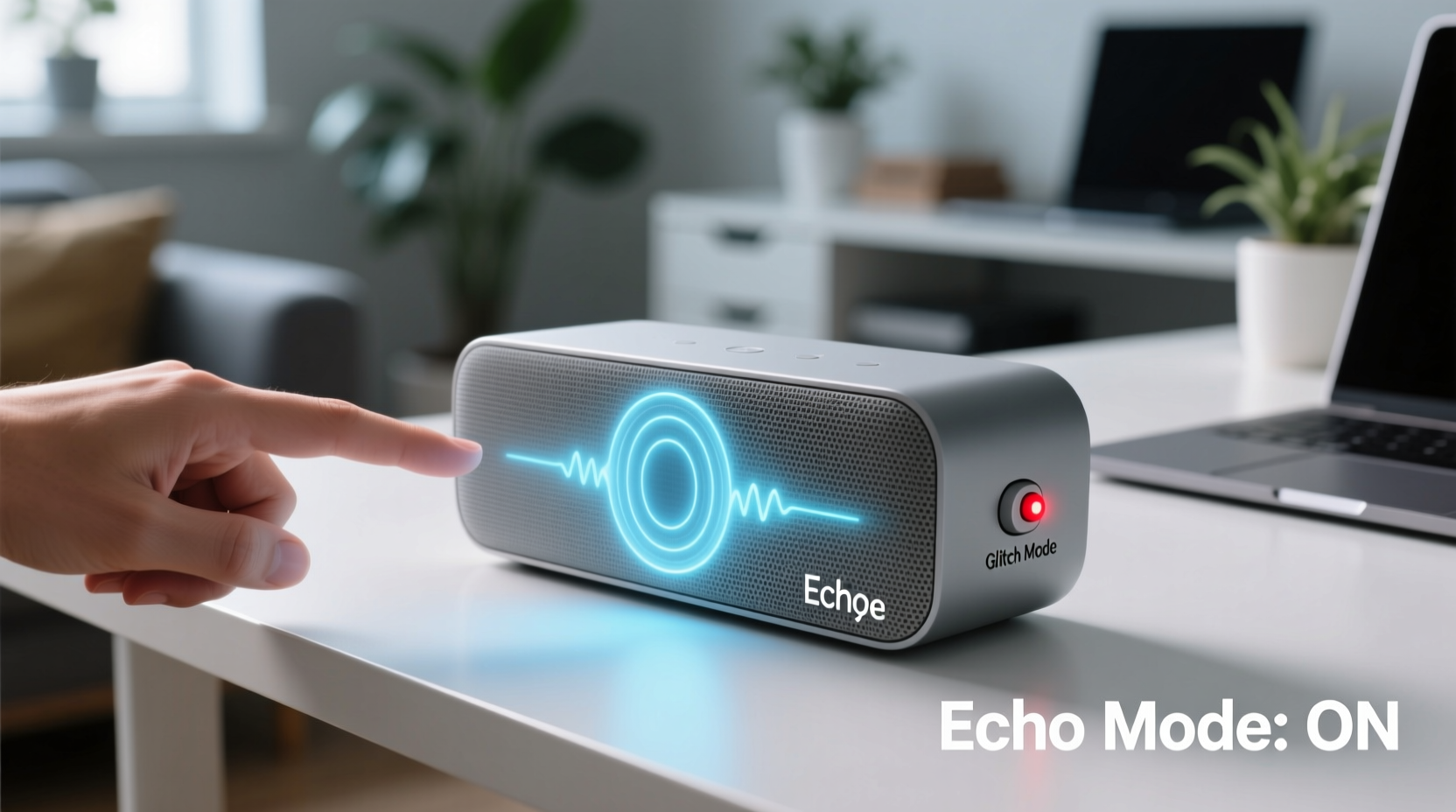
Voice echo occurs when a smart speaker captures your speech through its microphone, processes it, and then plays it back—either as part of a response or due to an unintended loop. This isn’t always a hardware defect; more often, it's the result of software behavior interacting poorly with its environment. Most smart speakers use far-field microphones designed to pick up voices from across a room. When sound reflects off walls, glass, or hard surfaces, the microphone may interpret delayed reflections as new input, especially if background noise confuses the wake-word detection system.
In some cases, the speaker repeats phrases because it believes it’s responding appropriately. For example, saying “Alexa” near an Amazon Echo might trigger the device, but if ambient noise causes multiple false activations, the speaker could begin repeating partial phrases or generating garbled output that sounds like an echo. Google Nest and Apple HomePod devices exhibit similar behaviors under certain conditions.
“Echoing is rarely about the speaker malfunctioning—it’s usually about context. The device hears what it thinks is a command and responds accordingly.” — Dr. Lena Patel, Audio Systems Engineer at MIT Media Lab
Common Causes of Smart Speaker Echo
Before attempting fixes, it’s important to identify what’s causing the echo. Not all instances stem from the same source. Below are the most frequent culprits:
- False Wake Word Detection: Background TV, radio, or even someone mentioning “Alexa,” “Hey Google,” or “Hey Siri” can activate the device unintentionally.
- Acoustic Feedback Loops: If two smart speakers are placed too close together, one may pick up the other’s output and reprocess it, creating a chain reaction.
- Firmware Glitches: Outdated or corrupted firmware can cause erratic behavior, including repeated voice playback or unresponsive controls.
- Noisy Environments: High ambient noise forces microphones to increase sensitivity, increasing the chance of misinterpreting sounds as commands.
- App or Account Sync Errors: Miscommunication between the companion app (e.g., Alexa app, Google Home) and the device can lead to abnormal operation modes.
Step-by-Step Guide to Disable Glitch Mode
When your smart speaker enters what users commonly call “glitch mode”—characterized by repetitive responses, random chimes, or continuous listening indicators—a systematic reset process can restore normal function. Follow these steps carefully:
- Disable Microphone Temporarily: Press the physical microphone mute button (usually marked with a red light). This stops all voice input immediately and breaks any ongoing feedback loop.
- Restart the Device: Unplug the speaker from power for at least 30 seconds, then plug it back in. Wait for the startup chime or light sequence.
- Check for Firmware Updates: Open your smart speaker’s companion app (e.g., Alexa, Google Home), navigate to device settings, and ensure the latest firmware is installed.
- Reconfigure Wake Word Sensitivity: In the app settings, adjust the wake word detection level. Lower sensitivity reduces false triggers in noisy environments.
- Remove and Re-add the Device: If problems persist, delete the speaker from your account via the app, then set it up again as a new device. This clears configuration errors.
- Factory Reset: As a last resort, perform a factory reset using the method specific to your model (often involves holding a button for 15+ seconds).
This sequence addresses both temporary glitches and deeper software conflicts. After completing these steps, test the speaker with simple commands in a quiet space to confirm stability.
Do’s and Don’ts: Preventing Future Echo Issues
Maintaining consistent performance requires proactive habits. The table below outlines key actions to adopt—and those to avoid—to minimize the risk of recurring echo problems.
| Do’s | Don’ts |
|---|---|
| Place speakers away from reflective surfaces like mirrors or large windows. | Don’t place multiple smart speakers directly opposite each other. |
| Use rugs, curtains, or soft furnishings to dampen sound reflections. | Don’t rely solely on digital volume controls—physical placement matters. |
| Regularly update device firmware through the companion app. | Don’t ignore persistent error lights or unusual beeping patterns. |
| Test microphone sensitivity monthly, especially after app updates. | Don’t shout at the device—this increases distortion and feedback risk. |
| Enable voice confirmation only when necessary to reduce verbal feedback. | Don’t leave the microphone unmuted overnight unless needed. |
Tips for Optimizing Smart Speaker Placement
Physical positioning plays a critical role in preventing echo. Even high-end models struggle in acoustically challenging rooms. Consider these optimization strategies:
- Position the speaker at ear level when seated, typically on a shelf or side table, rather than on the floor or inside a cabinet.
- Avoid corners, where sound waves converge and amplify, increasing the chance of self-triggering.
- Keep at least 12 inches of clearance around the device to allow proper airflow and microphone access.
- If using multiple units, stagger their locations across different rooms instead of clustering them in one area.
- Face the speaker toward the primary interaction zone (e.g., couch or kitchen island) while keeping it away from TVs or stereos.
Mini Case Study: Echo Loop in a Multi-Speaker Home
Mark, a homeowner in Portland, installed four Amazon Echo Dots throughout his house—one in each bedroom and one in the living room. After a few weeks, he noticed that asking Alexa to turn on the living room lights would sometimes trigger a delayed response from the upstairs unit, followed by a robotic repetition of his original request. The issue worsened at night when background music played.
Upon investigation, Mark realized the upstairs and downstairs speakers were picking up each other’s audio outputs. By adjusting the wake word sensitivity to “low” in the Alexa app and relocating the upstairs Dot away from the stairwell (a natural sound channel), the echoing stopped. He also enabled routines to automatically mute non-essential speakers during media playback. Within days, voice interactions became reliable again.
This case illustrates how easily acoustic coupling can disrupt smart speaker functionality—even in technically sound setups. Simple environmental adjustments often yield better results than complex technical interventions.
Checklist: Fixing and Preventing Voice Echo
Use this checklist to troubleshoot and maintain your smart speaker’s performance:
- ✅ Mute the microphone during loud gatherings or movie nights
- ✅ Restart the device weekly to clear memory caches
- ✅ Check for firmware updates monthly
- ✅ Position speakers at least 6 feet apart in open spaces
- ✅ Use fabric-covered surfaces near speaker zones to absorb sound
- ✅ Disable unnecessary voice prompts in app settings
- ✅ Perform a factory reset if glitch mode persists after basic troubleshooting
- ✅ Monitor LED indicators for unusual blinking patterns
Frequently Asked Questions
Why does my smart speaker repeat what I say?
Your speaker may be experiencing false wake word detection, where background noise or voice-like sounds trigger activation. It then attempts to respond, sometimes echoing fragments of speech. Adjusting microphone sensitivity or muting during high-noise periods can prevent this.
Can software updates cause echo issues?
Yes. Occasionally, firmware updates introduce bugs that affect voice processing. If echo begins immediately after an update, check online forums for known issues and wait for a patch—or roll back settings via a factory reset if supported.
Is it safe to leave my smart speaker unmuted all the time?
While convenient, leaving the microphone active continuously increases privacy risks and the likelihood of accidental activations. Experts recommend muting when not in use, especially during private conversations or media playback.
Conclusion: Regain Control of Your Smart Speaker Experience
Voice echo and glitch mode don’t have to be permanent annoyances. With a clear understanding of how smart speakers interpret sound and react to their surroundings, most issues are preventable or easily corrected. The key lies in balancing technology with environment—optimizing placement, maintaining updated software, and applying sensible usage habits. Whether you’re dealing with a single rogue Echo or managing a multi-room setup, the solutions are within reach. Take control today by reviewing your current configuration, applying the fixes outlined here, and enjoying a smoother, echo-free smart home experience.




 浙公网安备
33010002000092号
浙公网安备
33010002000092号 浙B2-20120091-4
Comments
No comments yet. Why don't you start the discussion?