
It’s a familiar scene: you blend a vibrant, nutrient-packed smoothie—rich with greens, fruit, protein, and healthy fats—and set it down for just five minutes. When you return, the liquid has pooled at the bottom, a thick layer of pulp floats on top, and the once-uniform mixture looks more like a science experiment than a breakfast solution. This separation isn’t a sign of failure—it’s physics. Understanding the science behind it empowers you to create smoother, more stable blends that hold their form from first sip to last.
The Science of Smoothie Separation
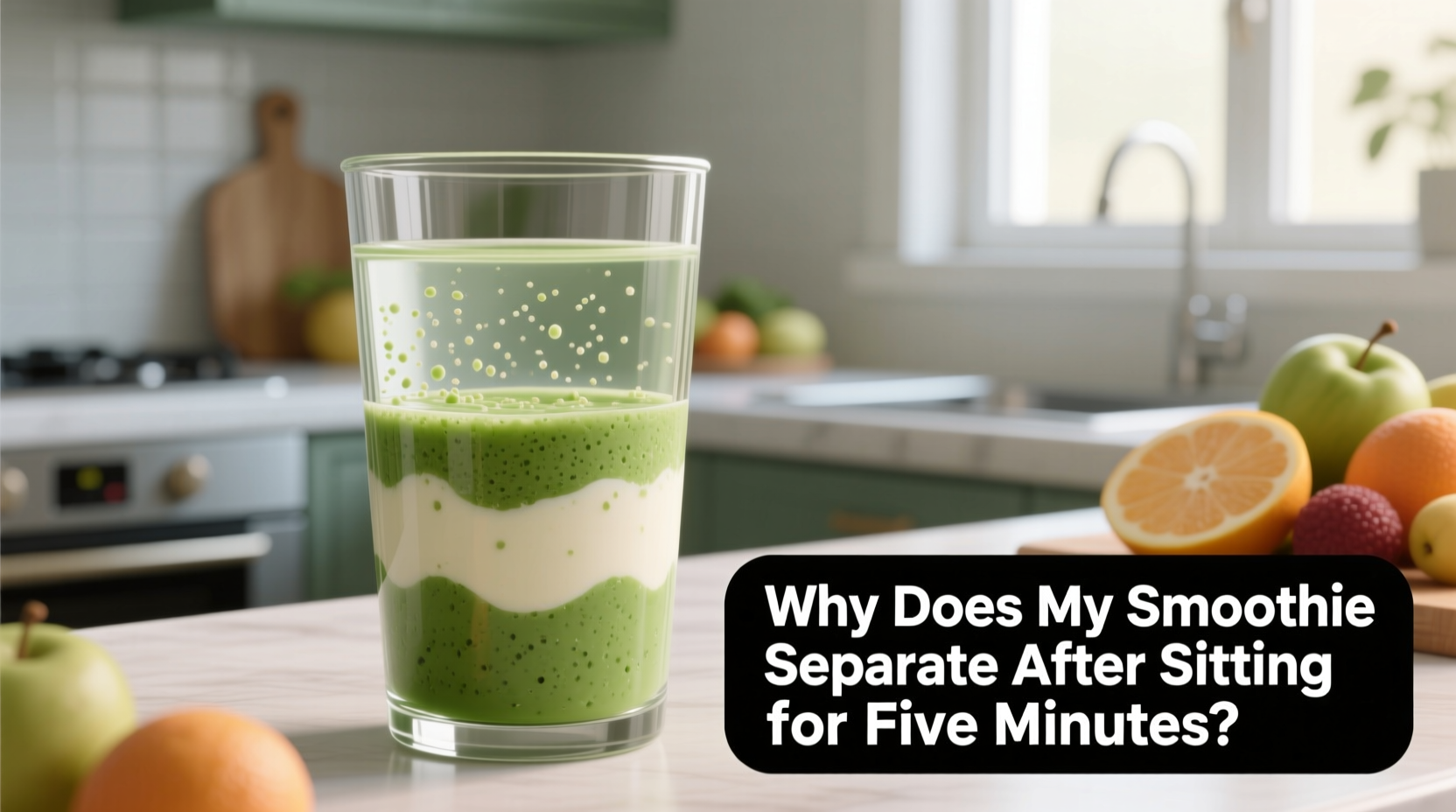
Smoothie separation is fundamentally a result of differences in density, solubility, and emulsification. When ingredients are combined, they don’t always bond permanently. Instead, gravity pulls heavier components downward while lighter ones rise. Water-based liquids like almond milk or orange juice sink below fibrous matter such as spinach or banana chunks. Oils from nut butters or chia seeds may float to the surface, forming an oily sheen.
This process, known as sedimentation and creaming, occurs because most smoothies are not true emulsions. An emulsion is a stable mixture of two immiscible substances—like oil and water—held together by an emulsifier. Without one, phases separate over time. Unlike commercial products that use gums, lecithin, or stabilizers, homemade smoothies rely on natural ingredients, which vary widely in their ability to stay blended.
“Homemade smoothies are inherently unstable due to ingredient variability and lack of industrial emulsifiers. Separation is normal—but manageable.” — Dr. Lena Torres, Food Scientist, University of California, Davis
Key Factors That Cause Separation
Several variables influence how quickly and severely your smoothie separates. Recognizing these allows for targeted adjustments.
1. Ingredient Density Differences
Denser ingredients like frozen berries, bananas, or protein powder settle faster than lighter liquids such as coconut water or yogurt. The greater the contrast in weight between components, the quicker separation occurs.
2. Lack of Emulsifiers
Natural emulsifiers help bind oil and water molecules. Common kitchen emulsifiers include egg yolks (not typical in smoothies), mustard, honey, and certain seeds. Chia, flax, and hemp seeds release mucilage when blended—a gel-like substance that helps stabilize mixtures. Without them, oils from nuts or avocado can break free and rise.
3. Fiber Content and Particle Size
Fiber-rich ingredients like kale, oats, or psyllium husk absorb liquid and expand, creating suspension. However, if the blender isn’t powerful enough to break down cell walls, large fiber particles trap air and float, contributing to layering. A high-speed blender reduces particle size, improving homogeneity.
4. Temperature and Viscosity
Cold ingredients slow molecular movement, temporarily delaying separation. But viscosity—the thickness of the liquid—is more critical. Thicker smoothies resist separation longer because suspended particles move slower through dense mediums. Adding thickeners like Greek yogurt, avocado, or oats increases viscosity naturally.
How to Prevent or Minimize Smoothie Separation
You can’t eliminate separation entirely without artificial stabilizers, but you can significantly delay it with smart formulation and technique.
Choose Ingredients Strategically
Prioritize ingredients that contribute both nutrition and stability:
- Chia or flax seeds: Soak one tablespoon in 3 tablespoons of water for 10 minutes before blending to form a gel that acts as a natural binder.
- Oats or cooked quinoa: Add body and absorb excess liquid, reducing sloshing and settling.
- Bananas or avocado: Provide creaminess and fat content that integrates better with liquids when fully pureed.
- Yogurt or kefir: Contain proteins and lactic acid that improve texture and emulsification.
Optimize Your Blending Technique
The order in which you add ingredients affects consistency. Follow this sequence:
- Liquid base (water, milk, juice)
- Soft ingredients (greens, yogurt, soft fruit)
- Frozen or hard items (ice, frozen fruit, nuts)
Starting with liquids ensures even distribution and prevents blade jamming. Blend on high for at least 45–60 seconds to achieve maximum homogenization. Pause and scrape the sides if needed.
Incorporate Natural Stabilizers
Beyond chia and flax, consider:
- Lecithin granules: A soy or sunflower-derived emulsifier that prevents oil separation. Use ½ teaspoon per smoothie.
- Pectin: Found naturally in apples and citrus peels; adding apple sauce or lemon juice slightly boosts pectin levels.
- Xanthan gum: A small pinch (⅛ tsp) dramatically increases viscosity and prevents settling. Use sparingly—it’s potent.
Step-by-Step Guide to a Stable Smoothie
Follow this timeline to make a smoothie that stays blended for up to 30 minutes—even when left unattended.
- Prep (5 minutes): Soak chia or flax seeds in part of your liquid base. If using oats, pre-soak or use instant varieties.
- Add Liquids First (1 minute): Pour in ¾ of your liquid (e.g., almond milk). Reserve some to adjust consistency later.
- Blend Greens (1 minute): Add spinach, kale, or herbs and blend until completely smooth—no flecks visible.
- Add Soft Ingredients (1 minute): Include banana, yogurt, nut butter, soaked seeds, and any powders (protein, spirulina).
- Add Frozen Components (2 minutes): Drop in ice or frozen fruit. Blend on high until creamy, stopping to scrape sides.
- Adjust & Final Blend (1 minute): Add remaining liquid if too thick. Blend again for 30 seconds to re-integrate.
- Serve Immediately or Store Properly: If not drinking right away, store in a sealed jar and shake vigorously before consuming.
Do’s and Don’ts: Smoothie Stability Table
| Do | Don’t |
|---|---|
| Use a high-speed blender for finer particle breakdown | Use a low-powered blender that leaves chunks |
| Soak chia, flax, or oats before blending | Add dry seeds directly without soaking |
| Layer ingredients in the correct order | Dump everything in randomly |
| Include a natural emulsifier like lecithin or avocado | Rely solely on water and fruit with no binding agents |
| Shake or stir before drinking if stored | Assume it’s ruined if layers form |
Real Example: From Sloppy to Stable
Sophie, a busy nurse in Portland, used to make green smoothies every morning but abandoned them after constant separation made them unappetizing by lunchtime. Her original recipe was simple: spinach, frozen mango, water, and a scoop of plant-based protein. Within minutes, the protein settled like concrete at the bottom.
After consulting a nutritionist, she revised her method. She began blending spinach with unsweetened oat milk first, added a tablespoon of pre-soaked chia seeds, replaced water with thicker liquid, and included half a banana for creaminess. She also upgraded to a high-performance blender. Now, her smoothies remain well-mixed for over 20 minutes—even during shift changes. “I don’t dread opening my bottle anymore,” she says. “It looks as good as when I made it.”
FAQ: Common Questions About Smoothie Separation
Is a separated smoothie still safe to drink?
Yes. Separation is a physical change, not a sign of spoilage. As long as the ingredients were fresh and the smoothie hasn’t been sitting out for hours (especially with dairy or perishables), it’s perfectly safe. Simply shake or stir before consuming.
Can I freeze my smoothie to prevent separation?
Freezing halts separation entirely, but thawing often results in a watery texture due to ice crystal formation breaking down cell structures. For best results, freeze in portions and blend briefly after thawing to restore consistency. Alternatively, make smoothie packs—pre-portioned frozen ingredients—and blend fresh each time.
Why do store-bought smoothies stay mixed?
Commercial brands use industrial equipment and stabilizers like pectin, guar gum, xanthan gum, and cellulose gel. These ingredients increase viscosity and prevent phase separation. Some also use high-pressure processing (HPP) to extend shelf life and maintain texture without pasteurization.
Checklist: Build a Smoother, More Stable Smoothie
Before you blend, run through this checklist to minimize separation:
- ☐ Use at least one natural thickener (banana, avocado, oats)
- ☐ Soak chia, flax, or psyllium husk for 10 minutes prior
- ☐ Include a liquid base with some fat content (oat milk, coconut milk)
- ☐ Layer ingredients: liquids first, then soft, then frozen
- ☐ Blend for at least 60 seconds on high speed
- ☐ Add a pinch of xanthan gum or ½ tsp lecithin for extra stability (optional)
- ☐ Store in a sealed container and shake before drinking
“The key isn’t fighting physics—it’s working with it. Small tweaks in ingredient prep and blending order yield dramatic improvements in texture and stability.” — Marcus Reed, Certified Nutrition Coach and Smoothie Formulation Specialist
Conclusion: Embrace the Shake, Not the Stress
Smoothie separation isn’t a flaw—it’s a natural consequence of combining diverse ingredients without industrial additives. Rather than viewing it as a problem, see it as a reminder to engage with your food: a quick stir or shake reconnects the layers and revitalizes the experience. With better ingredients, smarter techniques, and a few natural stabilizers, you can enjoy a smoothie that stays cohesive longer and tastes even better.




 浙公网安备
33010002000092号
浙公网安备
33010002000092号 浙B2-20120091-4
Comments
No comments yet. Why don't you start the discussion?