
Smoothies are a go-to for quick nutrition—packed with fruits, vegetables, protein, and healthy fats. But if your smoothie starts separating within minutes of blending, forming layers of liquid at the bottom and foam or pulp on top, you're not alone. This common issue isn't just unappealing—it can affect flavor balance and nutrient distribution. The culprit? Often a mix of incorrect blending order and imbalanced ingredient ratios. Understanding the science behind emulsification, density, and viscosity helps explain why separation happens and how to prevent it.
The Science Behind Smoothie Separation
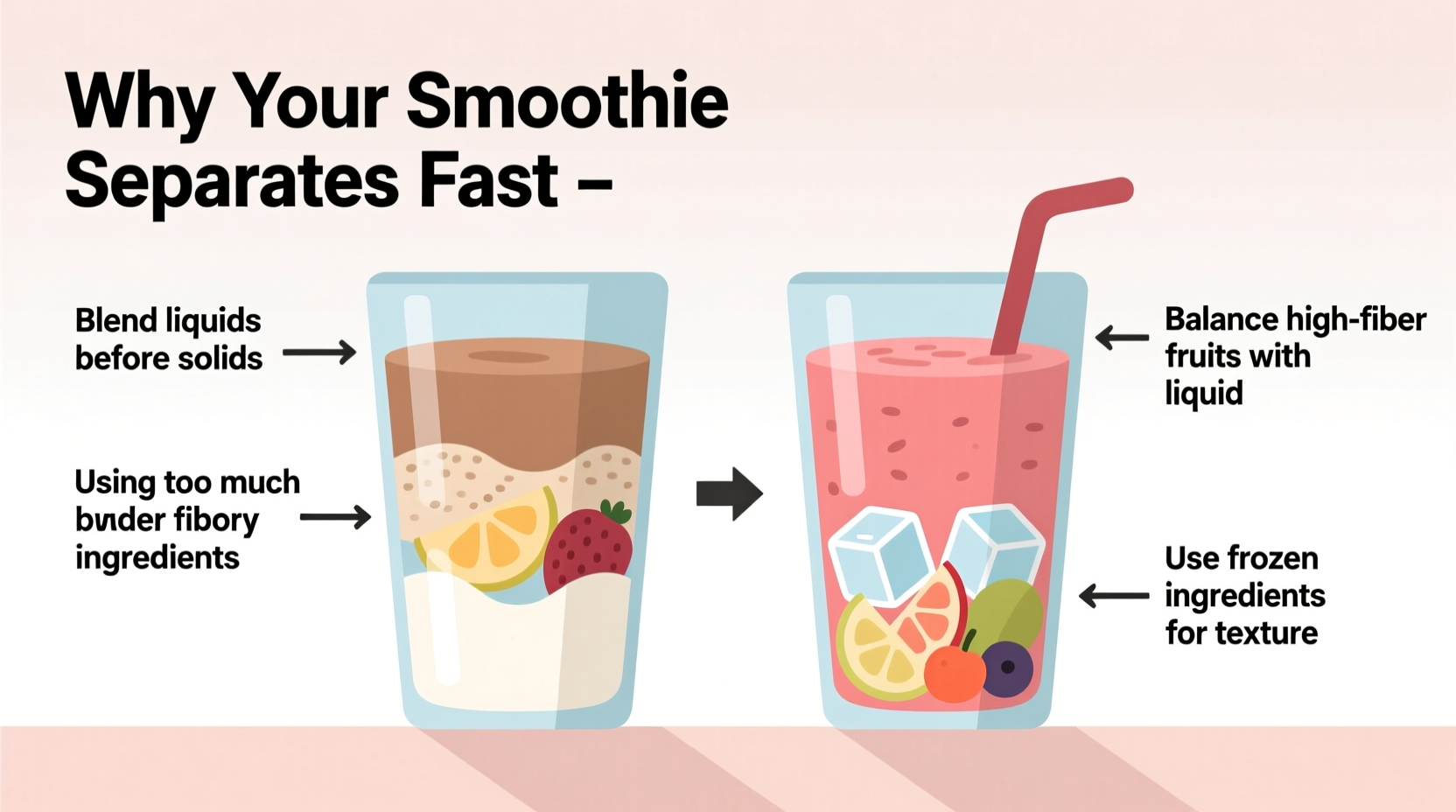
When ingredients blend, they don’t always form a stable suspension. Instead, they may temporarily mix but eventually separate due to differences in density, particle size, and polarity (how molecules interact with water). Liquids like water, juice, or milk are less dense than fibrous fruit or nut butters. Over time, gravity pulls heavier components down while lighter ones rise. This process is called sedimentation and creaming.
Additionally, many smoothie ingredients don’t naturally emulsify. Unlike salad dressings that use mustard or egg yolk as emulsifiers, most smoothies lack binding agents to keep oil-based (like avocado or flaxseed) and water-based (like almond milk or orange juice) components together.
Temperature also plays a role. Cold ingredients slow molecular movement, delaying separation slightly, but once warmed, the process accelerates. Ice can initially stabilize texture by increasing viscosity, but as it melts, it dilutes the mixture and speeds up layering.
“Without proper structure-building ingredients, even perfectly blended smoothies will break apart quickly.” — Dr. Lena Torres, Food Scientist & Nutritional Formulation Specialist
How Blending Order Impacts Stability
The sequence in which you add ingredients to your blender significantly influences texture and homogeneity. Many people dump everything in at once, assuming the blades will sort it out. But high-powered blenders still struggle when starting with dense solids or insufficient liquid.
Blending begins at the center of the vortex created by spinning blades. If heavy items like frozen fruit or spinach sit at the bottom without enough liquid around them, they won’t get pulled into the flow efficiently. This leads to uneven blending, larger particles, and weak integration—all contributing to faster separation.
Optimal Layering Strategy
To maximize blending efficiency and minimize separation, follow this recommended loading order from bottom to top:
- Liquid base – Start with 1/2 to 1 cup of liquid (water, milk, coconut water).
- Soft ingredients – Add yogurt, nut butter, honey, or protein powder next.
- Frozen or dense items – Place frozen fruit, ice, or avocado on top.
- Leafy greens or powders – Put spinach, kale, or supplements last so they’re drawn down quickly.
This method ensures liquids surround the harder-to-blend components early in the process, allowing smoother circulation and finer particle breakdown. A well-pulverized blend has more surface area for ingredients to bind, reducing phase separation.
Ingredient Ratios That Prevent Separation
Even with perfect blending order, an unbalanced ratio of liquids to solids will lead to instability. Too much liquid thins the smoothie, making separation inevitable. Too little, and you risk chunkiness and poor dispersion.
Aim for a ratio that supports viscosity without compromising drinkability. The ideal balance depends on your ingredients, but a general guideline is:
| Component | Recommended Proportion | Function |
|---|---|---|
| Liquid Base | 40–50% | Hydration and flow; choose thicker options like oat milk or kefir for better stability |
| Fruits/Vegetables | 30–40% | Natural fiber and pectin help suspend particles; bananas and apples work especially well |
| Thickeners/Binders | 10–15% | Avocado, chia seeds, oats, or Greek yogurt add body and fat-protein networks |
| Add-ins (Powders, Oils) | ≤5% | Flaxseed, collagen, or MCT oil need stabilizers to stay suspended |
For example, a balanced green smoothie might include:
- 1 cup unsweetened oat milk (liquid)
- 1 ripe banana (fiber + natural sugar)
- 1 cup frozen mango
- 1 handful spinach
- 1 tbsp chia seeds (binder)
- ½ scoop vanilla protein powder
- ½ avocado (fat + creaminess)
The banana and avocado provide both thickness and emulsifying properties. Chia seeds absorb liquid and swell, forming a gel matrix that traps other ingredients. Without these structural elements, the same recipe with only spinach, mango, and water would separate within 10 minutes.
Real Example: The Morning Commute Fail
Sarah, a busy marketing manager, prepares her smoothie the night before and stores it in a jar for her morning commute. By the time she reaches the office, there’s a thick layer of green sludge at the bottom and a foamy yellow cap on top. She stirs it, but the texture remains gritty and inconsistent.
Her original recipe: almond milk, frozen berries, spinach, protein powder, and a splash of lemon juice. While nutritious, it lacked any viscosity builders. After adjusting her formula—adding half a banana and one teaspoon of ground chia—and changing her blending order (liquid first, then powders, then frozen fruit), her smoothie stayed uniform for over two hours, even at room temperature.
This small tweak didn’t change the nutritional profile drastically but dramatically improved usability and enjoyment.
Step-by-Step Guide to a Stable Smoothie
Follow this proven process every time you blend to minimize separation and maximize consistency:
- Gather and prep ingredients – Chop large fruits, measure dry goods, and ensure liquids are chilled.
- Add liquid base first – Pour in ¾ cup of your chosen liquid to coat the blender jar.
- Incorporate soft binders – Add yogurt, nut butter, honey, or mashed banana.
- Include powdered supplements – Protein, greens powders, or spices go in now to avoid clumping.
- Top with frozen/dense items – Add frozen fruit, ice cubes, avocado, or cooked sweet potato. <6> Finish with leafy greens – Place spinach, kale, or herbs on top so they get pulled directly into the vortex. <7> Blend smartly – Start on low for 10 seconds, increase to medium for 20, then high for 30–60 seconds until completely smooth. <8> Check consistency – It should pour slowly, coat the back of a spoon, and show no visible chunks. <9> Pour immediately or store properly – If not drinking right away, transfer to an airtight container and refrigerate upright.
Common Mistakes That Accelerate Separation
Avoid these frequent errors that sabotage smoothie integrity:
- Overloading on liquid – More than 1.5 cups in a single-serving smoothie usually causes rapid layering.
- Skipping thickeners – Relying solely on fruit and milk often results in weak structure.
- Using watery fruits exclusively – Watermelon or cucumber-heavy blends separate quickly unless balanced with fiber-rich thickeners.
- Blending too briefly – Under-blended fibers and seeds settle faster because they aren’t fully integrated.
- Storing in wide-mouth containers – Wide openings expose more surface area to air, promoting oxidation and separation.
Do’s and Don’ts Summary
| Do | Don’t |
|---|---|
| Use banana, avocado, or oats for thickness | Use only ice to thicken (melts and dilutes) |
| Add chia, flax, or psyllium for binding | Add dry powders on top of solids (causes clumping) |
| Layer liquids first, then build upward | Put frozen fruit at the bottom (strains motor, poor mixing) |
| Store in narrow, sealed bottles | Shake vigorously after separation (creates foam, doesn’t rebind) |
FAQ: Your Top Smoothie Separation Questions Answered
Can I fix a separated smoothie?
Yes, but only partially. Re-blending is the best option. Simply pouring and stirring often won’t restore the original texture, especially if gelling agents like chia have already settled. A quick 15-second blitz usually brings it back to life.
How long should a smoothie stay mixed?
A well-formulated smoothie should remain relatively stable for 1–2 hours at room temperature and up to 24 hours refrigerated. Even then, some settling is normal. The key is whether it re-integrates easily with a shake or brief re-blend.
Does using a higher-wattage blender prevent separation?
Not directly. While powerful blenders pulverize ingredients more finely—which helps—separation is primarily governed by formulation, not power. A $500 blender with poor ratios will still separate faster than a $50 model with optimal ingredient balance.
Conclusion: Build Better Blends, One Ingredient at a Time
Smoothie separation isn’t random—it’s predictable chemistry. By respecting the principles of blending order and ingredient ratios, you gain control over texture, shelf life, and satisfaction. The difference between a smoothie that lasts and one that falls apart lies not in the machine, but in the method.
Start applying these insights today: layer your blender correctly, prioritize natural thickeners, and fine-tune your ratios. Whether you're fueling a workout, packing a lunch, or prepping breakfasts for the week, a stable, creamy smoothie makes all the difference.




 浙公网安备
33010002000092号
浙公网安备
33010002000092号 浙B2-20120091-4
Comments
No comments yet. Why don't you start the discussion?