
There’s nothing more disappointing than pouring a vibrant, nutrient-packed smoothie into your glass only to find it separating within minutes—watery liquid at the bottom, foam on top, and a thin, grainy consistency in between. You blended it thoroughly, used fresh ingredients, and yet, it falls apart before you’ve even finished half. This common issue isn’t just cosmetic; separation affects flavor, mouthfeel, and nutritional balance. The good news? It’s entirely preventable with the right techniques, ingredient order, and understanding of food science.
Smoothie separation happens due to differences in density, emulsification failure, and improper blending mechanics. But by adjusting how you layer ingredients, choosing the right thickeners, and optimizing your blending process, you can create smoothies that stay luxuriously creamy from first sip to last.
The Science Behind Smoothie Separation
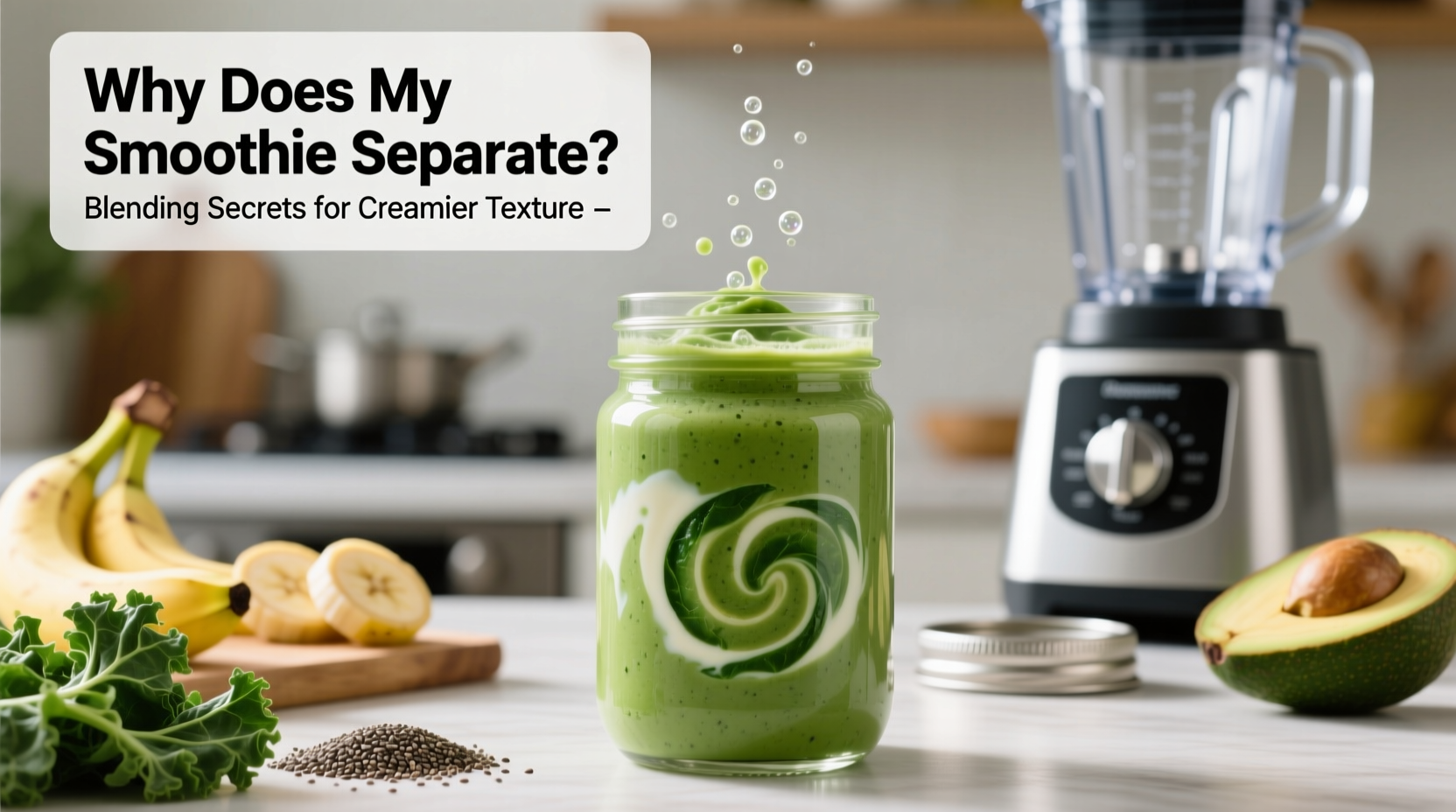
At its core, a smoothie is an emulsion—a mixture of liquids and solids that ideally remain suspended together. When components have vastly different densities or lack binding agents, they naturally separate over time. Water-heavy fruits like watermelon or citrus sink or rise based on their specific gravity. Leafy greens often float if not fully broken down. Powders like protein or collagen may clump and settle. Without proper stabilization, this physical separation is inevitable.
Emulsions require three key elements: a continuous phase (usually liquid), dispersed particles (fruits, greens, powders), and an emulsifier (like fats or fibers) to keep everything bound. Most homemade smoothies skip the emulsifier or fail to activate it through technique, leading to rapid layering.
“Without sufficient shear force and stabilizing ingredients, even the most balanced smoothie will break apart within 10–15 minutes.” — Dr. Lena Torres, Food Scientist & Nutritional Formulation Specialist
Understanding this helps shift focus from simply “throwing things in a blender” to crafting a stable, homogenous blend. The solution lies not in adding obscure ingredients, but in mastering foundational principles of texture engineering.
Blending Order Matters More Than You Think
Most people toss everything into the blender haphazardly—liquid first, then fruit, maybe some greens on top. But the order in which you add ingredients dramatically impacts extraction efficiency, air incorporation, and final consistency.
Liquids should never go in first unless they’re being used to assist blade movement initially. Instead, follow a strategic layering method designed to pull ingredients downward, not push them up into a vortex that traps air.
Optimal Ingredient Layering Sequence
- Dense solids first: Frozen fruit, ice, nuts, seeds. These heavy items sit at the bottom and help crush lighter materials above.
- Powders next: Protein, matcha, maca, spirulina. Placing them below liquids prevents clumping and ensures full dispersion.
- Fibrous ingredients: Kale, spinach, chia, flax. Their structure benefits from direct blade contact early in the cycle.
- Soft fruits and yogurt: Bananas, mangoes, Greek yogurt. They act as natural thickeners and aid in smoothing out the mix.
- Liquid last: Add milk, juice, or water at the very end to minimize splashing and improve suction.
This reverse-loading technique creates a downward spiral effect, forcing everything toward the blades rather than letting lighter components float. It also reduces oxidation, which contributes to foaming and instability.
Key Ingredients That Prevent Separation
Certain foods naturally stabilize emulsions by increasing viscosity, providing soluble fiber, or introducing healthy fats. Incorporating even one or two of these can transform a fragile blend into a long-lasting, restaurant-quality drink.
| Ingredient | Function | Recommended Amount (per 16oz smoothie) |
|---|---|---|
| Avocado | Rich in monounsaturated fats and fiber; adds creaminess without overpowering flavor | ¼ to ½ medium |
| Banana (frozen) | High in pectin and starch; acts as a natural thickener | ½ medium |
| Oats (rolled or quick) | Soluble beta-glucan forms a gel-like matrix that suspends particles | 2–3 tbsp |
| Chia or flax seeds | Absorb up to 10x their weight in water; excellent emulsifiers | 1 tbsp (soaked preferred) |
| Nut butter (almond, cashew) | Fats coat particles and slow sedimentation | 1–2 tsp |
| Full-fat yogurt or kefir | Proteins and live cultures enhance texture stability | ¼–⅓ cup |
For best results, combine at least two of these stabilizers. For example, banana + chia or avocado + oats. Avoid relying solely on ice or frozen fruit—they dilute the mix as they melt and offer no binding power.
Step-by-Step Guide to a Non-Separating Smoothie
Follow this proven routine every time you blend. It takes slightly longer than free-pouring, but guarantees a silky, cohesive result that lasts over an hour without stirring.
- Prep chia or flax (if using): Mix 1 tbsp seeds with 3 tbsp water and let sit for 5–10 minutes until gel forms.
- Add frozen fruit and ice to the blender jar—about 1 to 1.5 cups total.
- Layer powders directly on top—protein, greens powder, spices—so they don’t stick to the sides.
- Add fibrous greens like kale or spinach, pressing them down gently.
- Include soft thickeners: banana, avocado, nut butter, oats.
- Pour in pre-soaked chia gel or yogurt, followed by remaining liquid (non-dairy milk, juice, etc.). Leave about 1 inch of headspace.
- Blend on low for 10 seconds to initiate downward pull.
- Increase to high speed for 45–60 seconds until completely smooth and slightly warm (indicates friction and cell wall breakdown).
- Taste and adjust: Add more liquid only if necessary, then pulse briefly to reincorporate.
- Transfer immediately to a sealed container or drinking vessel.
Common Mistakes That Cause Fast Separation
Even with great ingredients, poor habits sabotage results. Here are the most frequent errors—and how to fix them.
- Overloading liquid: Too much water, juice, or milk dilutes the mixture, making it harder for solids to stay suspended. Stick to a 3:1 ratio of solids to liquid by volume.
- Using only watery fruits: Apples, oranges, melons lack thickness. Balance them with dense bases like banana, mango, or avocado.
- Blending too briefly: Under-blending leaves plant fibers intact, creating weak structure. Blend until no grit remains and the motor sounds smooth.
- Adding ice last: Ice floats and gets unevenly crushed, causing inconsistent texture and excess water release.
- Not soaking seeds: Dry chia or flax won’t absorb moisture mid-blend, leading to clumping and settling.
- Using low-powered blenders: Weak motors can’t generate enough shear force to break down cellulose walls. Upgrade if yours struggles with leafy greens.
Mini Case Study: From Soggy to Silky
Sarah, a busy nurse, relied on morning smoothies for energy during 12-hour shifts. Her usual recipe—orange juice, spinach, banana, protein powder, and frozen berries—would separate within 20 minutes, leaving her with a chalky residue at the bottom. She avoided bringing it to work because she didn’t want to carry a shaker bottle.
After adjusting her method—switching to almond milk instead of OJ, adding 1 tbsp soaked chia, using frozen banana chunks, and reversing her layering order—her smoothie stayed uniform for over 90 minutes. She now prepares it the night before and stores it in a mason jar with minimal separation. The change wasn’t in ingredients alone, but in execution.
Checklist for Creamier, Stable Smoothies
Use this checklist each time you make a smoothie to ensure optimal texture and longevity.
- ✅ Use at least one natural thickener (banana, avocado, oats)
- ✅ Soak chia/flax seeds ahead of time
- ✅ Layer ingredients from heaviest to lightest
- ✅ Add liquid last
- ✅ Start blending on low, then increase to high
- ✅ Blend for at least 60 seconds total
- ✅ Use a high-speed blender (1000+ watts recommended)
- ✅ Limit added water/juice to no more than 1 cup per serving
- ✅ Include a fat source (nut butter, seeds, full-fat dairy)
- ✅ Let rest 5 minutes post-blend before storing or drinking
Frequently Asked Questions
Can I make a smoothie the night before without separation?
Yes, but only if you include strong stabilizers like chia, oats, or avocado and store it in an airtight container. Even then, some separation may occur. Shake or stir vigorously before drinking. Avoid recipes high in citrus or watery fruits for overnight storage.
Why does my smoothie get foamy on top?
Foam forms when air is trapped during blending, especially with leafy greens or excessive liquid. To reduce it, start on low speed, avoid overfilling the blender, and let the smoothie sit for 5 minutes post-blend to allow bubbles to collapse. Using room-temperature liquids instead of cold can also help.
Does blending destroy nutrients?
No—blending preserves most nutrients. In fact, it enhances bioavailability by breaking down plant cell walls, making vitamins and antioxidants easier to absorb. Oxidation occurs slightly faster than juicing due to increased surface area, but consuming the smoothie within 2 hours minimizes any loss.
Final Thoughts: Texture Is Part of Nutrition
A smoothie that separates quickly isn’t just inconvenient—it signals imbalance. When ingredients don’t integrate, you’re not getting consistent nutrition with each sip. One mouthful might be all fat and fiber, the next all sugar and water. A well-emulsified smoothie ensures every drop delivers the intended nutrient profile.
Mastery comes from treating blending as both art and science. It’s not about complexity, but intentionality. By respecting ingredient behavior, leveraging natural thickeners, and refining your technique, you elevate a simple drink into a reliable, satisfying meal replacement or snack.




 浙公网安备
33010002000092号
浙公网安备
33010002000092号 浙B2-20120091-4
Comments
No comments yet. Why don't you start the discussion?