
Smoothies are a go-to for busy mornings, post-workout fuel, or a quick nutrient boost. But if yours separates within minutes—watery liquid at the bottom, pulp floating on top—it defeats the purpose of a well-blended drink. Separation isn’t just unappealing; it can mean inconsistent flavor, poor texture, and even compromised nutrient distribution. While many blame their blender or ingredients alone, one overlooked factor is critical: the order in which you add ingredients to the blender. Understanding this simple principle can transform your smoothie from a science experiment into a stable, creamy, satisfying beverage.
The Science Behind Smoothie Separation
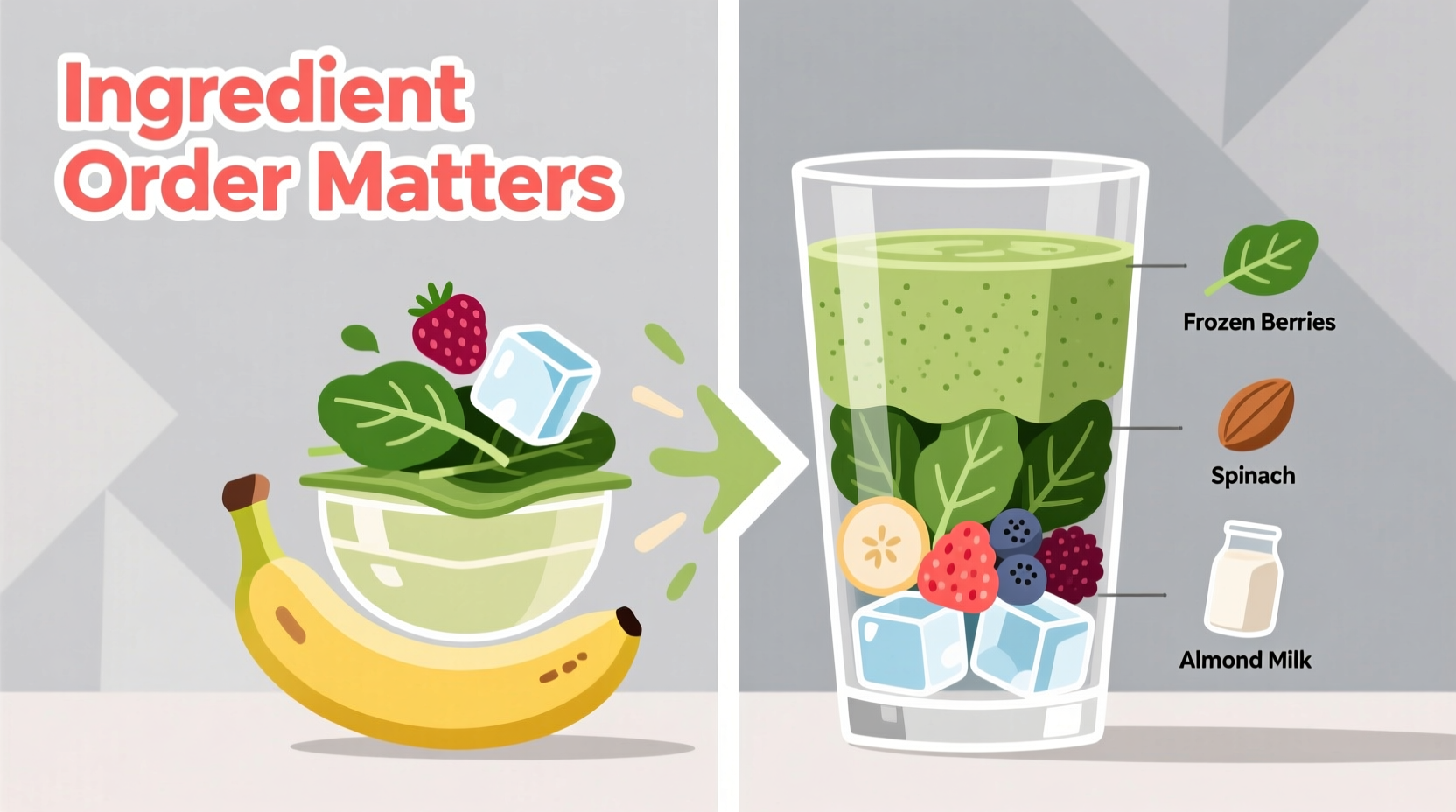
Smoothie separation occurs due to differences in density, viscosity, and emulsification between ingredients. When liquids and solids aren’t properly combined or stabilized, gravity takes over. Heavier components like nut butters or frozen fruit sink, while lighter liquids such as water or juice rise. This process, known as phase separation, is natural—but preventable with proper blending technique and ingredient sequencing.
Emulsifiers—substances that help bind oil and water-based ingredients—play a key role. In smoothies, natural emulsifiers include banana, avocado, chia seeds, flaxseed, and yogurt. However, even with these, improper layering in the blender can reduce their effectiveness. The motor’s ability to pull ingredients down toward the blades depends on what’s at the bottom. If heavy or fibrous items block the blades, lighter liquids swirl uselessly above, leading to incomplete mixing and faster separation.
Why Ingredient Order Matters More Than You Think
Most people toss everything into the blender randomly and hit “blend.” But the sequence determines how efficiently the blades can process each component. Blenders work by creating a downward spiral—like a whirlpool—that draws ingredients into the blades. If that flow is disrupted, blending becomes uneven, and the result is a poorly integrated mixture prone to rapid separation.
Consider this: placing a handful of spinach or ice cubes directly on the blades might seem logical, but it can jam the mechanism or cause splashing. Meanwhile, putting thick nut butter at the bottom means it never fully incorporates, leaving streaks and dense pockets. The ideal order ensures smooth circulation, complete breakdown, and better suspension of particles throughout the liquid base.
“The difference between a silky smoothie and a separated mess often comes down to three things: blade contact, ingredient density, and blending order.” — Dr. Lena Torres, Food Scientist & Nutritional Formulation Specialist
Optimal Ingredient Layering: A Step-by-Step Guide
To minimize separation and maximize consistency, follow this proven layering method:
- Liquids first – Pour in water, milk, coconut water, or juice. This creates a fluid base that helps the blades spin freely and initiate the vortex.
- Soft fruits and powders next – Add bananas, yogurt, protein powder, greens (spinach, kale), or spices. These mix easily once the liquid is moving.
- Frozen items and hard ingredients last – Top with frozen fruit, ice, nuts, seeds, or nut butters. Their weight helps push softer ingredients down into the blades as blending begins.
This sequence allows the blender to gradually pull everything downward, ensuring even processing. Starting with liquid prevents dry ingredients from clumping or sticking to the sides. Ending with frozen or dense items gives them time to break down without overwhelming the motor early on.
What Happens When You Get the Order Wrong?
- Blades get blocked – Ice or frozen fruit at the bottom can stop the blade from spinning, leading to partial blending.
- Powders clump – Protein or superfood powders added first may stick to the jar and never fully dissolve.
- Greens don’t blend – Leafy vegetables thrown in haphazardly often end up as fibrous chunks instead of being fully incorporated.
- Separation accelerates – Poorly mixed ingredients settle quickly because they were never truly emulsified.
Key Ingredients That Prevent Separation
Beyond order, certain ingredients act as natural stabilizers. Incorporating them strategically enhances texture and shelf life—even if you plan to drink immediately.
| Ingredient | Function | Recommended Amount |
|---|---|---|
| Banana (ripe) | Natural thickener and binder due to pectin and starch | ½ to 1 medium |
| Avocado | Creamy fat content improves emulsion and mouthfeel | ¼ to ½ fruit |
| Chia seeds | Form a hydrogel when soaked, slowing sedimentation | 1 tbsp (soak 5 min if possible) |
| Flaxseed (ground) | High in soluble fiber and mucilage, which binds water | 1–2 tbsp |
| Greek yogurt or kefir | Protein and fat help stabilize emulsions | ¼–½ cup |
| Oats (rolled) | Beta-glucan fiber thickens and suspends particles | 2–4 tbsp |
Using at least one of these in every smoothie significantly reduces separation. For best results, combine two—like banana and chia—for a synergistic effect.
Real Example: From Separated Mess to Creamy Success
Sarah, a fitness coach in Portland, used to make green smoothies every morning. She’d blend spinach, almond milk, protein powder, frozen mango, and a scoop of peanut butter—all dumped in at once. Within five minutes, the smoothie would split: a thin yellow layer on top, green sludge below. Frustrated, she tried different blenders, even straining her drinks. Nothing worked consistently.
After learning about ingredient order, she changed her method: 1 cup almond milk first, then ½ banana, 1 cup spinach, 1 scoop protein powder, 1 tbsp chia seeds, and finally ¾ cup frozen mango and 1 tbsp peanut butter on top. She blended for 45 seconds on high. The result? A uniform, creamy texture that stayed mixed for over 30 minutes—long enough for her commute. “It was like making a new recipe,” she said. “Same ingredients, completely different outcome.”
Checklist: Build a Stable Smoothie Every Time
- ✅ Start with ¾ to 1 cup liquid (milk, juice, water, tea)
- ✅ Add soft ingredients: banana, yogurt, cooked oats, powders
- ✅ Include a stabilizer: chia, flax, avocado, or oats
- ✅ Load frozen or dense items last: ice, frozen fruit, nut butter
- ✅ Blend in stages if needed: pulse first, then increase speed
- ✅ Blend for at least 30–45 seconds until completely smooth
- ✅ Stir or shake before drinking if storing for more than 10 minutes
Storage and Consumption Tips to Delay Separation
Even a perfectly made smoothie will eventually separate—especially if stored. But you can extend its stability.
Refrigerated smoothies should be consumed within 24 hours. To slow separation during storage:
- Use an airtight container with minimal headspace to reduce oxidation.
- Store upright and avoid shaking—gentle stirring before drinking is better.
- Keep in the coldest part of the fridge, not the door.
- Freeze in portions if making ahead: thaw and blend briefly to restore texture.
If you're prepping multiple servings, consider separating dry ingredients (powders, seeds) and adding them fresh each day. Liquids and frozen bases can be pre-packed and stored together.
“Pre-measuring ingredients in jars—liquid at the bottom, dry on top—can save time and ensure proper layering when you’re ready to blend.” — Jordan Lee, Plant-Based Nutrition Educator
FAQ: Common Questions About Smoothie Separation
Does blending longer prevent separation?
Only up to a point. Over-blending can introduce excess air, creating foam that destabilizes the mixture. It can also heat the smoothie slightly, accelerating separation. Blend until smooth—typically 30–60 seconds—but avoid prolonged processing.
Can I fix a separated smoothie?
Yes. Simply stir or shake vigorously. If it’s been sitting for over an hour, re-blend for 10–15 seconds to restore uniformity. Avoid adding more liquid unless necessary, as it dilutes flavor and worsens separation.
Are some blenders better at preventing separation?
Absolutely. High-powered blenders (e.g., Vitamix, Blendtec) create stronger vortices and shear forces, breaking down fibers more completely. However, even powerful blenders fail if ingredients are layered incorrectly. Technique still matters most.
Final Thoughts: Mastery Starts with Method
Smoothie separation isn’t inevitable—it’s a signal that something in your process needs adjustment. While ingredients and equipment matter, the order in which you layer components is the silent hero of a stable, delicious drink. By respecting the physics of blending and leveraging natural thickeners, you turn chaos into consistency.
Next time you make a smoothie, pause before pressing “blend.” Ask yourself: Is the liquid at the bottom? Are powders covered by liquid? Will the frozen fruit crush the spinach or block the blades? These small considerations compound into big improvements in texture, taste, and satisfaction.




 浙公网安备
33010002000092号
浙公网安备
33010002000092号 浙B2-20120091-4
Comments
No comments yet. Why don't you start the discussion?