
Solar-powered light strings offer an energy-efficient, eco-friendly way to illuminate patios, gardens, and walkways. But nothing is more frustrating than watching them shine brightly at dusk—only to fade significantly by early evening. If your solar lights are dimming drastically after 4 PM despite receiving full sunlight during the day, you're not alone. This issue affects countless homeowners who assume their setup should work flawlessly under ideal conditions. The reality, however, involves a combination of technical, environmental, and design factors that impact performance. Understanding these can help you diagnose the root cause and implement effective solutions.
The Science Behind Solar Light Performance
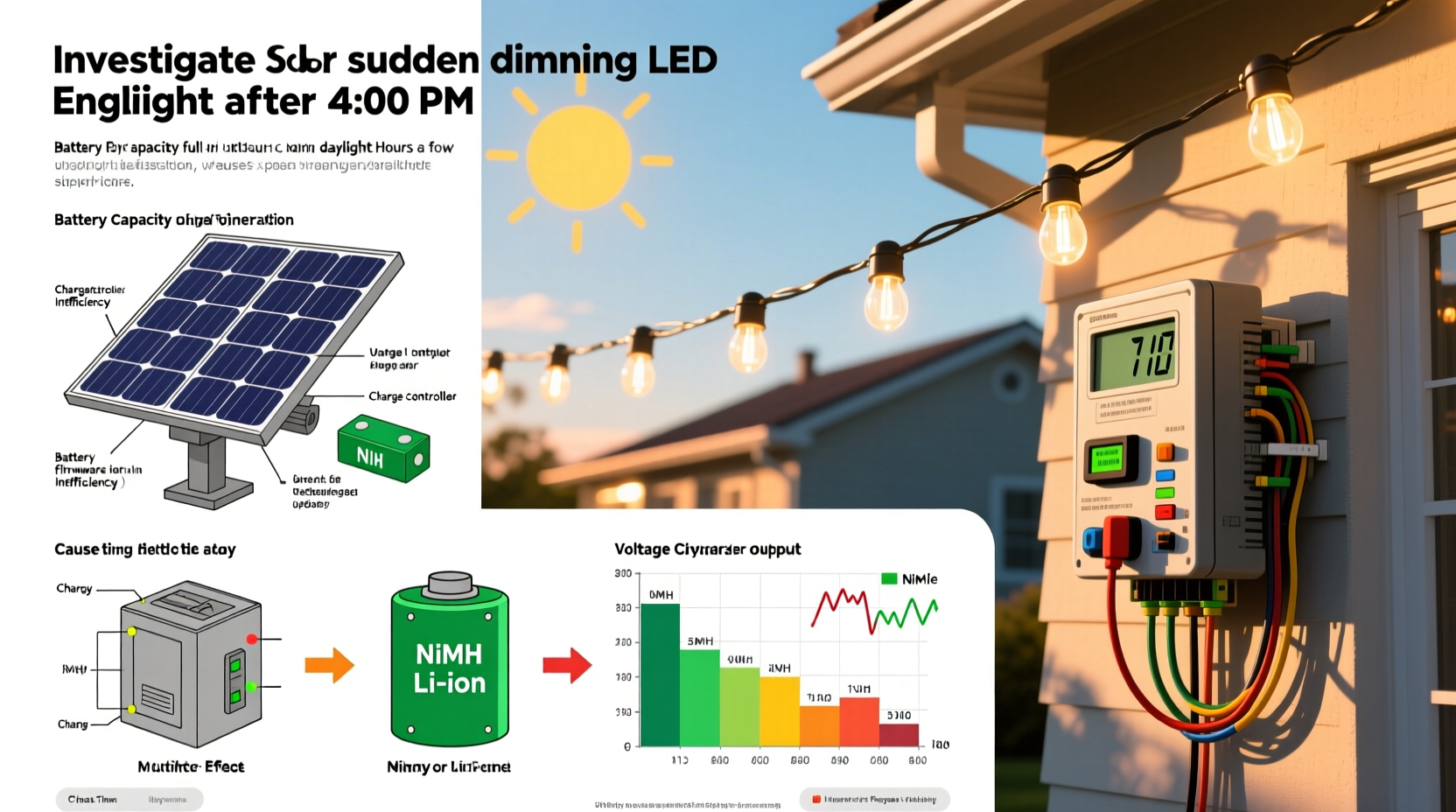
Solar light strings operate on a simple but delicate balance: photovoltaic panels absorb sunlight during the day, converting it into electrical energy stored in rechargeable batteries. At dusk, a built-in photocell detects reduced ambient light and triggers the LEDs to turn on using stored power. The brightness and duration depend entirely on how much energy was captured and retained.
Even with eight hours of direct sunlight, several hidden inefficiencies can prevent optimal charging. For instance, panel orientation, shading from nearby objects (even partial), temperature extremes, and battery degradation all influence charge capacity. Moreover, many budget-friendly solar lights use low-grade components that limit peak efficiency regardless of sun exposure.
A common misconception is that \"full sun\" equals \"full charge.\" In truth, solar panels have diminishing returns beyond certain thresholds, and real-world conditions rarely match laboratory specifications. Dust accumulation, angle of incidence, and seasonal sun position also play critical roles.
Key Factors Causing Premature Dimming
Premature dimming typically stems from one or more interrelated issues across three main systems: the solar panel, the battery, and the LED circuitry.
1. Battery Degradation or Poor Quality
The most frequent culprit is the internal rechargeable battery. Most solar lights use NiMH (Nickel-Metal Hydride) or Li-ion (Lithium-ion) cells rated for 500–1000 charge cycles. Over time, especially in extreme temperatures, these batteries lose capacity. A degraded battery may only store 40–50% of its original charge, leading to shorter runtime and lower output.
Additionally, cheaper models often include undersized or counterfeit batteries that fail within months. Even if the panel receives ample sunlight, insufficient storage means the lights start strong but deplete rapidly after sunset.
2. Inadequate Charge-to-Discharge Ratio
Solar lights are designed based on assumed usage patterns: e.g., 6–8 hours of charging for 8–10 hours of lighting. However, as daylight shortens in fall and winter, this ratio becomes unbalanced. Even with perfect midday sun, total daily irradiance drops significantly due to lower sun angles and shorter days.
For example, a location receiving 10 hours of daylight in June might only get 7 hours in September—with equivalent intensity. That reduction directly impacts stored energy.
3. Temperature Sensitivity
Cold weather reduces battery efficiency. While solar panels perform slightly better in cooler temperatures, the chemical reactions inside batteries slow down below 50°F (10°C). This means that even if the battery is fully charged, it cannot deliver power efficiently when needed.
Conversely, excessive heat (above 85°F/30°C) accelerates battery wear and increases self-discharge rates, meaning stored energy leaks away before nightfall.
4. LED Load vs. Energy Supply
Some solar strings contain too many LEDs for the available power. A string of 100 LEDs drawing 0.06 watts each requires 6 watts of continuous power. If the solar panel generates only 2 watts per hour over 6 hours (12Wh total), and losses consume 30%, usable energy drops to ~8.4Wh—barely enough for two hours at full brightness.
To compensate, manufacturers program lights to dim automatically after initial operation, preserving runtime. This explains why your lights appear bright at first but fade quickly after 4 PM.
Step-by-Step Diagnostic Timeline
Follow this timeline to identify and resolve the cause of premature dimming:
- Week 1: Observe and Record
Track when lights turn on, peak brightness duration, and dimming onset. Note weather, shading, and placement. - Day 3: Inspect Panel Angle
Ensure the panel faces true south (in the Northern Hemisphere) and is angled toward the sun (~equal to your latitude). - Day 5: Clean Components
Wipe the solar panel and check for debris blocking light. Examine wiring for damage. - Day 7: Test in Direct Sun Away From Fixture
Remove the light string from its usual spot and place the panel in open, unshaded sun for a full day. Compare nighttime performance. - Day 10: Swap Batteries (if accessible)
Replace old NiMH/Li-ion cells with high-quality, correctly rated replacements. - Day 14: Evaluate Results
Determine whether brightness improved. If not, consider upgrading to a higher-capacity system.
Do’s and Don’ts: Optimizing Solar Light Efficiency
| Do | Don’t |
|---|---|
| Position panels where they receive uninterrupted sun from 10 AM to 4 PM | Install under trees, eaves, or near reflective surfaces that create glare |
| Use lights with replaceable, standard-size batteries (e.g., AA NiMH) | Buy sealed units with non-replaceable batteries unless premium grade |
| Manually turn off lights during rainy/cloudy days to prevent partial charging cycles | Leave them running continuously through poor weather |
| Store lights indoors during winter months in cold climates | Expose them to freezing temps and moisture year-round |
| Choose fewer LEDs per string or higher-wattage solar modules | Prioritize length and quantity over quality and power specs |
Real-World Example: The Garden Patio Case
Consider Sarah, a homeowner in Portland, Oregon, who installed a 50-light solar string along her deck railing. Initially, the lights glowed warmly each evening in July. By late September, however, they began fading just 90 minutes after turning on—even though the panel sat in full sun all day.
After troubleshooting, she discovered three issues: First, fallen leaves partially shaded the panel between 2–3 PM. Second, the original batteries had swollen and were holding less than half their rated capacity. Third, the string contained 50 LEDs powered by a tiny 1.5W panel—a mismatched load.
Sarah cleaned the panel, replaced the batteries with 1200mAh NiMH cells, repositioned the panel to avoid afternoon shade, and switched to a 25-light version of the same product. Result? Her lights now stay consistently bright for over six hours, even in November.
Expert Insight: What Industry Professionals Say
“Most consumers don’t realize that solar lighting isn’t plug-and-forget. It requires seasonal maintenance and realistic expectations. A $20 string light won’t outperform physics.” — Marcus Lin, Renewable Energy Technician & Solar Product Designer
Lin emphasizes that while solar technology has improved, marketing often oversells capabilities. “The key is matching the product to the environment. If you live in a region with short winter days or frequent overcast skies, invest in larger panels and external battery packs—or supplement with grid-tied options.”
Checklist: Fix Your Dimming Solar Lights
- ☐ Clean the solar panel surface thoroughly
- ☐ Confirm the panel receives direct sun between 10 AM – 4 PM
- ☐ Check for nearby shadows cast by railings, plants, or structures
- ☐ Replace old or bulging batteries with high-capacity equivalents
- ☐ Verify battery polarity and connections inside the housing
- ☐ Reduce LED load by switching to a shorter string or spacing out multiple smaller sets
- ☐ Store units indoors during extended bad weather or winter freezes
- ☐ Consider upgrading to solar lights with separate panel and light units for flexible positioning
Frequently Asked Questions
Can solar lights charge on cloudy days?
Yes, but inefficiently. Diffuse sunlight allows partial charging—typically 10–25% of normal output. Continuous overcast conditions will degrade performance and may require manual shutdown to avoid deep discharge cycles.
Why do my solar lights work fine in summer but fail in winter?
Shorter daylight hours, lower sun angles, colder temperatures, and increased cloud cover reduce both energy input and battery efficiency. Even with identical installations, winter performance is naturally weaker. Adjust expectations or upgrade hardware accordingly.
Is it worth repairing old solar lights or should I replace them?
If the lights have replaceable batteries and durable construction, repair is cost-effective. However, if the panel is cracked, the casing is brittle, or LEDs flicker inconsistently, replacement is usually better. Look for newer models with improved battery management and higher lumen-per-watt ratios.
Conclusion: Take Control of Your Solar Lighting System
Dimming solar light strings after 4 PM aren’t necessarily defective—they’re signaling a mismatch between energy supply and demand. With a clear understanding of solar dynamics, battery behavior, and environmental influences, you can restore reliable performance. Start with basic maintenance: cleaning, repositioning, and battery replacement. Then evaluate whether your current setup meets your needs or if an upgrade is warranted.
Sustainable outdoor lighting is achievable—but it requires attention, not just installation. By treating your solar lights as a small renewable energy system rather than disposable décor, you’ll enjoy brighter nights and longer service life.




 浙公网安备
33010002000092号
浙公网安备
33010002000092号 浙B2-20120091-4
Comments
No comments yet. Why don't you start the discussion?