
Solar light strings are a favorite for patios, gardens, and festive decor—low-cost, eco-friendly, and effortless once installed. Yet every year, as temperatures drop and daylight shrinks, thousands of homeowners watch their cheerful twinkle fade: lights that shone brightly in June now blink weakly—or not at all—by December. It’s frustrating, especially when the hardware appears intact. The truth is, winter doesn’t “break” solar lights—it exposes design limitations and environmental mismatches most users never consider. This isn’t a manufacturing flaw; it’s physics meeting real-world conditions. Understanding why your lights falter—and how to counteract each factor—is the difference between seasonal disappointment and consistent, reliable illumination from October through March.
The Core Problem: Why Winter Is Solar Lights’ Worst Enemy
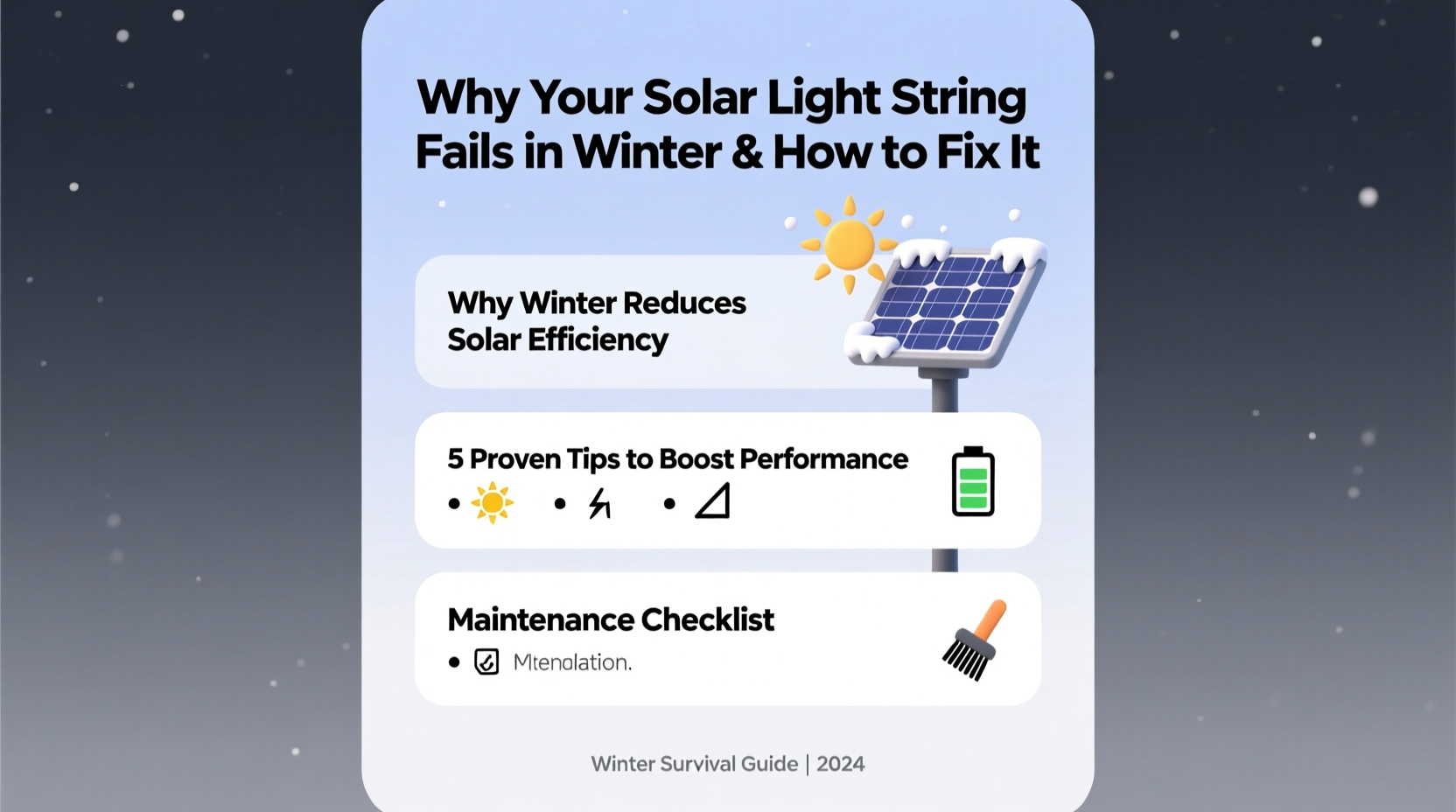
Solar light strings rely on three interdependent systems: photovoltaic (PV) charging, battery storage, and LED output. In winter, all three degrade—not simultaneously, but cumulatively. Shorter days mean fewer peak-sun hours. Snow, frost, and low-angle sun reduce irradiance reaching the panel by up to 70%. Cold temperatures slow lithium-ion and NiMH battery chemistry, lowering usable capacity and increasing internal resistance. And when batteries can’t hold enough charge, LEDs either dim significantly or shut off entirely to protect circuitry.
Crucially, most consumer-grade solar strings are engineered for *summer* performance—not year-round resilience. Their panels are small (often under 1.5W), batteries undersized (typically 400–600mAh), and charge controllers basic or absent. They work well in ideal conditions—but winter is rarely ideal.
“Many solar lights sold today prioritize aesthetics and low cost over cold-weather engineering. A panel rated for ‘full sun’ assumes 1,000 W/m² irradiance—something rarely achieved in northern latitudes between November and February.” — Dr. Lena Torres, Renewable Energy Engineer, NREL (National Renewable Energy Laboratory)
7 Actionable Tips to Restore & Sustain Winter Performance
These aren’t theoretical suggestions—they’re field-tested interventions used by landscape professionals, municipal maintenance crews, and seasoned DIYers across Canada, the UK, and the northern U.S. Each targets a specific failure point.
1. Maximize Panel Exposure—Not Just Placement
It’s not enough to mount the panel “in the sun.” In winter, the sun sits lower—often below rooflines, tree branches, or even gutters. Tilt the panel southward at an angle equal to your latitude +15° (e.g., 50° tilt in Boston at 42°N). Use a simple adjustable bracket or wedge block. Also, prune nearby branches that cast shade between 10 a.m. and 2 p.m.—the only window with meaningful solar intensity in midwinter.
2. Prioritize Panel Quality Over String Aesthetics
If your current string has a tiny, recessed panel integrated into the first bulb housing, its surface area is likely ≤10 cm²—too small for reliable winter charging. Replace the entire string with one featuring a *separate*, high-efficiency monocrystalline panel (≥2.5W, ≥30 cm² surface area) mounted independently. Monocrystalline cells outperform polycrystalline by 12–18% in low-light conditions and maintain efficiency down to -20°C.
3. Upgrade to Cold-Tolerant Batteries
Most stock solar lights use standard NiMH or low-grade lithium cobalt oxide (LiCoO₂) batteries. These lose ~40% capacity at 0°C and risk permanent damage below -10°C. Swap them (if accessible) for lithium iron phosphate (LiFePO₄) cells—rated for operation from -20°C to 60°C, with 2,000+ cycles and stable voltage discharge. Note: Only attempt this if the light has user-replaceable battery compartments and you’re comfortable with basic electronics. Otherwise, purchase new lights explicitly labeled “cold-weather rated” or “LiFePO₄ compatible.”
4. Insulate—Strategically
Batteries perform better when warm—but heat sources near LEDs create fire hazards. Instead, insulate the *battery compartment* itself. Wrap it loosely with closed-cell foam tape (like Armacell) or place it inside a small, ventilated thermal sleeve made from reflective bubble insulation. Do *not* seal it airtight—trapped moisture causes condensation and corrosion. The goal is thermal inertia, not warmth generation.
5. Reduce Load Demand During Low-Charge Periods
Many strings default to full brightness mode—even when barely charged. Look for models with multi-mode controllers (e.g., “eco,” “bright,” “flash”) or add an external dusk-to-dawn timer with dimming capability. Running at 30–50% brightness extends runtime by 2–3x during marginal-charging days. Some advanced strings automatically step down brightness after detecting two consecutive low-charge cycles—a feature worth paying extra for.
6. Prevent Snow & Ice Accumulation
A 3-mm layer of snow blocks >95% of sunlight. Don’t just brush it off—design for prevention. Mount panels at ≥45° tilt so snow slides off naturally. Apply a hydrophobic nano-coating (e.g., NeverWet or similar PV-safe formulas) to repel water and inhibit ice adhesion. For ground-mounted panels, elevate them on short stakes to avoid snowdrift burial entirely.
7. Implement a Rotational Charging Strategy
For critical areas (e.g., steps, pathways), use two identical light strings. Charge one string indoors near a south-facing window during daylight hours while the other operates outside. Rotate daily. Even indirect daylight through double-glazed windows delivers 100–300 lux—enough to top up a partially discharged LiFePO₄ battery in 6–8 hours. This “battery rotation” system boosts reliability without modifying hardware.
Do’s and Don’ts: A Practical Comparison Table
| Action | Do | Don’t |
|---|---|---|
| Panel Cleaning | Use distilled water + microfiber cloth; wipe gently in one direction | Use vinegar, ammonia, or paper towels—they etch coatings and leave lint |
| Battery Storage (Off-Season) | Store at 40–60% charge in a cool, dry place (~10–15°C) | Leave fully charged or fully drained—both accelerate degradation |
| Winter Operation | Group lights near reflective surfaces (light-colored walls, gravel) to bounce ambient light onto panels | Cover panels with plastic sheeting “to keep snow off”—it blocks all light |
| Troubleshooting | Test with a multimeter: panel should read ≥4.5V in direct sun; battery ≥3.6V when rested | Assume the LED is faulty—90% of “dead light” reports trace to panel or battery issues |
Mini Case Study: The Vermont Porch Project
In Burlington, VT (latitude 44.5°N), homeowner Maya R. installed 20m of warm-white solar string lights along her covered porch railing in September 2022. By late November, only 3 of 20 bulbs lit—and those flickered erratically. She tried cleaning panels, repositioning strings, and replacing batteries—all with minimal improvement. Then she consulted a local solar installer who diagnosed three root causes: (1) Panels were flush-mounted beneath an overhang, receiving zero direct sun November–February; (2) Batteries were low-grade NiMH, dropping to 22% capacity at -5°C; (3) The controller lacked low-voltage protection, causing premature shutdown.
Her solution: She replaced the string with a model featuring a detachable 3W monocrystalline panel, mounted it on a south-facing garage wall at 60° tilt, swapped in LiFePO₄ batteries, and added a $12 programmable timer to limit operation to 6 hours nightly. Result? From December 2023 through March 2024, all 20 bulbs operated at consistent brightness—averaging 4.2 hours per night, even during a week-long stretch of cloud cover and -12°C lows. Total investment: $89. Payback? Peace of mind and no ladder-climbing in snow.
Step-by-Step: Your 30-Minute Winter Readiness Checklist
- Evaluate panel location — Stand where the panel is mounted at noon on a clear December day. If you see roofline, eaves, or branches blocking the southern sky, relocate or tilt.
- Clean thoroughly — Wipe panel with damp microfiber cloth. Check for micro-scratches or yellowing (signs of UV degradation—replace if >3 years old).
- Test battery voltage — At dusk, disconnect battery and measure with multimeter. Below 3.4V (for 3.7V nominal) means replacement is needed.
- Inspect wiring & connections — Look for cracked insulation, corroded terminals, or loose crimps—cold makes brittle plastics fail faster.
- Enable low-power mode — If your string supports it, switch to “eco” or “motion-sensing only” to conserve charge for essential lighting.
- Record baseline performance — Note runtime and brightness for three consecutive clear nights. This becomes your benchmark for future troubleshooting.
FAQ: Real Questions from Real Users
Can I use a regular AA rechargeable battery instead of the original one?
No—unless the light’s manual explicitly states compatibility. Most solar lights use 1.2V NiMH or 3.7V lithium cells. Substituting a 1.5V alkaline battery may power the LED briefly but risks damaging the charge controller. Voltage mismatch can also cause overcharging or thermal runaway. Always match voltage, chemistry, and physical dimensions.
Why do my lights work fine on cloudy days but fail when it’s sunny and cold?
This paradox reveals a key misunderstanding: solar lights need *light*, not *heat*. On cold, sunny days, panels generate strong voltage—but if the battery is too cold, it cannot accept the charge efficiently. The controller detects rising panel voltage and falling battery acceptance, then halts charging to prevent damage. The result? Full sun, zero charge. Warming the battery compartment (via insulation, not heat) resolves this.
Will adding a second solar panel in parallel help?
Generally, no—and it can harm the system. Most consumer solar lights lack MPPT (maximum power point tracking) charge controllers. Connecting panels in parallel increases current but not voltage, potentially overloading the controller’s current rating. Without proper regulation, excess current causes overheating, erratic behavior, or permanent failure. Stick to one properly sized, high-efficiency panel.
Conclusion: Light Isn’t Optional—It’s Essential
Winter darkness affects more than ambiance—it impacts safety, mood, and routine. When your solar lights go dark, it’s easy to dismiss them as “just not meant for cold weather.” But that’s resignation, not reality. With targeted adjustments grounded in photovoltaic science and real-world testing, solar light strings *can* deliver dependable, beautiful illumination through the darkest months. You don’t need expensive smart systems or grid-tied backups—just informed choices about panel placement, battery chemistry, and operational habits. Start with one tip this weekend: clean your panels, check their tilt, and measure a battery’s voltage. That small act shifts you from passive user to active steward of your outdoor lighting. And when your string glows steadily on a snowy January evening—soft, steady, and self-sustaining—you’ll know it wasn’t luck. It was understanding, applied.




 浙公网安备
33010002000092号
浙公网安备
33010002000092号 浙B2-20120091-4
Comments
No comments yet. Why don't you start the discussion?