
If you've ever decorated for the holidays only to find that your string of festive lights goes completely dark because one tiny bulb burned out, you're not alone. This common frustration baffles many homeowners and decorators each season. The reason lies in the way most traditional light strands are wired—specifically, in series circuits. Unlike modern parallel-wired strings, older or budget-friendly sets rely on a continuous electrical path where every bulb must function for the circuit to stay complete. When one fails, the entire chain loses power. Understanding this principle helps explain not only why it happens but also how to identify, troubleshoot, and avoid total blackouts in your lighting displays.
How Series Circuits Work in Light Strings
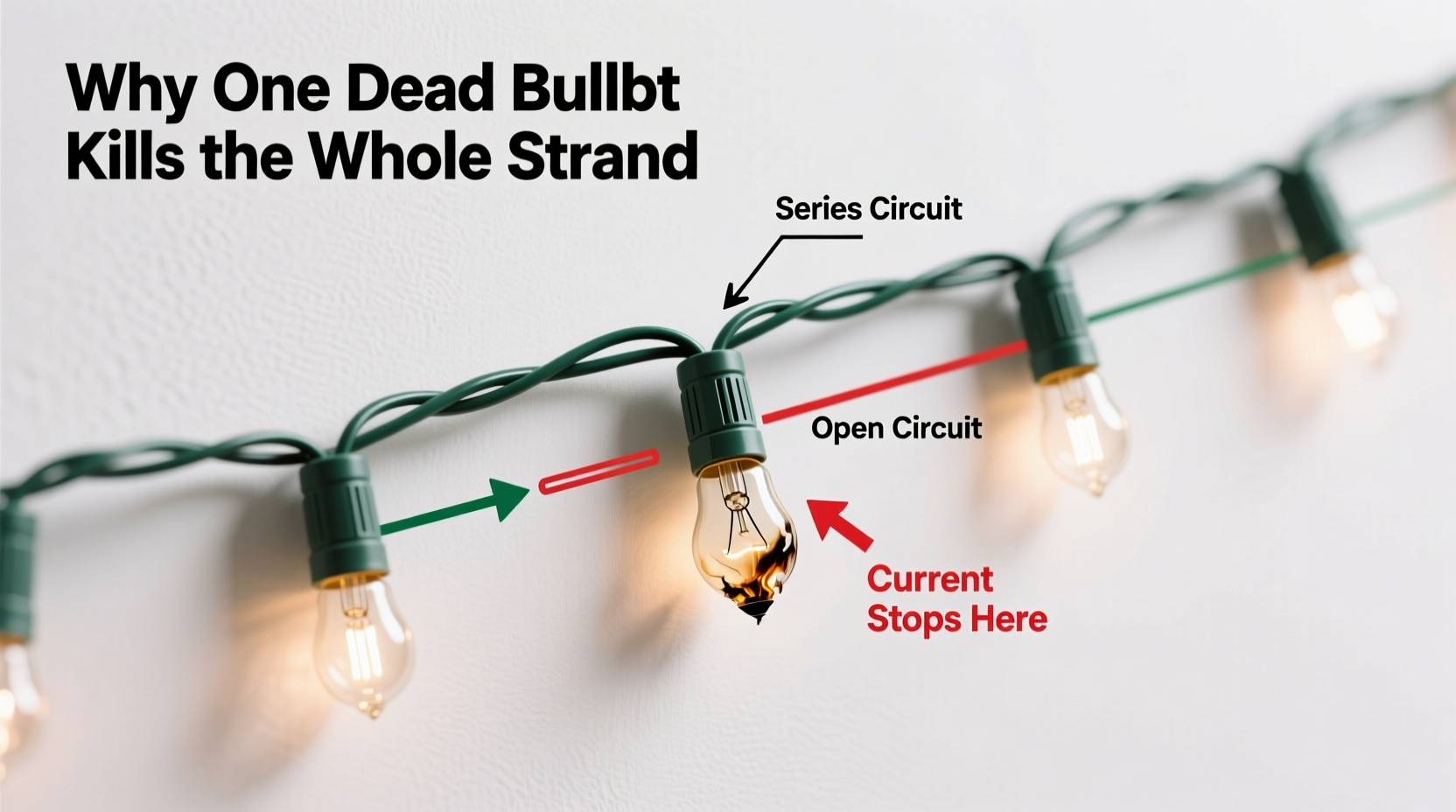
Most incandescent Christmas light strands use a **series circuit** design. In this configuration, electricity flows from the plug, through each bulb in sequence, and returns to complete the circuit. Each bulb acts like a small resistor, and the current must pass through all of them to keep the lights glowing. If any single bulb is missing, loose, or burnt out, the circuit breaks—just like cutting a wire—and no current can flow. As a result, the entire strand shuts off.
This design was historically favored for its simplicity and cost-effectiveness. Manufacturers could use lower-voltage bulbs (typically 2.5V to 3.5V) connected in series so that together they divide the standard 120V household supply evenly. For example, a strand of 40 bulbs would use 3V per bulb (40 × 3V = 120V). While efficient in production, this setup creates a fragility: one point of failure collapses the whole system.
The Role of Shunt Wires: A Built-In Backup?
Many modern mini-light strands include a hidden safety feature called a **shunt**. This is a small wire coated in insulating material that wraps around the base of the filament inside the bulb. When a bulb burns out normally (i.e., the filament breaks), heat from the initial surge can melt the coating on the shunt, allowing it to conduct electricity and bypass the broken filament. In theory, this keeps the rest of the strand lit even after a bulb fails.
However, shunts don’t always work as intended. They require a momentary surge of current to activate, which may not occur if the filament fails gradually. Additionally, physical damage, corrosion, or poor manufacturing can prevent the shunt from engaging. In such cases, the circuit remains broken, and the entire string goes dark despite having functional shunts.
Another limitation is that shunts only help when a single bulb fails. If multiple bulbs burn out or if there’s a wiring fault, the protection fails. Moreover, LED strands typically do not use shunted bulbs at all, relying instead on parallel wiring or advanced circuitry to maintain performance.
“Shunts were a clever innovation for their time, but they’re far from foolproof. Many people assume their lights will stay on after a bulb dies, but real-world conditions often defeat the design.” — Alan Reeves, Electrical Engineer & Lighting Systems Consultant
Parallel vs. Series Wiring: Why It Matters
The fundamental difference between series and parallel wiring explains why some light strings fail entirely while others remain partially lit when a bulb goes bad.
| Feature | Series Circuit Lights | Parallel Circuit Lights |
|---|---|---|
| Circuit Design | Bulbs connected end-to-end; single path for current | Each bulb has independent connection to power |
| Effect of One Failed Bulb | Entire strand turns off | Only one bulb goes dark; others stay lit |
| Voltage Per Bulb | Low (e.g., 3V) | Full line voltage (120V) or regulated via transformer |
| Common Use Case | Traditional incandescent mini-lights | Modern LED strings, commercial displays |
| Fault Diagnosis Difficulty | High – requires checking each bulb | Low – failed bulb is obvious |
Today, higher-end and LED-based decorative lights increasingly use **parallel wiring** or hybrid configurations. These systems ensure reliability and ease of maintenance. Some even integrate resistors or current-regulating chips to allow individual bulb operation without affecting neighbors. While more expensive to produce, they offer significant advantages in durability and user experience.
Step-by-Step Guide to Troubleshooting a Dead Light Strand
When your strand goes dark, follow this logical process to diagnose and resolve the issue efficiently:
- Unplug the strand before handling to avoid electrical shock.
- Inspect visually for obvious issues: missing bulbs, cracked sockets, frayed wires, or kinks in the cord.
- Check connections between sections. If using multiple strands, disconnect and test each separately.
- Examine each bulb for darkened glass, broken filaments, or looseness. Gently press each bulb into its socket to ensure contact.
- Use a light tester tool (available at hardware stores) to scan bulbs quickly. These detect voltage presence without removing bulbs.
- Replace suspect bulbs one at a time with known-good ones. Start with visibly damaged or discolored units.
- Test after each replacement to confirm whether the circuit is restored.
- Check the fuse in the plug—if accessible, replace it with an identical rated fuse (usually 3A or 5A).
If none of these steps restore function, the problem may lie in internal wire damage or a failed shunt that didn’t activate. In such cases, replacing the strand may be safer and more cost-effective than attempting repairs.
Real Example: The Holiday Display That Wouldn’t Stay On
Sarah, a homeowner in Vermont, spent hours draping her house in vintage-style incandescent lights every December. One year, her prized roofline strand kept going dark mid-display. She replaced the fuse, checked the outlet, and even bought a new timer—nothing worked consistently. After consulting an electrician, she discovered that two bulbs near the center had failed simultaneously, and their shunts never activated due to gradual filament wear. Because the strand used a series circuit, both failures broke the loop entirely.
The solution? She retrofitted her display with commercial-grade LED strings using parallel wiring. Though slightly more expensive upfront, the new lights remained fully operational even when individual bulbs eventually failed. Her holiday setup now takes less time to maintain and stays reliable throughout the season.
Prevention Checklist: Keep Your Lights Running Smoothly
- ✅ Choose LED light strands with parallel wiring when possible
- ✅ Inspect all strands before installation each season
- ✅ Store lights on reels or cardboard spools to prevent tangling and breakage
- ✅ Avoid pulling lights by the cord—this stresses internal wires
- ✅ Replace old incandescent strands showing frequent failures
- ✅ Use surge protectors and outdoor-rated extension cords
- ✅ Limit daisy-chaining to three strands unless manufacturer specifies otherwise
FAQ: Common Questions About Light Strand Failures
Can a loose bulb really turn off the whole strand?
Yes. In series-wired strings, a loose bulb breaks the electrical path just like a removed or burnt-out one. Even slight movement can disrupt conductivity, especially in older strands with worn sockets.
Why don’t all light strands use shunts?
While many do, shunts add complexity and cost. They also aren't 100% reliable. Some manufacturers skip them to reduce price, particularly in bulk or disposable-grade products. LEDs usually don't need shunts due to different circuit designs.
Is it safe to mix different types of light strands?
Mixing types—especially incandescent and LED—can cause overheating or underperformance. They draw different amounts of current and may not be compatible when daisy-chained. Always follow manufacturer guidelines and avoid combining old and new technologies unless explicitly rated for it.
Expert Recommendations for Long-Term Reliability
According to lighting specialists, the shift toward LED technology isn't just about energy savings—it's also a major leap in reliability. Modern LED strings often incorporate constant-current drivers and isolated circuits that prevent cascading failures. Some even include built-in diagnostics or blinking indicators when a fault occurs.
“Investing in quality lighting pays off in longevity and safety. Today’s best LED strands last 25,000 to 50,000 hours and rarely suffer full outages from single-point failures.” — Lena Patel, Senior Product Designer at BrightPath Lighting
Experts also recommend avoiding “value” brands sold exclusively during holiday seasons. These often cut corners on insulation, wire gauge, and connector durability. Instead, opt for UL-listed, weather-resistant models designed for repeated seasonal use.
Conclusion: Smart Choices Prevent Seasonal Frustration
The reason your strand of lights goes out when one bulb fails comes down to basic electrical engineering—specifically, series circuit dependency. While once a standard approach, this design is increasingly outdated compared to modern alternatives. By understanding how your lights are wired, recognizing early signs of failure, and upgrading to more resilient options like parallel-wired or LED strings, you can eliminate guesswork and enjoy consistent, hassle-free illumination year after year.




 浙公网安备
33010002000092号
浙公网安备
33010002000092号 浙B2-20120091-4
Comments
No comments yet. Why don't you start the discussion?