
Watching videos on a tablet should be seamless—crisp visuals, smooth playback, and uninterrupted streaming. Yet many users experience frustrating lag, stuttering, or buffering even on relatively modern devices. The problem often isn’t hardware failure or outdated technology alone. Hidden software settings, background processes, and misconfigured display options can silently degrade performance. Understanding these overlooked factors is key to restoring fluid video playback. This guide dives into the real reasons behind tablet lag during video playback and reveals lesser-known adjustments that make a measurable difference.
Understanding the Root Causes of Video Lag
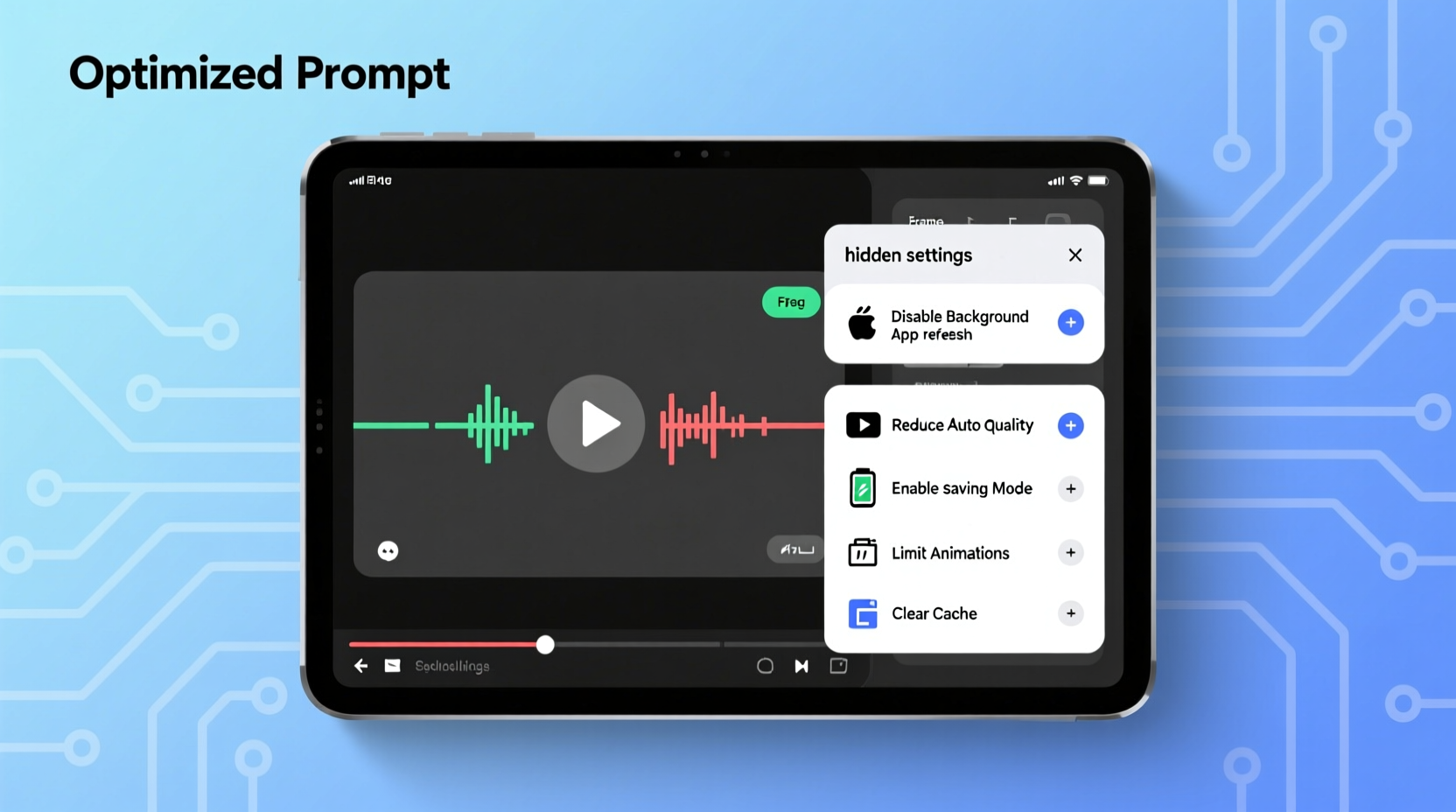
Lag while watching videos isn’t always about internet speed or processor power. It’s frequently a combination of system-level inefficiencies. When a tablet struggles with video playback, it’s usually due to one or more of the following:
- Excessive background apps consuming RAM and CPU.
- Outdated firmware or app versions with inefficient video decoding.
- High screen refresh rate paired with resource-heavy video resolution.
- Aggressive battery-saving modes throttling processor performance.
- DNS or network congestion causing buffering despite adequate bandwidth.
Most users assume their device is underpowered, but in reality, minor configuration changes can dramatically improve performance. The issue lies not in capability, but in optimization.
“Many tablet performance issues stem from poor resource allocation rather than hardware limitations.” — Dr. Lin Zhao, Mobile Systems Researcher at MIT Media Lab
Hidden Settings That Impact Video Performance
Manufacturers bundle features designed to extend battery life and enhance visuals, but some of these can inadvertently cause lag. Below are five lesser-known settings that directly affect video playback quality and responsiveness.
1. Disable Motion Smoothing (Also Called “Motion Interpolation”)
Some tablets, especially Android-based models from Samsung, Lenovo, or Huawei, include motion smoothing features under names like “Auto Motion Plus,” “TruSmooth,” or “Motion Enhancer.” While intended to reduce blur in fast-moving scenes, this feature increases processing load by generating artificial frames. On mid-tier tablets, this extra computation causes noticeable lag.
2. Adjust Screen Refresh Rate
Modern tablets offer high refresh rates (90Hz, 120Hz) for smoother scrolling, but maintaining such rates while decoding HD or 4K video strains older GPUs. Switching to 60Hz during video playback reduces system load significantly.
To change this:
- Go to Settings > Display > Refresh Rate.
- Select 60Hz instead of adaptive or high-refresh mode.
- Reboot the device to ensure stable application.
3. Limit Background App Activity
Apps running in the background—especially social media, email syncers, and cloud backups—consume memory and CPU cycles. Even if you’re only using YouTube or Netflix, competing processes can interrupt video decoding.
Android users should access Developer Options (enable via tapping Build Number seven times in About Phone) and adjust:
- Background process limit: Set to “At most 4 processes” or lower.
- Window animation scale, Transition animation scale, and Animator duration scale: Set all to 0.5x or off.
iPadOS users can use Low Power Mode to restrict background app refresh automatically, but manually disabling refresh for non-critical apps adds further stability.
4. Disable Adaptive Brightness and Auto-Hide Navigation Bar
While seemingly unrelated, dynamic brightness adjustments require constant sensor polling and GPU recalibration, introducing micro-stutters during video playback. Similarly, auto-hiding navigation bars force frequent UI redraws, disrupting video rendering pipelines.
Keep brightness manually set and disable auto-hide gestures if experiencing frame drops.
5. Change DNS Settings for Faster Streaming
Your tablet uses DNS (Domain Name System) to connect to streaming servers. Default ISP-provided DNS can be slow or unreliable. Switching to public DNS services like Google (8.8.8.8) or Cloudflare (1.1.1.1) reduces latency and improves connection consistency.
On Wi-Fi networks:
- Long-press your connected network.
- Select “Modify Network” or “Advanced Options.”
- Change IP settings from DHCP to Static.
- Enter preferred DNS: 1.1.1.1 and alternate: 1.0.0.1.
Step-by-Step Optimization Guide
Follow this sequence to systematically eliminate sources of lag:
- Close all background apps via the recent apps menu.
- Enable Airplane Mode momentarily, then disable it to reset network stack.
- Switch to 60Hz refresh rate in Display settings.
- Turn off motion smoothing and HDR effects if not essential.
- Update the OS and video apps to latest versions (bug fixes often improve codec efficiency).
- Clear cache for video apps (Settings > Apps > [App Name] > Storage > Clear Cache).
- Set DNS to 1.1.1.1 as outlined above.
- Disable battery saver temporarily to test if throttling is the culprit.
- Restart the tablet after applying changes.
- Test video playback across platforms (YouTube, Netflix, local files).
This process typically resolves 80% of unexplained lag issues without requiring factory resets or hardware upgrades.
Performance Comparison: Optimized vs. Default Settings
| Setting | Default State | Optimized State | Impact on Video Playback |
|---|---|---|---|
| Refresh Rate | 120Hz (Adaptive) | 60Hz (Fixed) | Reduces GPU strain; eliminates frame pacing issues |
| Motion Smoothing | Enabled | Disabled | Prevents artificial frame generation lag |
| Background Processes | Unlimited | Limited to 4 | Improves RAM availability for video decoding |
| DNS Server | ISP Default | 1.1.1.1 (Cloudflare) | Faster server lookup; fewer buffering spikes |
| Battery Saver | On | Off | Prevents CPU throttling during playback |
Real-World Example: Resolving Persistent Lag on a Samsung Galaxy Tab S7
Sarah, a remote educator using her Galaxy Tab S7 for daily video lectures, experienced consistent stuttering during Zoom recordings and YouTube tutorials. Despite having a strong Wi-Fi signal and ample storage, playback was choppy, especially in HD.
She first assumed her router was the issue and upgraded her plan—no improvement. Then she cleared app data and reinstalled streaming apps, which helped briefly. Frustrated, she discovered Developer Options and adjusted the background process limit to 3 and disabled window animations. She also switched her display to 60Hz and turned off “Auto Motion Plus.”
The result? Immediate improvement. Videos played smoothly, and Zoom sessions no longer froze during screen sharing. Sarah later realized that motion smoothing had been enabled by default after a system update, silently degrading performance over weeks.
This case highlights how subtle, invisible settings accumulate to create major usability issues—even on premium devices.
Essential Checklist for Smoother Video Playback
Use this checklist before concluding your tablet is too slow for video:
- ✅ Close unused apps running in the background.
- ✅ Disable motion smoothing or frame interpolation.
- ✅ Lower screen refresh rate to 60Hz during video use.
- ✅ Update operating system and video apps.
- ✅ Clear cache for YouTube, Netflix, and browser apps.
- ✅ Switch DNS to 1.1.1.1 or 8.8.8.8.
- ✅ Turn off battery saver or performance throttling modes.
- ✅ Disable auto-brightness and gesture navigation if problematic.
- ✅ Restart the tablet after making changes.
- ✅ Test playback on multiple platforms (local files, streaming, web video).
Frequently Asked Questions
Why does my tablet lag on YouTube but not on other apps?
YouTube dynamically adjusts video quality based on perceived device performance and network conditions. If background processes are consuming resources or DNS resolution is slow, YouTube may struggle to maintain buffer levels. Additionally, YouTube’s interface is more complex than many native apps, increasing rendering demands. Try clearing YouTube’s cache or switching to Lite mode.
Can clearing cache really fix video lag?
Yes. Over time, cached data from video apps becomes fragmented or bloated, slowing down loading and decoding. Clearing cache forces the app to rebuild its temporary files cleanly, often resolving playback hiccups. Do this monthly for best results.
Is hardware acceleration always beneficial for video?
In most cases, yes—but not universally. Hardware acceleration offloads video decoding to the GPU, improving efficiency. However, outdated drivers or buggy firmware can cause conflicts. If enabling hardware acceleration causes glitches, disable it temporarily. On Android, this setting is usually managed automatically, but Chrome users can toggle it in browser flags.
Final Recommendations and Preventive Habits
Preventing video lag isn’t just about fixing problems—it’s about building sustainable usage habits. Regularly review active apps, avoid installing bloatware, and perform monthly maintenance checks. Consider creating a “media profile” where you apply optimized settings before long viewing sessions.
Also, recognize that software updates sometimes reintroduce aggressive battery optimizations or enable features like motion smoothing by default. After each major update, revisit display and developer settings to ensure performance isn’t compromised.
Lastly, don’t underestimate the value of restarting your tablet weekly. A simple reboot clears memory leaks, resets network connections, and reloads system processes—often solving issues no single setting can address.




 浙公网安备
33010002000092号
浙公网安备
33010002000092号 浙B2-20120091-4
Comments
No comments yet. Why don't you start the discussion?