
It’s a familiar holiday scene: festive decorations glow in the living room, carols play softly—and your toddler bursts into tears the moment the string of lights flickers on. You double-check for hunger, fatigue, or discomfort, but nothing obvious explains the reaction. This isn’t misbehavior or attention-seeking. It’s a neurologically grounded response rooted in how young brains process light, motion, and unpredictability. For parents navigating the first few holiday seasons with a toddler, this reaction can feel isolating or even embarrassing—especially amid social expectations to “just enjoy the magic.” But understanding the science behind it transforms confusion into compassion, and overwhelm into actionable support.
The Neurological Basis: Why Flashing Light Triggers Distress
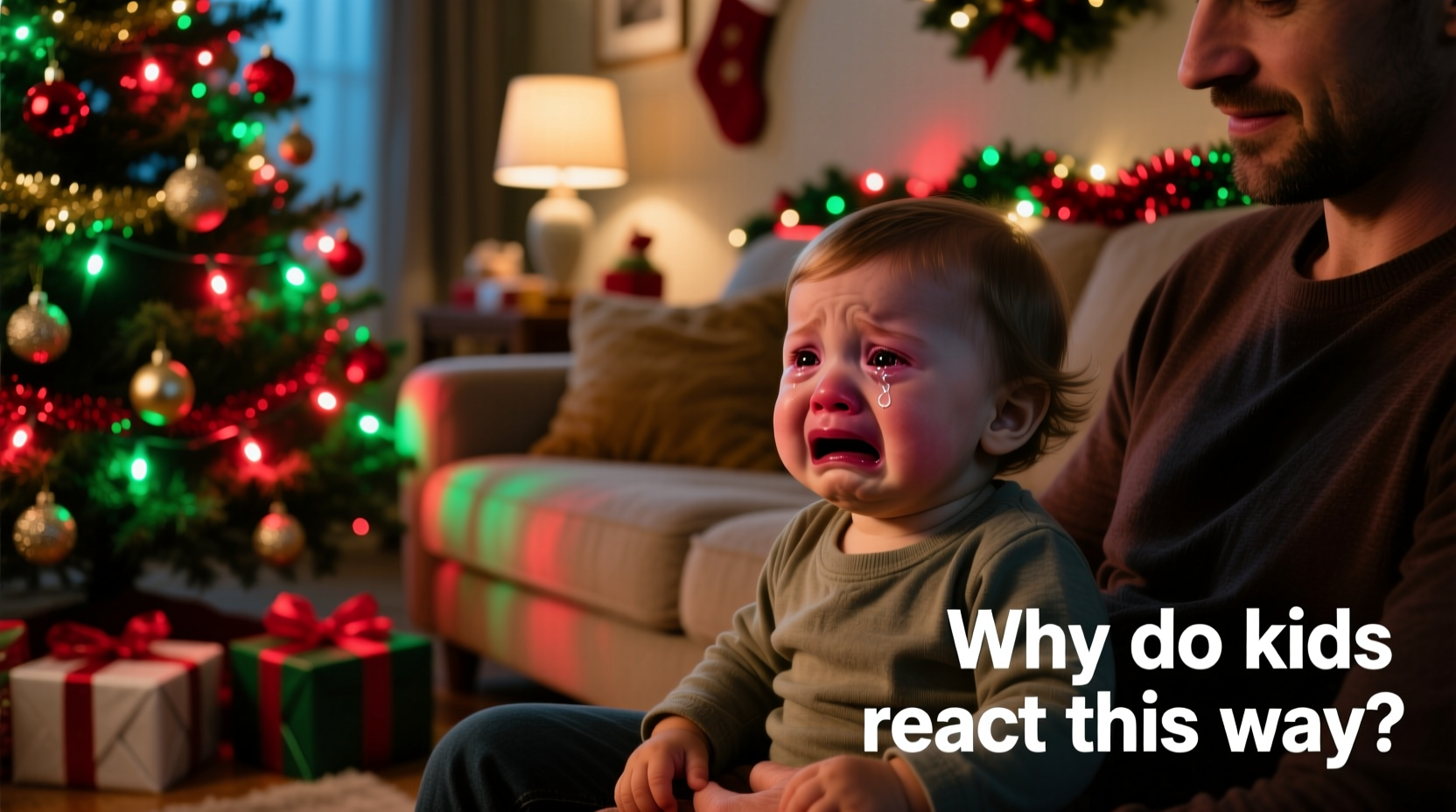
Toddlers’ visual systems are still maturing. The retina, optic nerve, and visual cortex undergo rapid development between 12 and 36 months—particularly in how they filter, integrate, and interpret complex visual stimuli. Flashing lights introduce three distinct neurological stressors:
- Rapid temporal contrast: Most holiday lights pulse between 2–10 Hz (flashes per second). That frequency overlaps with the brain’s natural “flicker fusion threshold”—the point at which discrete flashes merge into continuous light. In adults, this threshold is typically 50–90 Hz; in toddlers, it’s often as low as 15–25 Hz. Below that threshold, each flash registers as a jarring, high-contrast event—not smooth illumination.
- Lack of predictive rhythm: Unlike steady lights or rhythmic music, many LED strings use irregular or randomized flash patterns (e.g., chasing, twinkling, or fading sequences). The toddler’s developing prefrontal cortex hasn’t yet built robust predictive models for such unpredictability—making the visual input feel threatening rather than playful.
- Overactivation of the superior colliculus: This midbrain structure coordinates eye movements and orienting responses to sudden visual changes. In toddlers, it’s disproportionately reactive. A flash triggers an involuntary “startle-orient” reflex—similar to jumping at a loud noise—followed by physiological arousal (increased heart rate, cortisol release) before higher-order regulation kicks in.
This isn’t hypersensitivity in the emotional sense—it’s neurological immaturity. As Dr. Sarah H. Johnson, pediatric neurologist and author of Sensory Development in Early Childhood, explains:
“Flashing lights don’t ‘bother’ toddlers the way a loud noise might bother an adult. They literally hijack primitive neural circuits before the child has the capacity to modulate the response. Crying is the brain’s honest signal: ‘This input exceeds my current processing bandwidth.’” — Dr. Sarah H. Johnson, Pediatric Neurologist
Sensory Processing Differences: Beyond Typical Development
While all toddlers have immature sensory regulation, some experience more pronounced differences—often falling along the spectrum of Sensory Processing Disorder (SPD), though not necessarily meeting clinical criteria. SPD affects how the nervous system receives, organizes, and responds to sensory information. Visual over-responsivity—the most common subtype in toddlers reacting to lights—is characterized by:
- Heightened detection of brightness, contrast, and movement
- Delayed habituation (the ability to tune out repeated stimuli)
- Strong autonomic reactions: pupil dilation, blinking spasms, turning away, or full-body withdrawal
- Secondary emotional responses: anxiety, frustration, or meltdowns when unable to escape the stimulus
Crucially, visual over-responsivity rarely occurs in isolation. It frequently co-occurs with sensitivities to sound (e.g., jingling bells), texture (e.g., tinsel), or olfactory input (e.g., pine scent). A toddler who cries at flashing lights may also cover their ears near a choir or refuse to touch glittery ornaments—not because they’re “picky,” but because their nervous system is managing multiple simultaneous demands.
Developmental Context: What’s Normal, What’s Worth Monitoring
Reactivity to flashing lights peaks between 18–30 months and typically diminishes by age 4–5 as visual processing matures and top-down regulation strengthens. However, developmental timing varies widely. The table below outlines key milestones and red flags:
| Age Range | Typical Response to Flashing Lights | Potential Concerns Requiring Further Observation |
|---|---|---|
| 12–18 months | Mild startle, brief gaze aversion, or curiosity mixed with caution | Persistent crying or screaming *every time* lights appear—even dimmed or distant; refusal to enter rooms with lights on |
| 18–30 months | Variable tolerance: may tolerate slow, rhythmic pulses but protest erratic flashes; may seek proximity to caregiver during exposure | Self-injurious behavior (e.g., hitting eyes, head-banging); complete shutdown (freezing, unresponsiveness); regression in speech or motor skills coinciding with holiday season |
| 30–48 months | Increasing tolerance with scaffolding (e.g., watching lights from doorway, then closer); may verbalize preferences (“No blink!” or “Soft lights!”) | No improvement despite consistent, gentle exposure; extreme avoidance interfering with daily routines (e.g., refusing to go to stores, restaurants, or family gatherings) |
Importantly, no single reaction confirms a diagnosis—but persistent, intense, or escalating distress warrants discussion with your pediatrician or a pediatric occupational therapist specializing in sensory integration.
Practical Strategies: Supporting Your Toddler Without Removing the Joy
Removing all flashing lights isn’t necessary—or advisable. Controlled, respectful exposure builds neural resilience. The goal isn’t elimination, but co-regulation: helping your child feel safe while gradually expanding their capacity to process dynamic visual input. Here’s a step-by-step guide grounded in occupational therapy best practices:
- Assess & Adapt First: Before introducing lights, observe your toddler’s baseline state. Are they well-rested? Not hungry? Calm? Introduce lights only when they’re regulated—not during transitions or fatigue.
- Start with Static Light: Use warm-white, non-flashing LED strings or battery-operated fairy lights on a steady setting. Let your toddler explore them visually and tactilely (if safe) without movement or change.
- Introduce Predictable Rhythm: Choose lights with a slow, regular pulse (e.g., 1-second on/1-second off). Narrate it: “Watch—light… dark… light… dark.” This builds predictability and reduces threat.
- Control Distance & Duration: Begin with lights placed across the room (6+ feet). Limit initial exposure to 30 seconds. Gradually increase duration and decrease distance over days or weeks—not hours.
- Offer Agency & Exit Options: Give choices: “Do you want to watch from here, or hold this soft light?” Always honor “no” and provide a quiet, dim space nearby where they can retreat without shame.
This approach respects neurodevelopmental reality while honoring your family’s desire to celebrate meaningfully.
Real-World Example: Maya’s Story (Age 27 Months)
Maya had cried uncontrollably every time her grandmother turned on the porch lights—bright, multicolored LEDs with a rapid “chasing” effect. Her parents initially assumed she was afraid of the dark until they noticed she also covered her eyes during video calls with animated backgrounds. Working with a pediatric OT, they implemented a four-week plan:
- Week 1: Removed all flashing lights; used only warm, static string lights in her bedroom. She watched them while snuggled on the couch, no pressure to interact.
- Week 2: Introduced a single slow-pulse light (3-second cycle) on a side table. Her mom narrated the rhythm and let Maya press the on/off button herself.
- Week 3: Added a second light with identical rhythm. Maya began pointing and smiling at the “dance” of light and dark.
- Week 4: Returned to the porch—but with the original string set to “steady” mode. Maya stood beside her dad, holding his hand, for 90 seconds. By week 6, she’d walk up the steps independently and say, “My lights.”
Maya’s progress wasn’t linear—some days required stepping back—but consistency, patience, and honoring her nervous system’s pace made the difference. Her parents didn’t “fix” her sensitivity; they expanded her capacity to engage with it safely.
Frequently Asked Questions
Could this be a sign of epilepsy or photosensitive disorder?
True photosensitive epilepsy is rare in toddlers under age 3 and almost always involves additional symptoms: staring spells, jerking movements, loss of awareness, or post-episode confusion. Isolated crying or distress in response to lights—without neurological signs—is not indicative of epilepsy. If you observe any of those symptoms, consult your pediatrician immediately for EEG evaluation.
Should I avoid all holiday lights around my toddler?
No. Avoidance reinforces fear and limits sensory growth. Instead, prioritize control, predictability, and choice. Use dimmable lights, opt for warm color temperatures (2700K–3000K), choose steady or slow-pulse modes, and keep intensity low. Many families find success with fiber-optic trees or projection lights that offer soft, diffuse illumination without harsh flashes.
Will my child outgrow this?
In most cases, yes—especially with supportive exposure. Studies show 78% of toddlers with visual over-responsivity show significant improvement by age 4.5, and over 92% by age 6. However, some children retain a preference for calmer visual environments, and that’s perfectly valid. Maturity doesn’t mean eliminating sensitivity—it means developing tools to navigate it.
Conclusion: Reframing the Reaction as Communication, Not Defiance
Your toddler’s tears in front of flashing Christmas lights aren’t a failure of parenting, a flaw in your decorations, or a sign something is “wrong” with your child. They’re a precise, biologically honest message: “My brain is working hard to make sense of this world—and right now, it needs support.” Every time you pause, kneel to their eye level, soften your voice, and offer choice instead of correction, you strengthen the very neural pathways that will one day allow them to appreciate light shows with wonder instead of overwhelm. You’re not just getting through the holidays—you’re laying down foundational wiring for self-regulation, trust, and resilience.
This season, let your compassion be as bright as your tree. Prioritize presence over perfection. Celebrate small moments of connection over flawless traditions. And remember: the most meaningful holiday magic isn’t in the sparkle of the lights—it’s in the quiet courage of a parent choosing empathy over expectation, again and again.




 浙公网安备
33010002000092号
浙公网安备
33010002000092号 浙B2-20120091-4
Comments
No comments yet. Why don't you start the discussion?