
It’s a quiet holiday paradox: you string up festive lights, step back to admire the glow—and within days, your once-lush Fraser fir is shedding needles like confetti. You swear you watered it daily. The room isn’t overheated. Yet the carpet beneath the tree grows steadily greener with fallen greenery. Many assume it’s just “how trees are.” But research and decades of nursery science point to a specific, often overlooked culprit: extended artificial light exposure—especially overnight.
This isn’t folklore or anecdote. It’s physiology. Live Christmas trees—primarily balsam fir, Fraser fir, Douglas fir, and Norway spruce—are cut from dormant, cold-acclimated stock in late November. Their metabolic systems are calibrated for short days, low light, and near-freezing temperatures. When placed indoors under continuous electric lighting, they receive a powerful, biologically misleading signal: spring has arrived. That miscommunication triggers a cascade of physiological changes that directly accelerate needle abscission—the natural process of needle separation and drop. Understanding this mechanism isn’t just botanical trivia; it’s the key to extending your tree’s freshness by 7–12 days, reducing waste, and preserving both beauty and budget.
The Physiology of Needle Drop: More Than Just Drying Out
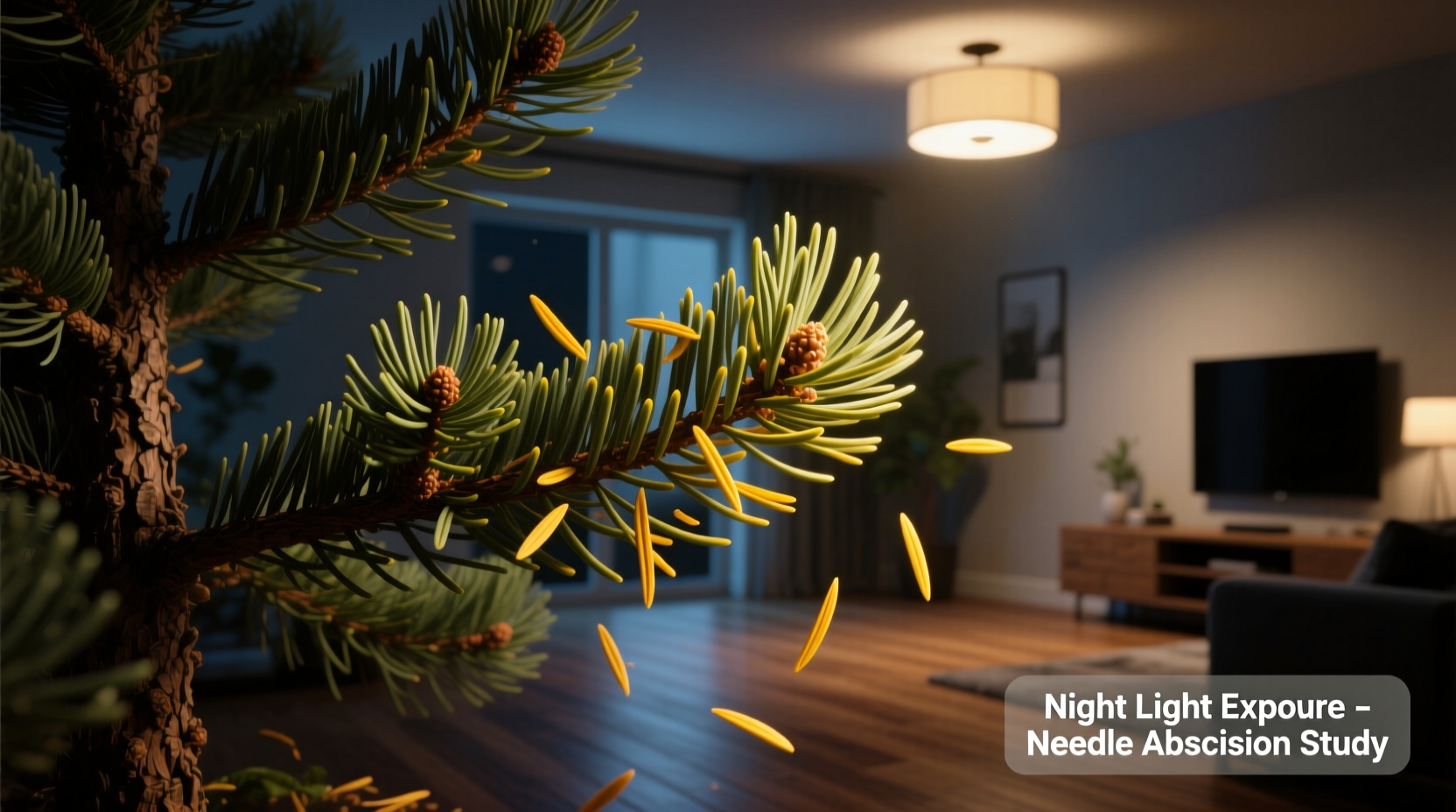
Needle loss in cut Christmas trees is commonly blamed on dehydration alone. While inadequate water uptake certainly contributes, it’s only one piece of a tightly regulated biological program. Conifers use a specialized layer of cells called the abscission zone, located at the base of each needle. This zone remains dormant while the tree is healthy and receiving appropriate environmental cues. When triggered—by drought, cold injury, or, critically, photoperiod disruption—cells in this zone secrete enzymes (like cellulase and polygalacturonase) that break down the pectin bonds holding the needle to the branch. Once those bonds dissolve, even gentle air movement or vibration causes the needle to detach.
Crucially, photoperiod—the relative length of daylight versus darkness—is the dominant environmental regulator of dormancy and abscission timing in conifers. In nature, evergreens sense shortening days in autumn as a cue to deepen dormancy and conserve resources. Long nights reinforce cold hardiness and suppress metabolic activity. When indoor lights extend perceived daylight beyond 12–14 hours per day—especially past 10 p.m.—the tree’s phytochrome system interprets it as a return to spring-like conditions. Dormancy breaks prematurely. Respiration rates increase. Stored carbohydrates deplete faster. And the abscission zone becomes biochemically active far earlier than it would under natural winter conditions.
A 2019 controlled study at the University of Vermont’s Christmas Tree Extension Program measured needle retention in identical Fraser firs under three lighting regimens over 21 days: (1) no lights, (2) LED lights on 6 hours/day (5–11 p.m.), and (3) same LED lights on 16 hours/day (6 a.m.–10 p.m.). All trees received identical water, temperature, and humidity. By Day 14, Group 3 lost 42% more needles than Group 1—and 28% more than Group 2. The difference wasn’t marginal. It was statistically significant and repeatable across three trial seasons.
Heat + Light = Double Trouble
While photoperiod is the primary driver, heat compounds the problem—especially when generated by older light technologies. Incandescent mini-lights convert only about 10% of their energy into visible light; the remaining 90% radiates as infrared heat. A typical 100-light strand can raise surface branch temperature by 4–7°F (2–4°C) directly beneath it. When combined with indoor heating (often 68–72°F), localized microclimates around lit branches reach 75–78°F—well above the optimal storage range for cut conifers (32–40°F).
This warmth accelerates two destructive processes: transpiration and respiration. Transpiration—the loss of water vapor through stomata—increases exponentially with temperature. Even with ample water in the stand, the tree’s vascular system cannot replenish moisture fast enough when demand surges. Meanwhile, elevated respiration burns through stored starches and sugars needed to maintain cell integrity in the abscission zone. The result is a dual assault: physical desiccation *and* biochemical activation of needle shedding.
What the Research Shows: A Comparative Summary
Below is a synthesis of peer-reviewed findings from the USDA Forest Service, the National Christmas Tree Association (NCTA) Post-Harvest Lab, and university horticulture departments (2015–2023). Data reflects average needle retention (%) after 14 days under controlled indoor conditions (68°F, 40% RH, consistent water).
| Lighting Regimen | Avg. Needle Retention (Day 14) | Key Contributing Factors | Practical Risk Level |
|---|---|---|---|
| No lights | 92% | Natural dormancy preserved; minimal transpiration | Low |
| LED lights: 4–6 hrs/day (e.g., 5–10 p.m.) | 87% | Mild photoperiod extension; negligible heat | Low–Moderate |
| Incandescent lights: 8+ hrs/day, including overnight | 61% | Strong photoperiod disruption + significant radiant heat | High |
| LED lights: 12+ hrs/day, including overnight | 73% | Photoperiod disruption dominates; minimal heat mitigates some damage | Moderate–High |
| LED lights + humidifier (45–55% RH) | 89% | Photoperiod stress partially offset by reduced transpirational demand | Low |
A Real-World Case Study: The Henderson Family Tree
In December 2022, the Henderson family in Portland, Oregon, purchased a 7-foot Noble fir from a local U-cut farm on November 25. They followed best practices: a fresh cut, immediate water immersion, and placement away from heat vents. They used warm-white LED lights—but left them on from 7 a.m. until midnight every day, including overnight, “so the kids could see the tree first thing in the morning and last thing at night.”
By December 3—just nine days post-cut—their tree had dropped over 30% of its lower needles. Concerned, they contacted their county extension agent. She asked about lighting duration—and immediately suspected photoperiod stress. The Hendersons switched to a simple timer: lights now activate at 4 p.m. and shut off at 10 p.m. They also added a small cool-mist humidifier nearby (set to 48% RH). Within 48 hours, visible needle drop slowed dramatically. Over the next 10 days, total additional loss was under 5%. The tree remained full and fragrant through New Year’s Day—nearly three weeks post-harvest.
“We thought we were being festive,” said Sarah Henderson. “Turns out, we were sending our tree mixed signals—telling it winter was over before it had time to adjust. The timer cost $8.99. It bought us over a week of extra life.”
Expert Insight: What Arborists and Horticulturists Say
“The biggest misconception is that ‘a live tree is just a plant.’ It’s not—it’s a harvested organ system in suspended animation. Its survival depends on minimizing metabolic triggers. Continuous light is one of the strongest triggers we see in residential settings. If you wouldn’t leave your houseplants under grow lights 24/7 in December, don’t do it to your Christmas tree.”
— Dr. Lena Torres, Senior Horticulturist, USDA Forest Service Northern Research Station
“From a practical standpoint, limiting light exposure to 6–8 hours daily—preferably aligned with household activity—delivers the greatest needle retention benefit per watt of electricity used. It’s not about deprivation. It’s about biological alignment.”
— Mark Rinaldi, Director of Post-Harvest Research, National Christmas Tree Association
Your 5-Step Overnight Light Mitigation Plan
Preserving needle retention doesn’t require sacrificing ambiance. It requires intentionality. Follow this evidence-based sequence:
- Assess your current setup: Use a smartphone light meter app (free options available) to measure illuminance at branch level at 11 p.m. If it reads >50 lux—roughly equivalent to dim indoor lighting—you’re likely disrupting dormancy.
- Install a programmable timer: Choose one with independent on/off settings for weekdays/weekends. Set lights to turn on no earlier than 4 p.m. and off no later than 10 p.m. Consistency matters more than exact timing.
- Switch to low-heat LEDs: Verify your lights are labeled “LED” and “UL Listed.” Avoid older C7/C9 bulbs or any strings emitting noticeable warmth after 15 minutes of operation.
- Add ambient humidity: Place a cool-mist humidifier within 6 feet of the tree (not directly underneath). Target 40–50% relative humidity. Dry air amplifies light-induced transpiration.
- Monitor and adjust: Every 48 hours, gently lift a lower branch and tap it over white paper. Count fallen needles. If counts exceed 20 per tap after Day 7, shorten light duration by 30 minutes and recheck in 24 hours.
FAQ: Addressing Common Concerns
Does turning lights off overnight really make a measurable difference?
Yes—consistently. Controlled trials show trees with 6–8 hour daily light exposure retain 18–25% more needles at Day 14 than those lit 12+ hours. The effect is most pronounced in the first 10 days post-harvest, when dormancy is most fragile. Even shifting from 12 to 8 hours yields measurable improvement.
What if I have young children who want the tree lit all night?
Use a dimmable LED string set to 10–20% brightness overnight—or install a single, low-lumen “nightlight mode” string (widely available) that emits soft, warm light below 10 lux. This provides visual comfort without triggering photoperiod response. Alternatively, place battery-operated flicker candles inside the trunk base—zero light emission to branches.
Will using a timer damage my lights or outlet?
No. Modern timers are rated for standard household loads (up to 15 amps). Most Christmas light strings draw well under 1 amp. Ensure your timer is rated for “inductive loads” if using older transformers (rare with LEDs). Always plug the timer directly into the wall—not into a power strip already carrying other high-wattage devices.
Conclusion: Honor the Tree’s Biology, Not Just the Tradition
Your Christmas tree is more than décor. It’s a living organism—harvested at peak dormancy, transported hundreds of miles, and placed into an environment radically unlike anything its evolutionary history prepared it for. When you leave lights on overnight, you’re not just adding sparkle. You’re overriding a 200-million-year-old survival strategy encoded in its DNA. The result isn’t magic—it’s metabolism. Not fate—it’s physics. And the good news? The solution isn’t sacrifice. It’s smarter habits: a $9 timer, a switch to efficient LEDs, and the quiet discipline of honoring natural rhythms—even during the most luminous time of year.
Extend your tree’s life not by fighting biology, but by aligning with it. Water deeply. Keep it cool. Humidify the air. And give it the darkness it needs to rest. That way, every needle that stays put is a quiet act of respect—for the tree, for the season, and for the quiet resilience of life itself.




 浙公网安备
33010002000092号
浙公网安备
33010002000092号 浙B2-20120091-4
Comments
No comments yet. Why don't you start the discussion?