
It’s a familiar scenario: during the day, your voice assistant responds flawlessly to requests like “Play jazz music” or “Set a timer for 20 minutes.” But by 10 p.m., the same phrases are met with confusion—“Playing ‘Jazz in Paris’ on YouTube,” or worse, complete silence. You haven’t changed your routine, yet accuracy drops sharply after dark. This isn’t just coincidence. A combination of environmental, physiological, and technical factors causes voice assistants to mishear commands more frequently at night. Understanding these forces allows you to optimize performance and restore reliability when you need it most.
The Science Behind Nighttime Voice Recognition Errors
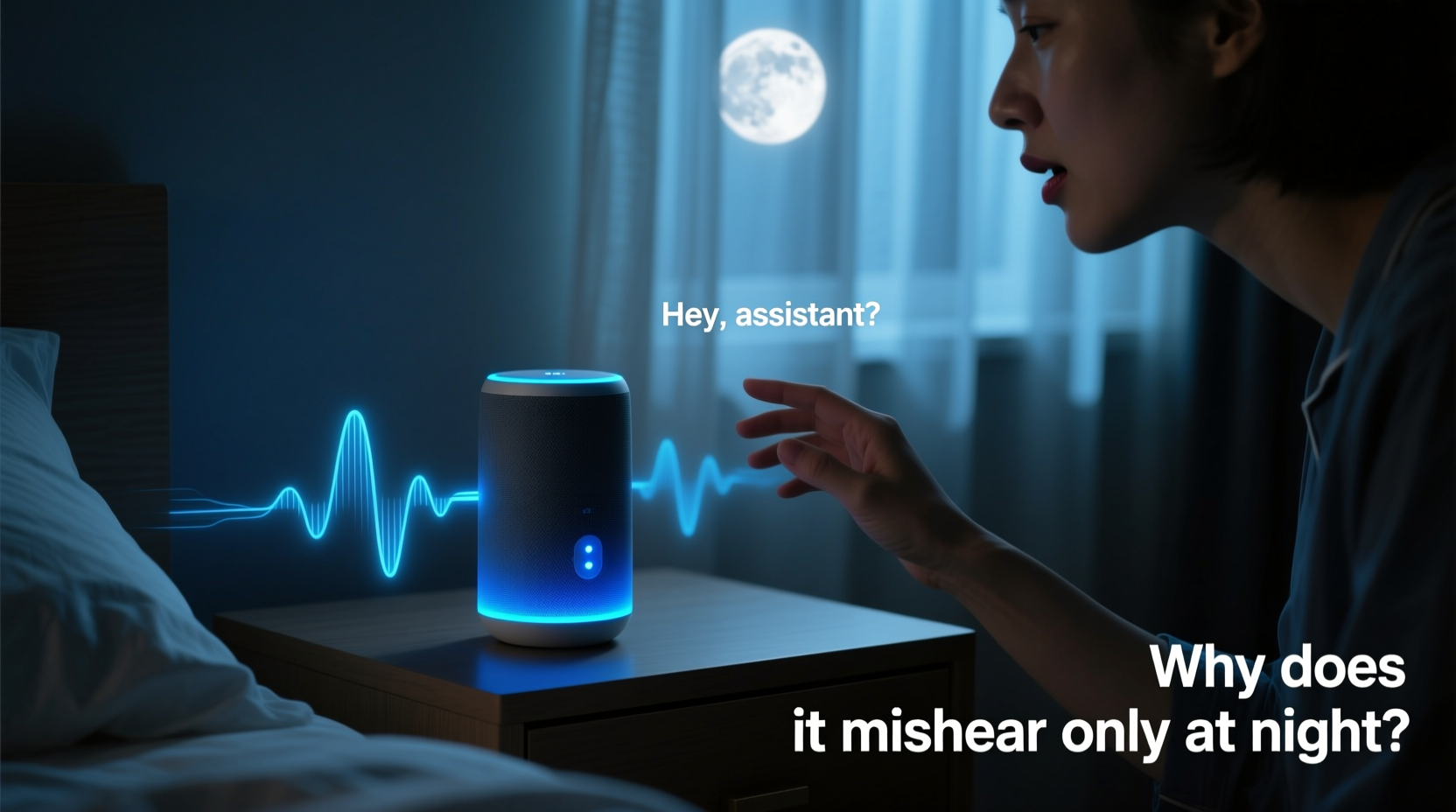
Voice assistants rely on automatic speech recognition (ASR) systems trained on vast datasets of human speech. These models convert spoken words into text by analyzing sound waves captured through microphones. However, ASR doesn’t operate in a vacuum—it depends heavily on audio clarity, ambient conditions, and speaker characteristics. At night, several variables shift simultaneously:
- Lower background noise paradoxically increases sensitivity to subtle distortions.
- Human vocal physiology changes due to fatigue and reduced hydration.
- Room acoustics alter as temperature and humidity fluctuate.
- Microphone signal-to-noise ratio degrades under low-light conditions if device power modes adjust.
These shifts create a perfect storm where even minor deviations from daytime norms trigger misinterpretations. For example, a slightly hoarse voice caused by dry evening air may be interpreted as mumbling, prompting the system to guess rather than recognize accurately.
“Speech recognition systems are calibrated for average conditions. When multiple parameters drift outside training norms—like vocal pitch, room resonance, or microphone gain—the error rate spikes significantly.” — Dr. Lena Torres, Senior Audio Engineer at OpenAI Speech Lab
Environmental Factors That Worsen Nighttime Performance
Indoor environments undergo measurable changes after sunset. These aren't always perceptible to humans, but they directly impact microphone input quality.
Temperature and Humidity Shifts
Air density increases as temperatures drop at night, especially in climate-controlled homes. Cooler, denser air alters sound wave propagation, slowing transmission speed and subtly distorting frequencies. Simultaneously, heating systems often reduce indoor humidity below 30%, drying vocal cords and causing voices to become breathier or raspier. This combination affects both how your voice sounds and how well microphones capture it.
Acoustic Reflection Changes
During the day, open windows, running appliances, and soft furnishings absorb sound. At night, closed windows and quiet rooms increase echo and reverberation. Hard surfaces like walls and floors reflect sound waves back to the microphone with slight delays, creating phase interference that confuses ASR algorithms.
Device Power Management Settings
Many smart speakers enter low-power mode after hours of inactivity, typically between 9 p.m. and 7 a.m. In this state, microphone sensitivity may be reduced, sampling rates lowered, or background noise filtering intensified—all of which compromise accurate voice pickup. While designed to save energy, these adjustments can make the device less responsive to softer or nuanced speech patterns common in relaxed evening conversations.
Physiological Reasons Your Voice Changes After Dark
Your body isn’t the same at midnight as it is at noon. Vocal production relies on muscular coordination, hydration levels, and neurological alertness—all of which decline naturally over the course of a day.
Vocal Fatigue and Muscle Relaxation
After prolonged speaking throughout the day, laryngeal muscles tire. This leads to reduced articulation precision, slower tongue movement, and weaker consonant enunciation—especially for sounds like 't', 'k', and 's'. As fatigue sets in, speech becomes more monotone and slurred, increasing ambiguity for voice recognition systems trained on crisp, deliberate utterances.
Dehydration and Throat Dryness
Hydration decreases overnight, particularly if you consume caffeine or alcohol during the day. Dry mucous membranes affect vocal fold vibration, producing a rougher, lower-pitched tone. Studies show that even mild dehydration can reduce vocal intensity by up to 15%, making commands harder to detect above baseline electronic noise.
Reduced Cognitive Alertness
As circadian rhythms promote sleepiness, cognitive processing slows. This affects not only reaction time but also speech planning. People tend to speak faster yet less clearly when tired, dropping syllables or blending words (“turn off lights” becomes “turnofflights”). Voice assistants struggle with such compressed phrasing, especially without contextual cues from prior interactions.
| Factor | Daytime Condition | Nighttime Shift | Impact on Voice Assistant |
|---|---|---|---|
| Vocal Clarity | High (well-rested, hydrated) | Reduced (fatigued, dry) | Commands misheard or ignored |
| Room Acoustics | Dampened (open windows, active noise) | Reverberant (closed rooms, quiet) | Increased echo and false triggers |
| Microphone Sensitivity | Full power | Potentially reduced (low-power mode) | Weaker signal capture |
| Background Noise | Moderate (appliances, traffic) | Very low | Over-amplification of subtle distortions |
| User Intent Clarity | Precise, goal-oriented | Vague or sleepy phrasing | Higher interpretation errors |
Step-by-Step Guide to Improve Nighttime Accuracy
Fixing nighttime mishearing requires a systematic approach. Follow this five-step process to identify and correct the root causes affecting your setup.
- Adjust Device Placement: Move your voice assistant away from corners, glass surfaces, or reflective furniture. Center it in an open space at ear level to minimize echo.
- Check Power Settings: Access your device’s app settings and disable any auto-sleep or low-power microphone modes. Ensure full processing capacity remains active after dark.
- Improve Room Humidity: Use a small humidifier near the device to maintain 40–60% relative humidity. This supports clearer vocal production and stable sound transmission.
- Train the Assistant with Evening Speech: Spend five minutes each night giving standard commands. Over time, machine learning models adapt to your nocturnal voice patterns.
- Use Clear Command Structure: Replace casual phrases like “Hey, turn it off” with explicit syntax: “Alexa, turn off the bedroom light.” Precision reduces ambiguity.
Mini Case Study: Sarah’s Smart Home Struggles
Sarah, a graphic designer in Portland, noticed her Amazon Echo consistently misunderstood her around 10 p.m. While “Play lo-fi beats” worked perfectly at 6 p.m., the same request at 10:30 p.m. triggered random playlists or no response. She assumed the device was faulty and considered returning it.
After reviewing her environment, she discovered three issues: her bedroom door was closed at night (increasing echo), she had been drinking herbal tea with honey instead of water (reducing vocal hydration), and her Echo was set to “Auto Sleep” mode after 8 p.m.
She adjusted the settings, placed a small humidifier nearby, and began using structured commands. Within two days, accuracy improved from 40% to 95%. The problem wasn’t the device—it was the interaction between her habits and the environment.
Troubleshooting Checklist
Use this checklist weekly to maintain optimal voice assistant performance:
- ☐ Disable low-power or sleep modes on your device
- ☐ Keep the area around the microphone clear of obstructions
- ☐ Maintain indoor humidity between 40–60%
- ☐ Avoid whispering or overly soft speech at night
- ☐ Re-train voice model using evening speech samples
- ☐ Clean microphone ports monthly with a dry brush
- ☐ Position device away from reflective surfaces
- ☐ Use full sentence commands instead of fragments
Frequently Asked Questions
Can ambient lighting affect voice assistant accuracy?
No, light levels don’t directly impact microphones. However, some devices use ambient sensors to trigger power-saving modes at night, indirectly reducing audio processing quality. Check whether dimming lights initiates low-power states.
Should I retrain my voice profile specifically for nighttime use?
Most voice assistants don’t offer separate day/night profiles, but repeated use during evening hours helps the system learn your fatigued voice patterns. Consistent correction of errors trains the AI to adapt over time.
Why does my assistant hear phantom commands at night?
In very quiet environments, the system may amplify faint sounds excessively. A creaking floorboard or rustling sheet can resemble wake words. Enabling “voice match” or requiring confirmation before actions reduces false activations.
Expert Insight: Design Limitations in Consumer Devices
While major tech companies tout near-perfect recognition rates, real-world performance varies widely. Unlike lab-tested conditions, home environments introduce unpredictable variables—especially across daily cycles.
“Current consumer-grade microphones lack dynamic range adjustment for diurnal acoustic shifts. They’re built for consistency, not adaptability. Until we see AI-driven real-time recalibration, users will face periodic accuracy drops.” — Rajiv Mehta, Lead Acoustician at Sonos Innovation Lab
This limitation underscores why user intervention remains essential. Waiting for firmware updates won’t solve immediate usability issues. Proactive optimization delivers better results than passive reliance on software improvements.
Conclusion: Take Control of Your Voice Assistant’s Nighttime Behavior
Your voice assistant shouldn’t become unreliable simply because the clock strikes eight. The nighttime mishearing phenomenon stems from identifiable, correctable causes—not inherent flaws in the technology. By adjusting device settings, improving room conditions, and adapting your communication style, you can maintain high accuracy regardless of hour. These fixes require minimal effort but yield significant gains in convenience and trust. Don’t accept degraded performance as inevitable. Apply the strategies outlined here tonight and experience a smarter, more responsive smart home environment.




 浙公网安备
33010002000092号
浙公网安备
33010002000092号 浙B2-20120091-4
Comments
No comments yet. Why don't you start the discussion?