
Voice cracking while singing is a common frustration—whether you're a beginner or an experienced vocalist. It can happen unexpectedly, especially when reaching higher notes or sustaining phrases. While occasional breaks are normal, frequent cracking often signals underlying issues in technique, breath support, or vocal health. The good news: most causes are correctable with targeted exercises and mindful practice. Understanding the mechanics behind the break and applying consistent training can restore smooth transitions across your range and boost confidence in performance.
The Science Behind Vocal Cracks
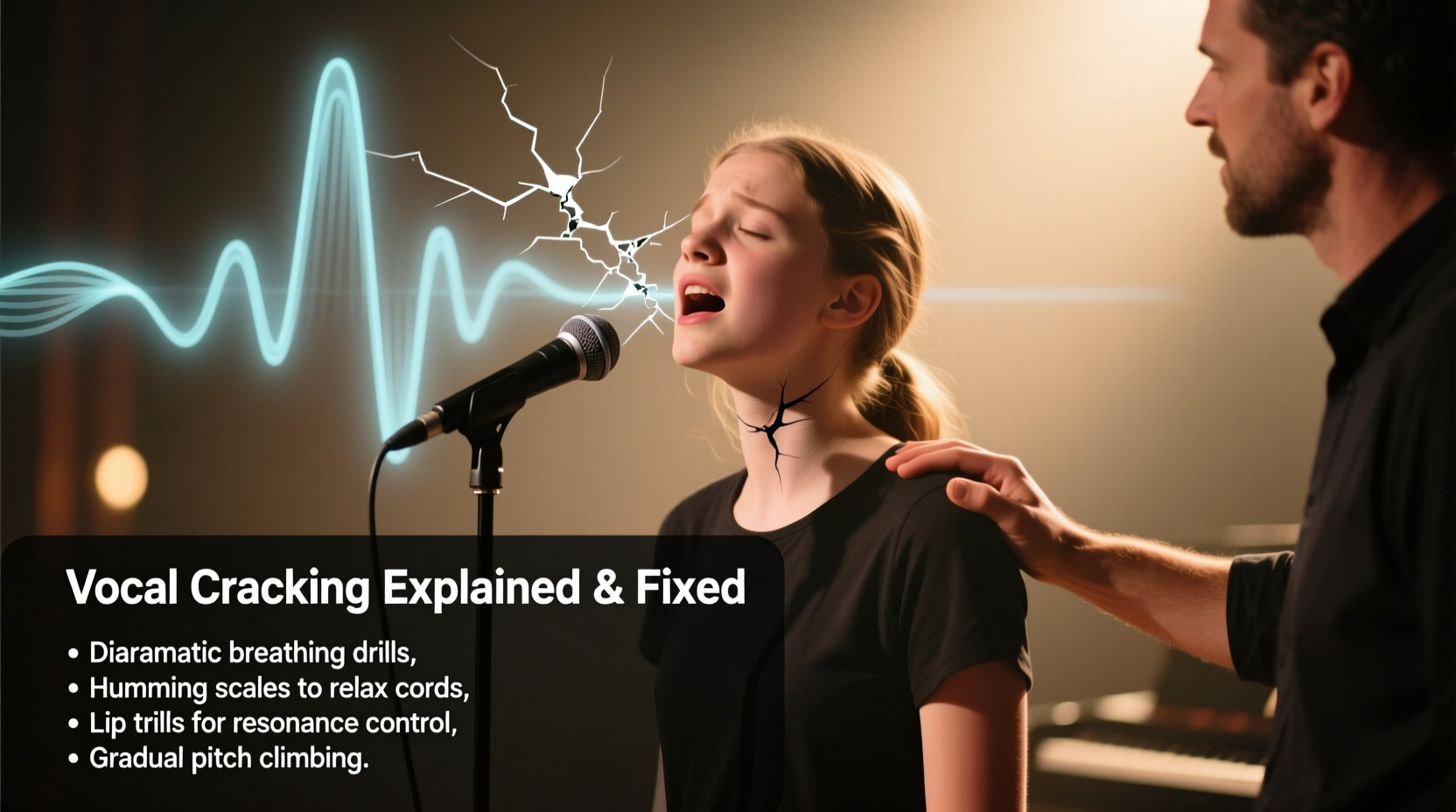
Your voice produces sound through the vibration of the vocal folds inside the larynx. As air passes from the lungs, the folds open and close rapidly, creating pitch. When you sing higher, your vocal folds stretch and thin out—a process controlled by two primary muscle groups: the cricothyroid (CT) muscles, which elongate the folds for high pitches, and the thyroarytenoid (TA) muscles, which thicken them for lower tones.
A \"crack\" occurs when there’s a sudden shift between these muscle groups without coordination. This often happens at register boundaries—most commonly between chest voice and head voice, known as the *passaggio*. If the transition isn’t balanced, one set of muscles may abruptly disengage while the other hasn’t fully engaged, resulting in a momentary loss of tone or a noticeable break.
Other contributing factors include:
- Inadequate breath support – Insufficient airflow destabilizes the vocal folds.
- Vocal fatigue – Overuse or improper technique leads to strained tissue.
- Dehydration – Dry vocal folds don’t vibrate smoothly.
- Nervous tension – Anxiety increases laryngeal muscle tightness.
- Hormonal changes – Especially during adolescence, but also in adults due to stress or health shifts.
“Register transitions aren’t flaws—they’re natural physiological events. The goal isn’t to eliminate them, but to make them seamless.” — Dr. Ingo Titze, Director, National Center for Voice and Speech
Common Triggers and How to Identify Them
Not all cracks stem from the same cause. Identifying your personal trigger helps tailor solutions effectively. Here’s how different patterns reveal their origins:
| Symptom | Possible Cause | Solution Focus |
|---|---|---|
| Crack only on high notes above C5 | Weak head voice engagement | Balanced register blending exercises |
| Voice breaks after prolonged singing | Vocal fatigue or dehydration | Rest, hydration, and stamina training |
| Cracking under pressure (e.g., live performance) | Nervous tension or shallow breathing | Relaxation and diaphragmatic control |
| Frequent cracking across mid-range | Poor breath support or inconsistent airflow | Support and onset training |
| Sudden hoarseness after cracking | Vocal strain or swelling | Immediate rest and professional evaluation |
Essential Vocal Exercises to Smooth Your Register Transitions
These evidence-based exercises strengthen coordination between vocal registers, improve breath management, and reduce cracking over time. Perform them daily, ideally after gentle warm-ups like humming or lip trills.
1. Lip Trills Across the Range
Lip trills (or “bubbles”) naturally balance airflow and reduce laryngeal tension. They encourage even vibration across registers.
- Begin in your comfortable mid-range (e.g., G3).
- Trill your lips while ascending chromatically using a 5-note scale (do-re-mi-fa-so).
- Continue upward until you feel resistance, then descend.
- Repeat 3 times, aiming for smooth transitions through the passaggio.
2. Semi-Occluded Vocal Tract (SOVT) Sounds
Using straws or tongue positioning partially blocks airflow, increasing back pressure that stabilizes the vocal folds.
- Straw phonation: Hum through a drinking straw into a glass of water. Bubbles should be steady. Sing simple scales this way for 5 minutes.
- Ng hum: Make the “ng” sound (as in “sing”) on a descending scale. This isolates head resonance and eases high-note access.
3. Slides (Portamento) Through Passaggio
Gliding smoothly between chest and head voice trains muscle coordination.
- Start at E4 (just below typical break zone for men) or A4 (for women).
- Use a neutral syllable like “voo” or “goo.”
- Slide up chromatically to C5 or D5, then back down.
- Focus on minimizing effort—avoid pushing or squeezing.
4. Octave Jumps with Staccato
Builds agility and dynamic control at register boundaries.
- Select a note just below your crack point.
- Staccato-sing it, then jump an octave up and staccato again.
- Return down. Repeat over 3–5 semitones.
- Use light, bouncy articulation—like bouncing a ball with your voice.
5. Balanced Onset Training
Poor onset (how you start a note) causes abrupt attacks or breathy starts, both precursors to cracking.
Practice glottal-onset equivalents gently:
- Say “uh-oh” clearly—notice the closure before sound.
- Apply that sensation to singing “ah” on middle C, using minimal effort.
- Progress to short 3-note scales with clean starts.
Case Study: Recovering Smooth High Notes After Years of Cracking
Jamal, a 28-year-old church vocalist, struggled with cracking on sustained high notes during worship songs. Despite years of singing, he avoided solos due to unpredictable breaks around F#4–G4. He recorded himself and noticed his cracking worsened after long services and when nervous.
Working with a vocal coach, Jamal identified three root causes: poor hydration, shallow breathing, and avoidance of head voice. His solution included:
- Drinking 2.5 liters of water daily
- Practicing 10 minutes of lip trills and SOVT exercises every morning
- Learning to engage mixed voice using slides and vowel modification (“oo” to “eh”)
Within six weeks, Jamal reported smoother transitions and increased stamina. By week ten, he performed a solo without a single break. His breakthrough wasn’t dramatic—it was built on small, consistent habits that retrained muscle memory and reduced anxiety.
Step-by-Step Daily Routine to Prevent Cracking
Consistency beats intensity. Follow this 15-minute routine daily to build resilience and coordination:
- Hydrate First (Before Singing)
Drink room-temperature water. Avoid caffeine or dairy pre-practice. - Warm-Up: Gentle Humming (2 min)
Hum on a comfortable pitch, feeling facial resonance. Move slowly up and down a fifth. - Lip Trills (3 min)
Ascend and descend through your range on “loo,” focusing on steady airflow. - SOVT Exercise (3 min)
Use a straw in water or ng-hum on descending scales from high to low. - Passaggio Slide (4 min)
Slide on “voo” through your break zone. Use mirror feedback to keep jaw and neck relaxed. - Cool Down: Soft Sighs (1 min)
Release tension with exaggerated sighs on “haaa,” starting high and falling low.
“The voice is an instrument of habit. Replace inefficient patterns with intelligent repetition, and change becomes inevitable.” — Anne-Maria Laukkanen, Voice Researcher, University of Tampere
FAQ: Common Questions About Voice Cracking
Is voice cracking a sign of permanent vocal damage?
No. Occasional cracking is a functional issue, not structural damage. However, chronic cracking accompanied by pain, hoarseness, or loss of range may indicate nodules or inflammation. If symptoms persist beyond two weeks despite rest, consult an ENT or speech-language pathologist.
Can adults still fix their vocal breaks, or is it too late?
It’s never too late. The vocal mechanism remains adaptable throughout life. Adults often learn faster than adolescents because of greater body awareness and discipline. With proper guidance, most singers significantly reduce or eliminate disruptive cracks regardless of age.
Should I avoid singing high notes until I fix the cracking?
No—avoidance reinforces fear and weakens coordination. Instead, approach high notes mindfully using supported, semi-occluded exercises. Sing within a safe volume and prioritize smooth transitions over power. Gradual exposure builds strength without strain.
Final Checklist: Fixing Voice Cracks the Right Way
Use this checklist weekly to stay on track:
- ✅ Hydrate consistently (at least 2 liters/day)
- ✅ Practice daily vocal exercises (even 10 minutes helps)
- ✅ Record and review your singing weekly
- ✅ Warm up before any extended vocal use
- ✅ Avoid yelling, whispering, or speaking over noise
- ✅ Maintain relaxed posture and jaw during singing
- ✅ Seek feedback from a qualified voice teacher annually
Conclusion: Take Control of Your Voice
Voice cracking doesn’t define your ability—it reveals an opportunity for growth. Every singer, from beginners to professionals, navigates register transitions. What separates those who overcome it from those who don’t is not talent, but persistence and informed practice. By understanding the physiology behind the break and applying targeted exercises, you reclaim control over your instrument. Start today: hydrate, warm up, and commit to just ten minutes of focused training. Over time, the cracks will fade, replaced by a voice that moves freely, confidently, and authentically across its full range.




 浙公网安备
33010002000092号
浙公网安备
33010002000092号 浙B2-20120091-4
Comments
No comments yet. Why don't you start the discussion?