
Most people experience a jolt of surprise—or even discomfort—when they hear their own voice played back on a recording. It often sounds higher, thinner, or just “off” compared to what they’re used to hearing when speaking. You're not imagining it: your voice genuinely *does* sound different on recordings than in real life. But why? And more importantly, can anything be done about it?
The disconnect between self-perception and recorded reality is rooted in both biology and physics. Understanding this gap not only demystifies the phenomenon but also empowers you to take control of how your voice comes across in videos, podcasts, meetings, and social media.
The Science Behind the Sound Gap
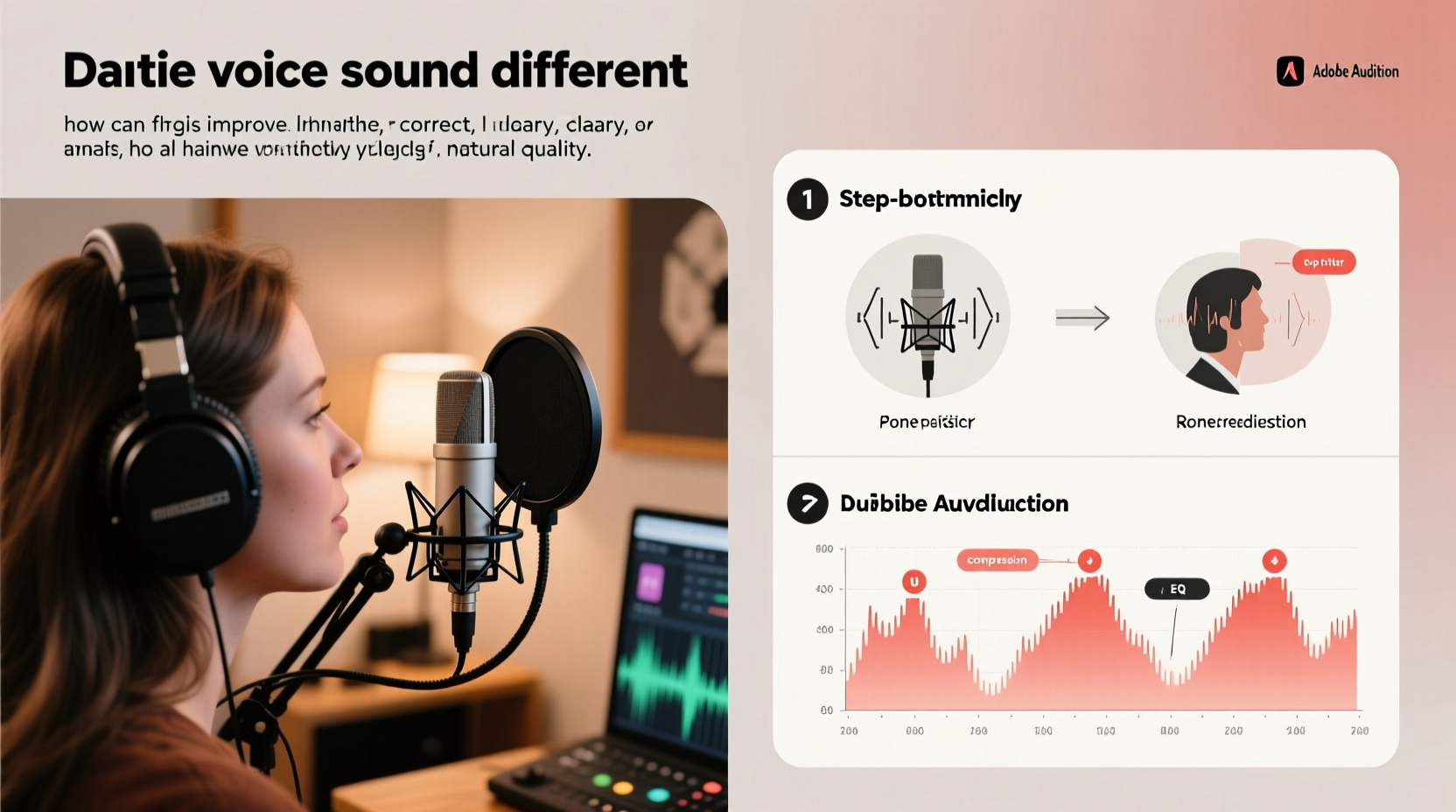
When you speak, sound reaches your ears through two distinct pathways: air conduction and bone conduction. Air-conducted sound travels from your vocal cords through the air into your ear canal, just like anyone else hears you. Bone-conducted sound, however, vibrates through the bones in your skull directly to your inner ear. This internal vibration amplifies lower frequencies, making your voice sound deeper and richer to yourself.
Recordings, by contrast, capture only the air-conducted sound—the version others hear. Without the bone-conducted bass boost, your recorded voice lacks the fullness you perceive internally. That’s why playback often feels unfamiliar, sometimes even disappointing.
“People are startled by their recorded voice because it contradicts their lifelong self-image. What they hear isn’t aligned with their internal model.” — Dr. Sarah Kim, Auditory Perception Researcher, Stanford University
This mismatch explains why many find their recorded voice annoyingly high-pitched or nasal. The truth is, that’s closer to how everyone else hears you every day.
Why Your Brain Resists the Recorded Voice
Psychologically, we form a stable identity around our self-image—including how we think we sound. When a recording challenges that image, cognitive dissonance kicks in. Studies show that individuals consistently rate their own recorded voices as less pleasant, trustworthy, or competent—even when objectively identical to others’ assessments.
This bias isn’t vanity; it’s neural wiring. The brain prioritizes familiarity. A 2020 study published in *The Journal of Acoustic Society of America* found that participants preferred manipulated versions of their voice that were slightly deeper and smoother, regardless of actual quality—simply because those versions felt more “like me.”
So when you cringe at your podcast intro or skip watching your presentation replay, remember: it’s not necessarily that your voice is bad—it’s that it doesn’t match your expectations.
Common Misconceptions About Voice Recording
- My mic is faulty. While poor equipment affects clarity, it doesn’t change the fundamental frequency discrepancy.
- I sound weird because I’m nervous. Nervousness may alter pitch or pace, but the core issue lies in auditory perception, not emotion.
- Everyone else hears me like this all the time. Actually, yes—they do. Your recorded voice is the closest approximation of what others hear daily.
Can You Fix How Your Voice Sounds on Recordings?
You can’t change the physics of sound transmission, but you *can* influence how your voice is captured, perceived, and received. Some solutions focus on technical adjustments; others involve vocal training or mindset shifts.
Here’s a breakdown of actionable strategies—from immediate fixes to long-term improvements.
1. Optimize Recording Equipment and Environment
Even if your voice naturally sounds thin on playback, poor gear or acoustics can exaggerate flaws. A cheap built-in laptop microphone might emphasize sibilance (harsh \"s\" sounds) or pick up room echo, distorting tone further.
| Factor | Do | Avoid |
|---|---|---|
| Microphone Type | Use a condenser mic for warmth and detail | Low-quality USB mics with plastic bodies |
| Recording Space | Choose small, carpeted rooms with soft furnishings | Bare walls, tiled floors, large empty spaces |
| Positioning | Maintain 6–12 inches from mic, slightly off-axis | Directly into mic; too close causes plosives (\"p\", \"b\") |
| Software Settings | Enable noise suppression and moderate compression | Over-compression or excessive EQ boosting |
2. Train Your Speaking Voice
Your natural voice isn't fixed. With practice, you can develop a clearer, more confident delivery that translates well on recordings. Focus on three key areas:
- Resonance: Speak from your chest rather than your nose or throat. Humming exercises help locate chest resonance—try humming while touching your sternum and feel the vibration.
- Pitch Control: Use apps like VoiceTools or Spectroid to visualize your frequency range. Aim for slight lowering of average pitch without forcing a fake “radio voice.”
- Breath Support: Diaphragmatic breathing stabilizes volume and reduces vocal fatigue. Practice inhaling deeply so your belly expands, then speak slowly on the exhale.
Professional voice coaches often recommend reading aloud for 10 minutes daily using expressive intonation. Over weeks, this builds muscle memory for a more balanced, engaging tone.
3. Edit Strategically (Without Losing Authenticity)
Digital audio workstations (DAWs) like Audacity, Adobe Audition, or GarageBand offer tools to enhance vocal recordings. Used wisely, these can reduce harshness and add warmth.
- Equalization (EQ): Boost around 100–200 Hz slightly to add body. Cut frequencies near 800 Hz–1 kHz if your voice sounds boxy, and reduce 4–6 kHz if it's overly sharp.
- Compression: Apply light compression (ratio 2:1 to 3:1) to smooth out volume spikes without squashing dynamics.
- Reverb (sparingly): A touch of room reverb can simulate natural space, but too much makes speech muddy.
Never try to make your voice sound like someone else. The goal is clarity and comfort—not disguise.
Real Example: From Podcast Panic to Confidence
Mark, a financial advisor who started a weekly podcast, dreaded listening to his episodes. “I thought I sounded like a whiny teenager,” he said. He almost quit after episode two. Instead, he took action: invested in a basic XLR microphone, recorded in a closet filled with clothes (for natural sound absorption), and practiced speaking with slower pacing and intentional pauses.
He also committed to listening to each episode once—no skipping—and gradually noticed improvement. After six weeks, he realized his voice wasn’t changing much, but his perception was. “Now I don’t love every word I say, but I trust that listeners aren’t judging me the way I used to.”
Today, Mark receives regular feedback praising his “calm, authoritative tone.” The transformation wasn’t technological—it was psychological and behavioral.
Step-by-Step Guide to Improving Your Recorded Voice
If you want to sound better on recordings—both technically and perceptually—follow this timeline:
- Week 1: Audit & Accept
- Record yourself speaking naturally for one minute.
- Listen twice: once critically, once neutrally.
- Note specific concerns (pitch, clarity, speed).
- Week 2: Optimize Setup
- Test different microphones or use your smartphone in quiet mode.
- Find the quietest room; hang blankets if needed.
- Record again under improved conditions.
- Week 3: Vocal Practice
- Do daily tongue twisters and humming drills.
- Read news articles aloud with emphasis on consonants.
- Focus on steady breath and relaxed jaw.
- Week 4: Edit & Evaluate
- Import your latest recording into free editing software.
- Apply gentle EQ and compression.
- Compare before/after versions objectively.
- Ongoing: Normalize Exposure
- Listen to your voice weekly in real contexts (voicemails, video calls).
- Ask trusted colleagues for honest but constructive feedback.
- Remind yourself: familiarity breeds acceptance.
Frequently Asked Questions
Does everyone hate their recorded voice?
Not everyone, but most do—at first. A 2018 survey by the National Center for Voice and Speech found that over 70% of adults reported initial discomfort upon hearing their recorded voice. However, repeated exposure significantly reduced negative reactions within four weeks.
Is my recorded voice an accurate representation of how others hear me?
Yes—mostly. While room acoustics, microphone quality, and distance affect tonal balance, the fundamental characteristics (pitch, rhythm, accent) are faithfully captured. If your recording sounds nasal, chances are others notice that too, though likely less intensely than you do.
Can surgery or medication change how my voice sounds on recordings?
In rare cases, medical interventions like vocal cord surgery or hormone therapy (e.g., during gender transition) can alter voice structure. However, for typical users seeking better recordings, non-invasive methods—training, technique, and tech—are safer, more effective, and reversible.
Checklist: Improve Your Recorded Voice in 30 Days
- ☐ Record a baseline sample of your speaking voice
- ☐ Choose a quiet, soft-surfaced room for future recordings
- ☐ Invest in or borrow a decent microphone
- ☐ Practice diaphragmatic breathing for 5 minutes daily
- ☐ Read aloud with expression for 10 minutes per day
- ☐ Use free software to apply light EQ and compression
- ☐ Listen to one full recording per week without stopping
- ☐ Ask one person for honest feedback on your vocal clarity
- ☐ Reflect: Has your reaction to your voice changed over time?
Conclusion: Embrace the Real You
Hearing your true voice on a recording isn’t a flaw to fix—it’s a mirror to reality. The discomfort fades with time and intention. Whether you're presenting at work, launching a YouTube channel, or simply leaving a voicemail, your voice matters not because of its pitch or timbre, but because it carries your message.
Instead of chasing a perfect sound, aim for authenticity, clarity, and confidence. With the right tools and mindset, you won’t just tolerate your recorded voice—you’ll recognize it as uniquely yours.




 浙公网安备
33010002000092号
浙公网安备
33010002000092号 浙B2-20120091-4
Comments
No comments yet. Why don't you start the discussion?