
It’s December, you’ve pulled out the holiday lights, untangled them with care, and finally hung them up—only to discover half the strand won’t light. Or worse: not a single bulb glows. After some testing, you realize it's not the outlet, not the fuse, and not the plug. The culprit? One tiny, seemingly innocent burned-out bulb. But why does one bad bulb shut down an entire string of lights? And more importantly, how can you track it down—and fix it—without losing your holiday spirit?
The answer lies in the way traditional incandescent mini-light strings are wired. Unlike modern LED strands that often use parallel circuits, most older and budget-friendly light sets are wired in series. That means electricity flows through each bulb in sequence before completing the circuit. If one bulb fails—or worse, if its shunt (a small internal wire) doesn't activate properly—the current stops, and the entire string goes dark.
Understanding this setup is the first step toward fixing the problem efficiently. More importantly, knowing how to diagnose and repair these strings can save money, reduce waste, and keep your decorations glowing for years.
How Series-Wired Lights Work (And Why One Bulb Can Kill the Whole String)
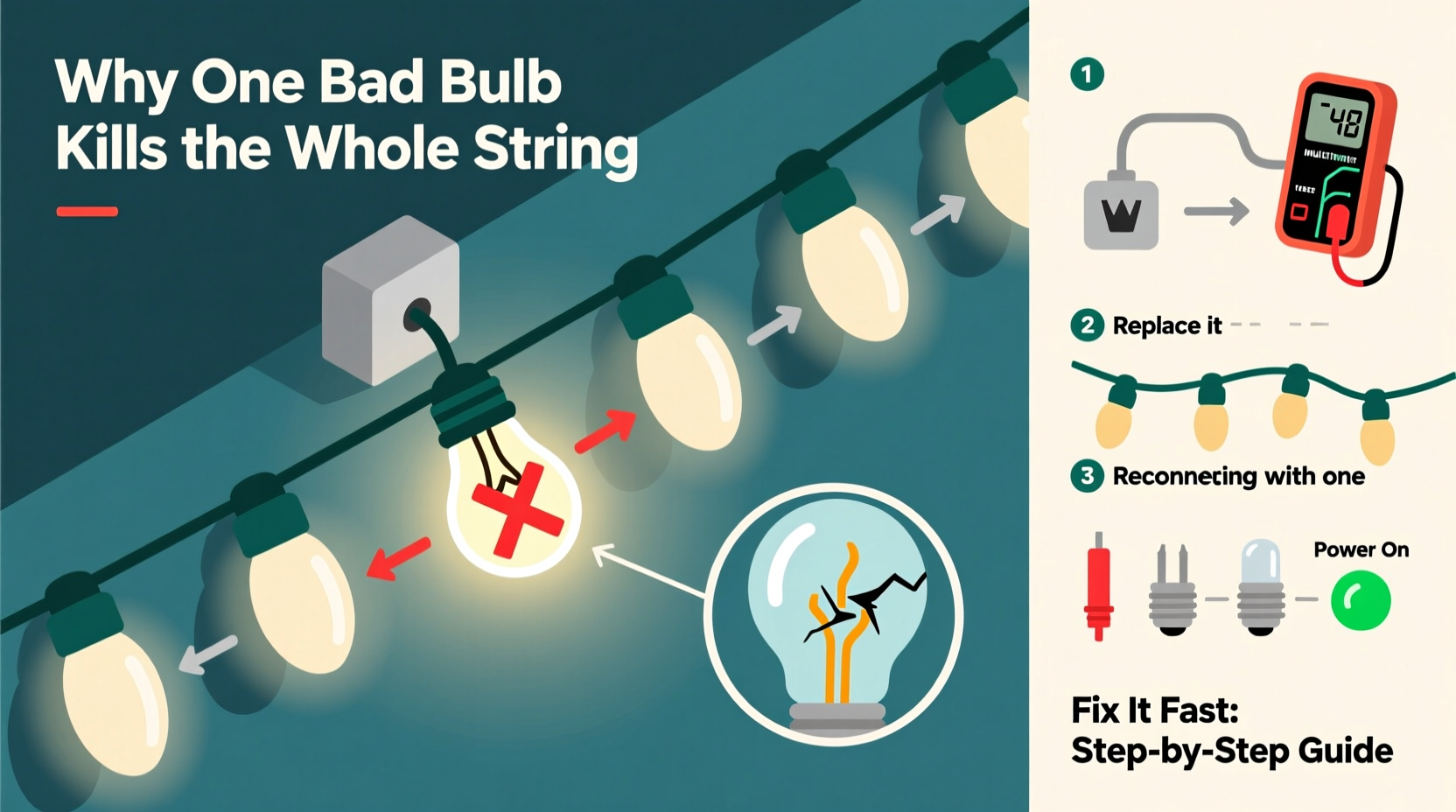
In a series circuit, electrical current passes from one bulb to the next in a single path. Think of it like a looped chain: break one link, and the entire chain falls apart. Each bulb acts as both a resistor and a conductor. When all bulbs are functional, the current flows smoothly, heating the filament inside each bulb to produce light.
But when a filament burns out, the circuit breaks—unless the bulb has a working shunt. A shunt is a small coiled wire coated in insulating material. Under normal conditions, it remains inactive. However, when the filament fails, the increased voltage across the broken ends should cause the coating to burn off, allowing the shunt to conduct electricity and keep the circuit alive.
The problem arises when the shunt fails to activate. This can happen due to manufacturing defects, corrosion, or age. Without a functioning shunt, the circuit remains open, and no current flows—even if every other bulb is perfectly fine.
“Over 70% of non-working light strings we see during holiday repairs have just one or two faulty bulbs causing total failure. It’s almost never the entire strand.” — Mark Reynolds, Holiday Lighting Technician with 15+ years of experience
Step-by-Step Guide to Find and Fix a Bad Bulb Fast
Finding the one bad bulb in a 50- or 100-light strand might sound like searching for a needle in a haystack. But with the right approach, you can isolate the problem in under 30 minutes. Follow this systematic method:
- Test the outlet and fuses first. Plug the strand into a known-working outlet. Check the fuse compartment near the plug—many strands have two small fuses (usually labeled “A” and “B”). Use a multimeter or replace them with spares if included.
- Divide the strand visually into sections. For a 100-light string, split it into four groups of 25. Start at the end opposite the plug.
- Use a light tester or multimeter. A non-contact voltage tester or dedicated Christmas light tester (like the LightKeeper Pro) can detect voltage along the wire. Starting from the plug end, test after each bulb until the signal stops. The faulty bulb is usually just before the dead section.
- Inspect for visible damage. Look for darkened bulbs, loose filaments, cracked glass, or corroded metal bases. Wiggle each bulb gently—if the strand flickers, that bulb may be loose or failing.
- Replace suspect bulbs one at a time. Use replacement bulbs of the same voltage and wattage. Many packs include spares; if not, buy a universal mini-bulb pack matching your set (typically 2.5V or 3.5V).
- Re-test after each replacement. Plug in the strand after swapping a bulb. If it lights, you’ve found the culprit. If not, continue down the line.
Alternative Methods When You Don’t Have Tools
Not everyone owns a multimeter or light tester. Fortunately, there are low-tech ways to locate the bad bulb using only patience and observation.
The Process of Elimination (Half-Split Method)
This technique reduces testing time significantly by cutting the problem area in half each time:
- Unplug the strand.
- Remove the bulb in the middle of the string.
- Plug the strand back in.
- If the remaining lights turn on, the removed bulb was the problem—or the issue lies in the second half.
- If still dark, the fault is in the first half.
- Repeat the process within the faulty half until the defective bulb is isolated.
This binary search method ensures you’ll find the bad bulb in no more than 6–7 tries, even on a 100-light strand.
The Water Test (For Shunt Failure Diagnosis)
A lesser-known but effective trick involves submerging bulbs in water to test shunt activation. Warning: Only do this with unplugged bulbs and never while connected to power.
- Remove a suspect bulb.
- Submerge it in a cup of water for 10–15 seconds.
- Let it dry completely (at least 30 minutes).
- Reinsert and test.
Water can sometimes dissolve corrosion on the shunt or help the insulating coating fail safely, allowing the shunt to bridge the gap. While not foolproof, this method works surprisingly well on older, moisture-exposed strands.
Do’s and Don’ts of Light Strand Repair
| Do | Don’t |
|---|---|
| Use replacement bulbs with matching voltage and base size | Mix different voltage bulbs in the same strand |
| Check fuses before assuming bulb failure | Assume the entire strand is dead without testing |
| Store lights on cardboard reels or hangers | Yank tangled lights apart with force |
| Clean bulb sockets with isopropyl alcohol | Use household cleaners that leave residue |
| Test strands before and after storage | Leave lights plugged in unattended for long periods |
Real Example: Sarah’s Struggling Strand
Sarah had a favorite red-and-white mini-light strand she used every year on her front porch. Last season, it refused to turn on. She replaced the fuses, checked the outlet, and even bought a new plug adapter—but nothing worked. Frustrated, she nearly tossed the strand.
Instead, she borrowed a friend’s LightKeeper Pro. Running the trigger tool along the first few inches of wire produced no pulse. That meant the problem was near the plug. She examined the first five bulbs closely and noticed one with a slightly darker glass envelope. After removing it, she saw the filament was intact but the base was corroded.
She cleaned the socket with rubbing alcohol, inserted a spare bulb, and plugged it in. The entire strand lit up. The root cause? Moisture from winter weather had seeped into a poorly sealed base, disabling the shunt. One $0.10 bulb saved a $15 light set.
When to Upgrade: LED vs. Incandescent Strings
Modern LED light strings are changing the game. Most are wired in parallel or use shunted series designs that remain partially lit even if one bulb fails. They also consume up to 90% less energy, last 10 times longer, and generate far less heat—making them safer for indoor and outdoor use.
While LEDs cost more upfront, their durability and efficiency make them a smarter long-term investment. Consider upgrading if you're tired of annual troubleshooting.
“Switching to commercial-grade LED strings cut my maintenance time by 80%. I haven’t replaced a single bulb in three years.” — Lisa Tran, Home Decor Blogger and Holiday Enthusiast
Prevention Checklist: Keep Your Lights Working Year After Year
Fixing a dead strand is satisfying, but preventing the issue is better. Follow this checklist each season:
- ✅ Test all strands before storing
- ✅ Replace any dim or flickering bulbs immediately
- ✅ Store lights on reels or in compartmentalized bins
- ✅ Keep away from damp areas (avoid basements without dehumidifiers)
- ✅ Use outdoor-rated strands outside—even if only for a few weeks
- ✅ Avoid stacking heavy items on stored lights
- ✅ Label each strand by location (e.g., “Front Porch – Red”) for easy setup
FAQ: Common Questions About Bad Bulbs and Light Strings
Can a loose bulb cause the whole string to go out?
Yes. Even if the filament is intact, a loose bulb can break the circuit. The metal base must make full contact with the socket. Gently press each bulb down until it clicks or feels secure.
Why do some strands stay lit even with a missing bulb?
Those strands likely use shunted sockets or parallel wiring. In shunted designs, extra pathways allow current to bypass a dead bulb. Most newer LED sets use this technology, which is why they’re more reliable.
Is it safe to leave repaired light strings outdoors?
If the repair was done correctly—using weather-resistant bulbs and ensuring no exposed wires—it’s generally safe. However, always check manufacturer guidelines and consider replacing frequently failing strands with certified outdoor LED versions.
Conclusion: Save Time, Money, and the Holidays
One bad bulb doesn’t have to ruin your holiday display. With a clear understanding of how series circuits work and a few simple tools, you can diagnose and fix most lighting failures in under an hour. Whether you use a high-tech tester or rely on the half-split method, the key is patience and systematics.
More importantly, taking preventive steps—like proper storage, seasonal testing, and upgrading to durable LED options—can drastically reduce future headaches. Every strand you repair is one less piece of electronic waste and one more symbol of sustainable celebration.
So next time a string goes dark, don’t throw it out. Fix it. Share what you learn. Help keep the lights on—for your home, your holidays, and the planet.




 浙公网安备
33010002000092号
浙公网安备
33010002000092号 浙B2-20120091-4
Comments
No comments yet. Why don't you start the discussion?