
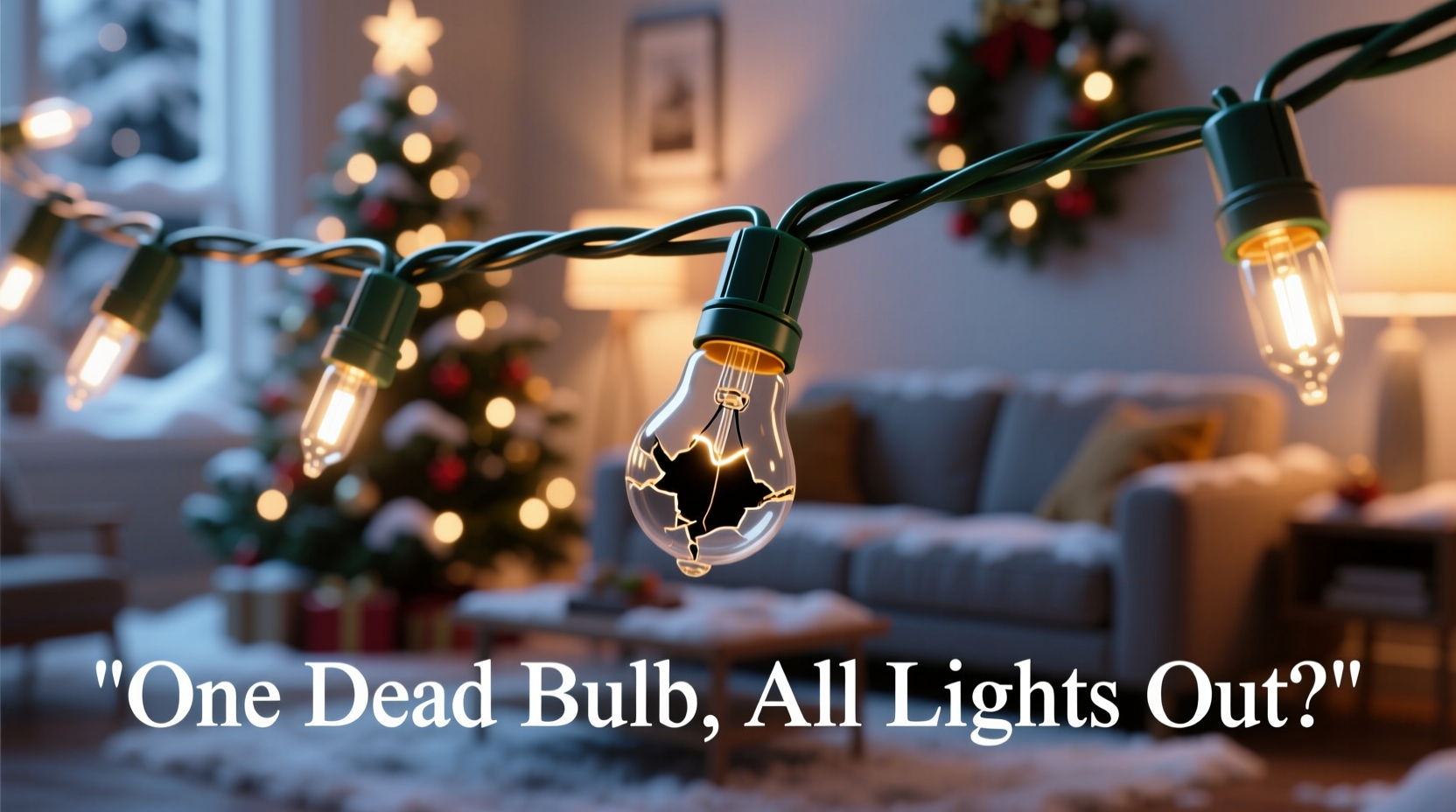
If you've ever plugged in a string of traditional Christmas lights only to find that the entire strand stays dark because one tiny bulb is burnt out, you're not alone. This frustrating phenomenon has puzzled homeowners for decades. Unlike modern electronics where components function independently, many older-style light strings are designed so that the failure of a single bulb can interrupt the flow of electricity through the entire circuit—leaving you in the dark, literally.
The answer lies in the electrical design of the strand. Most classic incandescent Christmas lights are wired in what's known as a \"series circuit.\" In such a configuration, every bulb must be functional for the current to pass through completely. When one bulb burns out or becomes loose, it breaks the circuit, stopping the flow of electricity to all bulbs downstream. Understanding this principle not only helps explain the problem but also guides smarter purchasing decisions and troubleshooting strategies during the holiday season.
How Series Circuits Work in Christmas Lights
In a series circuit, electrical components are connected end-to-end in a single path. Current flows from the power source, through each bulb in sequence, and returns to complete the circuit. Because there’s only one pathway for electricity, any break at any point stops the current entirely.
Imagine a looped necklace where each bead represents a light bulb. If one bead falls off, the chain is broken and no longer forms a continuous circle. Similarly, in a series-wired light strand, if one filament inside a bulb burns out, it creates an open circuit—just like cutting a wire. No current means no light anywhere along that strand.
This setup was historically favored for its simplicity and low manufacturing cost. By dividing household voltage (typically 120V in North America) across multiple small bulbs—say, 50 bulbs rated at 2.5 volts each—the system operates safely without requiring complex transformers or resistors. However, this efficiency comes at the expense of reliability: one weak link collapses the whole chain.
“Series wiring made mass-produced holiday lighting affordable, but it introduced a notorious fragility—entire strands failing over a single dead bulb.” — Dr. Alan Reeves, Electrical Engineer & Lighting Historian
Why Don’t All Light Strands Behave This Way?
Not all Christmas lights go dark with one failed bulb. The behavior depends on the type of circuit used and the technology behind the bulbs.
Newer LED light strands often use parallel circuits or incorporate shunt wires within incandescent bulbs to maintain continuity even after a failure. In a parallel circuit, each bulb has its own independent connection to the power source. A break in one branch doesn't affect others, much like how individual appliances operate separately in your home.
Even some traditional incandescent strands include a clever workaround: shunted sockets. These contain a small conductive strip (a “shunt”) that activates when a filament burns out. The heat from the breaking filament melts insulation on the shunt, allowing current to bypass the dead bulb and keep the rest lit. However, these aren't foolproof—shunts can fail to activate due to age, corrosion, or insufficient heat.
Step-by-Step Guide to Troubleshooting a Dead Strand
Finding the culprit bulb in a dark strand may seem daunting, but with patience and methodical effort, you can restore the glow. Follow this proven process:
- Unplug the strand before handling to avoid electrical shock.
- Inspect visibly for obvious issues: missing bulbs, cracked lenses, or blackened filaments.
- Check connections between sections. Ensure plugs are fully seated and undamaged.
- Use a known-good replacement bulb to test suspect positions. Start near the plug or middle of the strand.
- Test each socket systematically. Remove one bulb at a time and insert the test bulb. Plug in briefly after each insertion.
- Look for loose bulbs. Even a slightly unseated bulb can break contact in a series circuit.
- Examine for damaged wires, especially near bends or where pets might have chewed.
- Try a light tester tool (available at hardware stores), which detects voltage along the strand without needing to remove bulbs.
If none of the above works, the issue could lie in the fuse located in the plug. Many strands have two small fuses (often one active, one spare) designed to protect against surges. Use a multimeter to check continuity or simply replace both fuses with identical ratings (usually 3A or 5A).
Comparison: Series vs. Parallel Wiring in Holiday Lights
| Feature | Series-Wired Lights | Parallel-Wired Lights |
|---|---|---|
| Voltage per Bulb | Low (e.g., 2.5V) | Full line voltage (120V) |
| Bulb Failure Impact | Entire strand goes dark | Only one bulb affected |
| Circuit Continuity | Single path; break anywhere kills circuit | Multiple paths; isolated failures tolerated |
| Common Technology | Traditional incandescent | Modern LEDs, commercial-grade sets |
| Repair Difficulty | High (must find faulty bulb) | Low (replace individual bulb) |
| Energy Efficiency | Lower (more heat loss) | Higher (especially with LEDs) |
| Cost | Generally cheaper upfront | Higher initial cost |
While series-wired lights dominate budget-friendly seasonal displays, parallel systems offer superior reliability and ease of maintenance—making them ideal for permanent installations or large-scale decorations.
Real Example: The Case of the Living Room Wreath
Sarah in Portland decorated her front door wreath each November with a favorite red-and-gold incandescent strand passed down from her grandmother. Every year, she faced the same ritual: plugging it in, seeing half the lights flicker then die, and spending evenings hunting for the bad bulb.
One particularly cold December evening, after replacing three bulbs with no success, she borrowed a friend’s non-contact voltage detector. Running it along the wire, she noticed the signal dropped midway—indicating a break before the first dark section. Closer inspection revealed not a burnt bulb, but a corroded socket caused by years of outdoor exposure.
She cleaned the contacts with electrical contact cleaner and applied dielectric grease to prevent future moisture buildup. The strand lit up—but only briefly. Ultimately, she accepted that the wiring had degraded beyond repair. She replaced it with a new LED strand featuring parallel circuitry and built-in surge protection. Since then, her wreath has powered on instantly every season, with minimal maintenance.
Sarah’s experience illustrates both the emotional attachment we form with holiday items and the practical limits of aging technology. Sometimes, upgrading isn’t surrender—it’s smart preservation of peace of mind.
Checklist: Preventing Full-Strand Failures
- ✅ Inspect strands annually before installation
- ✅ Replace frayed wires or cracked sockets immediately
- ✅ Store lights coiled loosely around cardboard to prevent kinks
- ✅ Use clips instead of nails or staples when mounting outdoors
- ✅ Keep connections elevated and covered to avoid water pooling
- ✅ Choose LED strands with shunt technology or parallel wiring
- ✅ Label storage boxes clearly by location and color scheme
- ✅ Install on timers to reduce thermal cycling stress
Frequently Asked Questions
Can I convert a series-wired strand to work like a parallel circuit?
No practical DIY method exists to rewire a standard light strand into a true parallel configuration. Doing so would require rewiring each socket back to common positive and negative rails—an extremely labor-intensive task. Instead, consider retiring old strands and investing in modern LED alternatives designed with better circuitry.
Why do some bulbs in a dead strand still look intact?
A bulb can appear fine visually while having a broken filament invisible to the naked eye. Tilting the bulb under bright light or gently shaking it may reveal a loose filament (you might hear a faint rattle). Alternatively, use a multimeter to test for continuity across the base contacts.
Do LED Christmas lights last longer than incandescent ones?
Yes, significantly. LEDs typically last 25,000 to 50,000 hours compared to 1,000–2,000 hours for incandescent bulbs. They also generate less heat, consume up to 90% less energy, and are less prone to vibration damage. Most quality LED strands now use partial or full parallel wiring, reducing total strand failure risk.
Moving Beyond the Burnout: Future of Holiday Lighting
The era of painstakingly scanning dozens of tiny bulbs for one failure is gradually fading. Advances in solid-state lighting, microcircuitry, and modular design are making holiday displays more reliable and user-friendly than ever.
Smart LED strands now come with app control, customizable patterns, music synchronization, and self-diagnostic features. Some can even notify you via smartphone when a segment fails—pinpointing the location digitally rather than forcing manual inspection.
Moreover, manufacturers are increasingly adopting hybrid designs: grouping small clusters of bulbs in local parallel arrangements, then connecting those clusters in series. This balances voltage requirements with fault tolerance. If one bulb dies, only a few nearby lights go dark—not the entire run.
As consumers demand convenience and durability, the market continues shifting away from fragile series-only models. While nostalgic charm remains, functionality is winning the long-term battle.
Final Thoughts: Embrace Better Lighting Smarter
The reason one strand of your Christmas lights goes out when a single bulb fails boils down to legacy engineering choices optimized for cost over resilience. But understanding this flaw empowers you to make informed upgrades and adopt preventive habits that save time, frustration, and repeated trips to the attic.
Whether you choose to preserve vintage strands with careful maintenance or transition to advanced LED systems, the goal remains the same: creating warm, joyful illumination without the annual headache. With proper selection, storage, and care, today’s lights can perform reliably for decade-spanning holidays.




 浙公网安备
33010002000092号
浙公网安备
33010002000092号 浙B2-20120091-4
Comments
No comments yet. Why don't you start the discussion?