
It’s a familiar holiday frustration: you plug in your string lights, only to find that the first 20 bulbs glow brightly—then darkness hits at bulb #21. Worse still, when you replace that single dead bulb, the entire section—or sometimes the whole string—stays dark. You’re not dealing with bad luck. You’re encountering a fundamental design feature of most incandescent and many LED mini-light strings: series wiring. Unlike household outlets or modern parallel-wired fixtures, these lights rely on a continuous electrical path where each bulb is part of a shared circuit. A break anywhere along that path interrupts current flow for everything downstream. Understanding *why* this happens—and how to respond—isn’t just about convenience; it’s about safety, longevity, and avoiding unnecessary replacements.
How Series Wiring Creates Cascading Failures
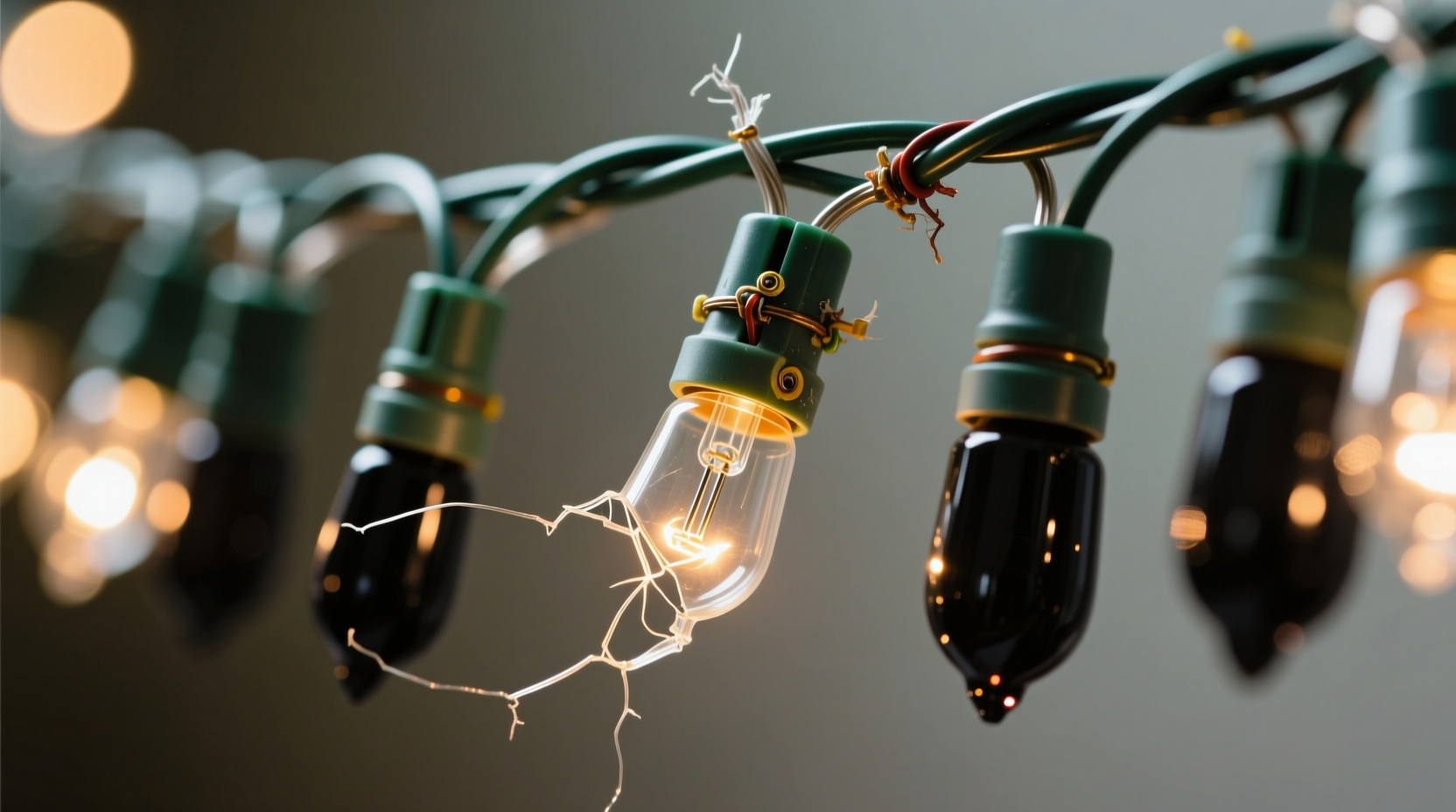
Most traditional mini-light strings (especially those sold before 2015 and many budget-friendly options today) use series wiring. In this configuration, electricity flows from the plug, through the first bulb’s filament, then into the second bulb, and so on—like beads on a single thread. There is no independent path to neutral for each bulb. If any single point fails—whether a broken filament, corroded socket, loose wire, or failed shunt—the circuit opens, halting current flow to all subsequent bulbs.
This isn’t a flaw—it’s intentional engineering. Series wiring allows manufacturers to run dozens of low-voltage bulbs (typically 2.5V–3.5V each) safely off standard 120V household current. By dividing voltage across many bulbs, each receives just enough to glow without overheating or requiring bulky transformers. But the trade-off is vulnerability: one weak link collapses the chain.
Crucially, modern incandescent strings include “shunts”—tiny conductive bridges inside each bulb’s base. When a filament burns out, heat triggers the shunt to melt and close the circuit, allowing current to bypass that bulb and keep the rest lit. Yet shunts fail too—especially in older strings, or if corrosion, moisture, or manufacturing defects interfere. That’s why a single dead bulb often leaves half the string dark: the shunt never activated.
The Real Culprits Behind the Cascade
While a burnt-out bulb is the most visible suspect, it’s rarely the sole cause. In practice, cascading failures stem from interrelated physical and electrical issues:
- Filament failure with shunt bypass failure: The bulb’s tungsten wire breaks, but its internal shunt doesn’t activate due to oxidation or age.
- Socket corrosion or deformation: Moisture, dust, or repeated plugging/unplugging degrades metal contacts. A slightly bent socket tab or greenish corrosion creates high resistance—or an open circuit—even if the bulb itself is fine.
- Wire fatigue at connection points: The thin copper wires inside light strings are prone to micro-fractures where they enter sockets or splice into connectors. These breaks aren’t visible to the naked eye but interrupt continuity.
- End-to-end connector issues: Many strings daisy-chain via male/female plugs. A loose pin, bent prong, or cracked housing in the connector between two strands can kill power to everything downstream—even if both individual strings test fine when plugged directly into an outlet.
- Voltage drop under load: Longer strings (especially over 250 bulbs) may exceed safe amperage limits. Dimming toward the end—or intermittent blackouts—often signals overloaded circuits or undersized internal wiring, not isolated bulb failure.
Diagnosing the Problem: A Step-by-Step Troubleshooting Protocol
Effective diagnosis requires methodical isolation—not random bulb swapping. Follow this sequence to pinpoint the exact failure point:
- Unplug and inspect visually. Look for obvious damage: cracked bulbs, melted sockets, frayed wires near plugs, or discoloration indicating overheating.
- Test the outlet and cord. Plug a known-working device (e.g., phone charger) into the same outlet. Then test the light string’s plug with a multimeter (set to continuity or AC voltage) to confirm power reaches the first socket.
- Divide and conquer. Starting at the working end, locate the last lit bulb. Count three bulbs beyond it—remove the fourth. Replace it with a known-good bulb. If the string reignites, the removed bulb was faulty *and* its shunt failed. If not, the problem lies upstream—in the socket, wiring, or previous bulb.
- Bypass suspected sockets. Using insulated needle-nose pliers, carefully insert a paperclip or dedicated bulb tester probe across the two contact points inside a dark socket (with string unplugged!). Reconnect and test. If lights return, the socket is defective—not the bulb.
- Check daisy-chain connections. Disconnect any downstream strings. Test the first string alone. If it works, reconnect one additional string at a time until failure recurs. The last connected string—or its input connector—is the source.
This protocol avoids wasted time and prevents introducing new faults (e.g., forcing bulbs into damaged sockets). It also reveals whether the issue is repairable or indicates systemic wear—such as brittle insulation or widespread corrosion—that warrants replacement.
LED Strings: Why They’re Different (and Sometimes Worse)
Many assume LED lights eliminate cascading failures. While true for *parallel-wired* LEDs (common in commercial or premium residential strings), most consumer-grade LED mini-lights still use series or hybrid-series designs. Here’s why the behavior persists—and worsens:
| Feature | Traditional Incandescent | Common LED Mini-Lights |
|---|---|---|
| Wiring Topology | Series (with shunts) | Series or “series-parallel” segments (e.g., 3 bulbs per sub-circuit) |
| Failure Mode | One dead bulb + failed shunt = section outage | One dead LED or failed driver IC = entire segment dark; often no shunt equivalent |
| Diagnostic Clue | Dark section starts after a visibly burnt bulb | Dark section has no obvious damage; may flicker or show partial dimming |
| Repairability | Bulbs easily replaced; shunts often recover with cycling | LEDs soldered in place; drivers require desoldering and component-level repair |
| Lifespan Expectancy | 1,000–2,000 hours | 15,000–25,000 hours—but vulnerable to voltage spikes and heat buildup |
LED strings introduce new failure vectors: tiny driver chips that regulate current, sensitive semiconductor junctions, and thermal management challenges. A single voltage surge (e.g., from a nearby lightning strike or faulty dimmer) can silently damage multiple driver ICs across a string, causing seemingly random sections to fail. Unlike incandescent filaments, there’s no visual cue—just silent, systemic degradation.
“Consumers often blame ‘bad bulbs’ in LED strings, but 70% of the time, the root cause is either a compromised controller board or cumulative electrostatic discharge damage during handling. Never touch exposed LED leads with bare hands.” — Rafael Mendez, Lighting Systems Engineer, UL Certified Product Safety Lab
Mini Case Study: The Porch Light Cascade
In December 2023, Sarah K. in Portland, Oregon, installed new 300-bulb LED icicle lights along her front porch eaves. For three weeks, they worked perfectly. Then, after a rainstorm followed by a hard freeze, the entire right section—150 bulbs—went dark. She replaced every bulb in the dark section with spares. No change. She checked the outlet: fine. She tested the plug: 120V present. Frustrated, she called a local electrician.
The technician arrived with a continuity tester and began at the first working bulb. He found voltage up to bulb #147, then zero beyond. Instead of replacing more bulbs, he examined the socket at #147—slight white residue (calcium deposits from evaporated rainwater) on the contacts. He cleaned it with isopropyl alcohol and a soft brush, reseated the bulb, and the entire section reignited. Further inspection revealed micro-cracks in the plastic housing near the connector where the string entered the gutter—a stress point from wind and thermal expansion. The moisture intrusion had created intermittent high-resistance paths, confusing the LED driver into shutting down the segment.
Sarah’s experience underscores a critical truth: environmental factors and mechanical stress—not just component failure—drive cascading outages. Her $45 string didn’t need replacement; it needed targeted cleaning and strain relief at a single vulnerable joint.
Prevention and Long-Term Solutions
Once you’ve restored function, prevent recurrence with these field-tested strategies:
Do’s
- Store strings coiled loosely—not wrapped tightly around cardboard tubes—to avoid wire fatigue.
- Use outdoor-rated GFCI outlets for exterior displays, and install whole-house surge protection.
- For permanent installations, mount strings using UV-stabilized cable ties—not metal staples—that won’t pierce insulation.
- Before seasonal use, wipe sockets with electronics-grade contact cleaner to remove oxidation.
- Label daisy-chained strings with their order (e.g., “String 1 → String 2”) to simplify troubleshooting.
Don’ts
- Don’t overload extension cords—never exceed 80% of rated wattage (check label).
- Don’t use indoor-rated strings outdoors, even under eaves—humidity and temperature swings degrade insulation rapidly.
- Don’t force bulbs into sockets; misalignment bends contacts and breaks shunts.
- Don’t ignore warm spots along the cord—this signals dangerous resistance buildup and fire risk.
- Don’t assume “energy-efficient” means robust—many ultra-cheap LED strings skip thermal management and surge protection to hit price points.
FAQ
Can I cut and rewire a dead section of my light string?
Technically yes—but strongly discouraged. Cutting alters impedance, risks improper grounding, and voids UL certification. Most strings lack accessible splice points; re-soldering requires precision tools and electrical knowledge. Replacement is safer, faster, and more reliable for non-professionals.
Why do some strings have “replaceable fuses” while others don’t?
Fuses protect against overcurrent (e.g., short circuits), not bulb failure. Older incandescent strings often include a 3A or 5A fuse in the plug housing. If the fuse blows, *all* bulbs go dark instantly—and replacing it restores full function. Modern LED strings rarely include user-replaceable fuses because their drivers incorporate electronic overcurrent protection that resets automatically or requires full controller replacement.
Will using a higher-wattage bulb in one socket fix the cascade?
No—and it’s dangerous. Substituting a bulb with different voltage/current ratings disrupts the entire series balance. It can overheat adjacent sockets, accelerate shunt failure, and create fire hazards. Always use manufacturer-specified replacement bulbs.
Conclusion
Cascading light failures aren’t random acts of holiday sabotage—they’re predictable outcomes of deliberate electrical design, compounded by environmental exposure, material fatigue, and subtle manufacturing variances. Recognizing that “one bulb out” is rarely just about the bulb transforms frustration into focused action. You now understand how series circuits behave, why shunts matter, where to look beyond the obvious, and how to distinguish repairable faults from systemic limits. More importantly, you’re equipped to prevent future outages—not with guesswork, but with systematic care: proper storage, environmental protection, and informed purchasing (look for UL-listed, parallel-wired, or commercial-grade strings for permanent displays). Your lights don’t need to be disposable. With attentive diagnostics and respectful handling, that string you bought in 2019 can still shine brightly in 2029.




 浙公网安备
33010002000092号
浙公网安备
33010002000092号 浙B2-20120091-4
Comments
No comments yet. Why don't you start the discussion?