
In Apple TV+'s critically acclaimed series Severance, one of the most jarring and enigmatic elements is the presence of Miss Huang — a child who serves as the stern, authoritative boss of the Macrodata Refinement division at Lumon Industries. On the surface, it defies logic: how can a young girl command such power over adult employees in a corporate environment? Yet, within the show’s meticulously constructed dystopian world, Miss Huang is not just a bizarre anomaly but a calculated symbol. Her existence speaks volumes about the psychological manipulation, dehumanization, and surreal bureaucracy that define life inside the severed floor.
This article unpacks the layered reasons behind Miss Huang’s role, examining her narrative function, symbolic meaning, and what she reveals about Lumon’s broader ideology. Far from a random creative decision, her portrayal is central to understanding the show’s deeper commentary on control, childhood, and institutional absurdity.
The Narrative Function of Miss Huang
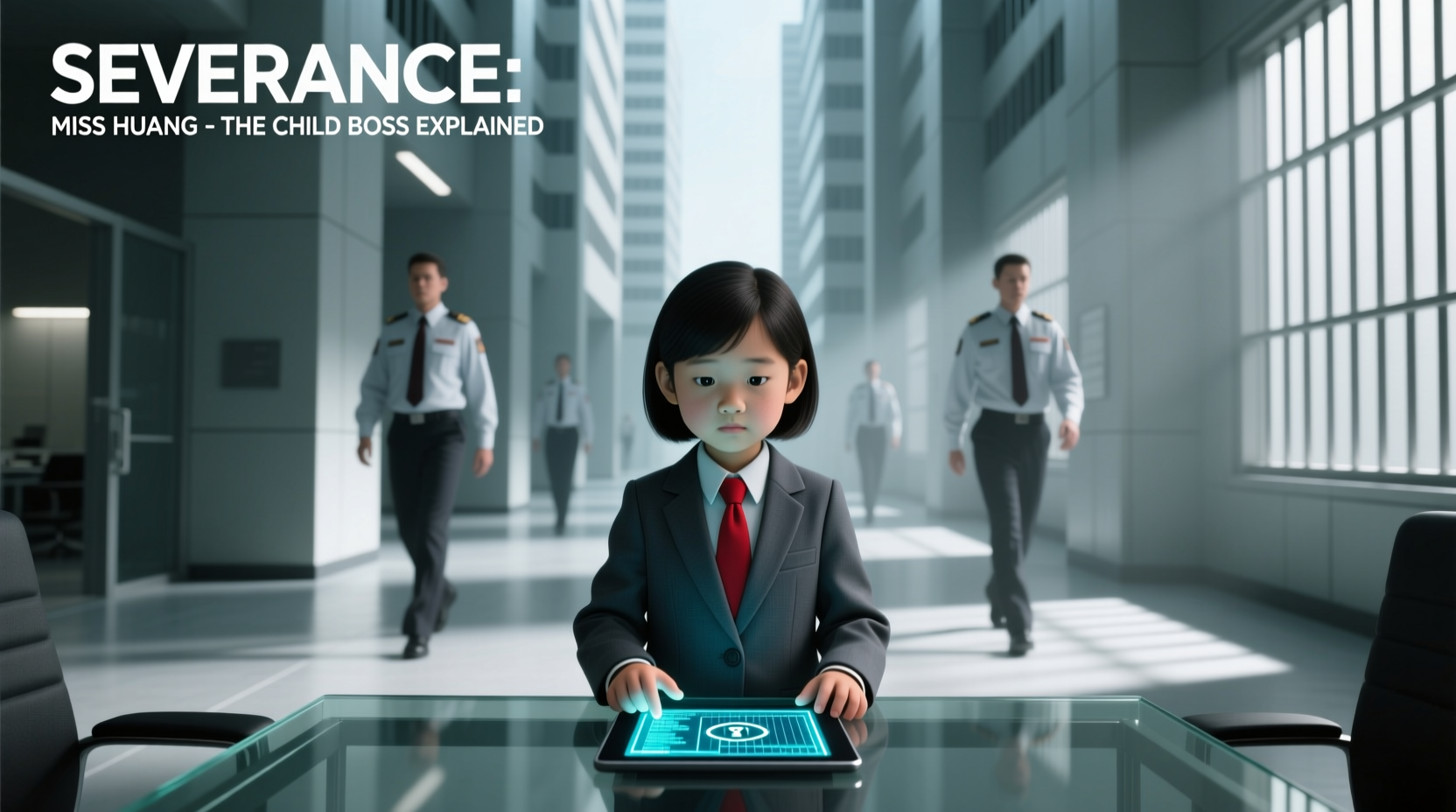
Miss Huang appears exclusively on the severed floor — the isolated workspace where employees’ memories are split between their “innie” (workplace self) and “outie” (outside-world self). She presides over the Macrodata Refinement team with an eerie calmness, delivering reprimands, enforcing rules, and even conducting performance reviews. Despite her age, her authority is never questioned by the innies, who treat her with a mix of fear and deference.
This dynamic immediately disrupts audience expectations. In real-world hierarchies, authority is typically earned through experience, seniority, or expertise — none of which a child could possess. But within the sealed reality of the severed floor, traditional logic doesn’t apply. The innies have no access to external context; they don’t know her age is unusual for a supervisor. To them, Miss Huang *is* the system. She embodies Lumon’s opaque, unchallengeable governance.
Her presence reinforces the theme of cognitive dissonance: the characters accept the illogical because they lack the tools to question it. This mirrors real-life scenarios where individuals comply with authoritarian structures simply because “that’s how things are done.”
Symbolism of Childhood and Control
Miss Huang is not merely a child — she is a symbol of corrupted innocence and manufactured authority. Children are traditionally associated with vulnerability, learning, and moral purity. By placing a child in a position of punitive power, Severance inverts these associations. She becomes a vessel for institutional cruelty masked as neutrality.
Consider her demeanor: emotionless, precise, and unyielding. She recites corporate doctrine without empathy, echoing the way bureaucratic systems depersonalize human interaction. Her youth amplifies the unnaturalness of her role — she hasn’t lived enough to understand the weight of her decisions, yet she wields consequences like demotions or “breaks” in the Testing Floor.
Moreover, her appearance may be a deliberate psychological tool used by Lumon. Studies in organizational psychology suggest that people are more likely to obey figures who appear non-threatening or neutral. A child boss may disarm resistance — after all, who would suspect a little girl of being part of a sinister regime?
“In authoritarian environments, power often hides behind innocence. The more benign the face, the deeper the control.” — Dr. Lena Moreau, Organizational Psychologist, Columbia University
Lumon’s Ideology and the Cult-Like Culture
To fully grasp Miss Huang’s role, one must understand Lumon Industries as more than a corporation — it functions as a cult. Its leadership venerates Kier Eagan, the company’s long-dead founder, whose teachings are treated as sacred texts. Employees participate in rituals, memorize core principles, and are punished for deviation.
Within this framework, Miss Huang fits perfectly. She is not evaluated by competence but by loyalty to Kier’s philosophy. Her youth may even be a feature, not a bug: children are more malleable, easier to indoctrinate, and less likely to question doctrine. If Lumon believes in preserving “purity” of ideology, then promoting a child — untouched by outside influence — makes perverse sense.
Additionally, her presence aligns with Lumon’s obsession with legacy and continuity. Just as Kier’s children were groomed to inherit his vision, Miss Huang may represent the next generation of ideological custodians. She is not a manager — she is a successor.
Miss Huang vs. Other Authority Figures in Severance
| Character | Role | Authority Style | Symbolic Meaning |
|---|---|---|---|
| Miss Huang | Supervisor (Intra-floor) | Cold, mechanical, childlike | Perversion of innocence; institutionalized control |
| Harmony Cobel | Outie Supervisor / Manager | Obsessive, manipulative | Dual identity; surveillance culture |
| Mr. Graner | Security Chief | Brutal, physical enforcement | Raw power; fear-based compliance |
| Kier Eagan | Founder (deceased) | Ideological, omnipresent | Cult of personality; eternal leadership |
A Mini Case Study: The Break Room Scene
One of the most revealing moments involving Miss Huang occurs during Petey’s “reintegration therapy” aftermath. When Mark S. fails to meet quotas, Miss Huang calmly informs him that he will be sent to the Break Room — a white, silent chamber where employees must apologize endlessly for undefined infractions.
What’s chilling is not the punishment itself, but who delivers it: a child telling an adult he must be humiliated. There’s no anger, no malice — just procedure. This scene exemplifies how systems of control become normalized when authority is detached from empathy. The viewer feels discomfort not because Miss Huang is cruel, but because she is indifferent. She has been trained to administer pain without understanding it.
In real-world parallels, this mirrors how junior bureaucrats or automated systems enforce punitive policies — think of AI-driven layoffs or robotic customer service scripts that deny aid without explanation. The harm isn’t intentional; it’s systemic.
Is Miss Huang Real? The Question of Identity
Another layer of mystery surrounds whether Miss Huang is actually a child — or if she’s an adult playing a role, or even an artificial construct. Some fans speculate she could be a hologram, a programmed avatar, or a mentally regressed employee. While the show hasn’t confirmed any theory, the ambiguity itself is meaningful.
By keeping her origins unclear, Severance emphasizes that her identity matters less than her function. Whether she’s a real girl or a corporate puppet, she represents the same thing: the infantilization of power. In a world where memory is erased and autonomy erased, even the figure of authority can be reduced to a script.
Checklist: Understanding Surreal Characters in Severance
- Ask: What does this character represent beyond their literal role?
- Consider how their presence affects the psychological state of the innies.
- Look for parallels between fictional elements and real workplace behaviors.
- Analyze dialogue and setting for clues about hierarchy and control.
- Remember: In Severance, nothing is arbitrary — even the strangest details serve a thematic purpose.
Frequently Asked Questions
Is Miss Huang a real child in the show?
The show presents her as a real child within the narrative, though her background and selection process remain unexplained. There is no evidence suggesting she is a robot or actor, but her authenticity is left ambiguous to enhance the surreal atmosphere.
Why don’t the employees question having a child boss?
The “innies” have no access to the outside world or context for normal corporate structures. Their reality is defined entirely by Lumon’s rules. Since Miss Huang is presented as legitimate authority, they accept her without skepticism — a commentary on how easily people conform to illogical systems.
Does Miss Huang appear outside the severed floor?
No. She is only seen on the severed floor, reinforcing her role as a product of that environment. Her absence in the outside world suggests she may not exist beyond the innies’ controlled reality — or that her role is strictly confined to internal operations.
Conclusion: Why Miss Huang Matters
Miss Huang is far more than a shocking visual gag or plot quirk. She is a masterstroke of symbolic storytelling — a child who embodies the cold, unquestioned authority of corporate control. Her presence strips away the pretense of meritocracy and exposes how power can be arbitrarily assigned, especially in closed systems designed to suppress dissent.
Severance uses her to ask uncomfortable questions: How much of our obedience in workplaces is based on habit rather than logic? Who do we allow to judge us — and why? And what happens when institutions prioritize ideology over humanity?




 浙公网安备
33010002000092号
浙公网安备
33010002000092号 浙B2-20120091-4
Comments
No comments yet. Why don't you start the discussion?