
Snow blankets landscapes in a serene, luminous glow each winter, transforming cities and forests into monochrome wonderlands. One of the most striking features of snow is its brilliant whiteness. But have you ever paused to wonder why snow is white when it’s made of clear ice? After all, individual ice cubes or frost on a window are transparent or translucent. So what causes snow to reflect light so uniformly that it appears bright white to our eyes? The answer lies not in pigment, but in physics—specifically, in how light interacts with the complex structure of snowflakes.
This phenomenon may seem simple at first glance, but it involves fascinating principles of optics, crystallography, and atmospheric science. Understanding why snow appears white reveals much about the nature of light, reflection, and the microscopic architecture of frozen water.
The Nature of Light and Color Perception
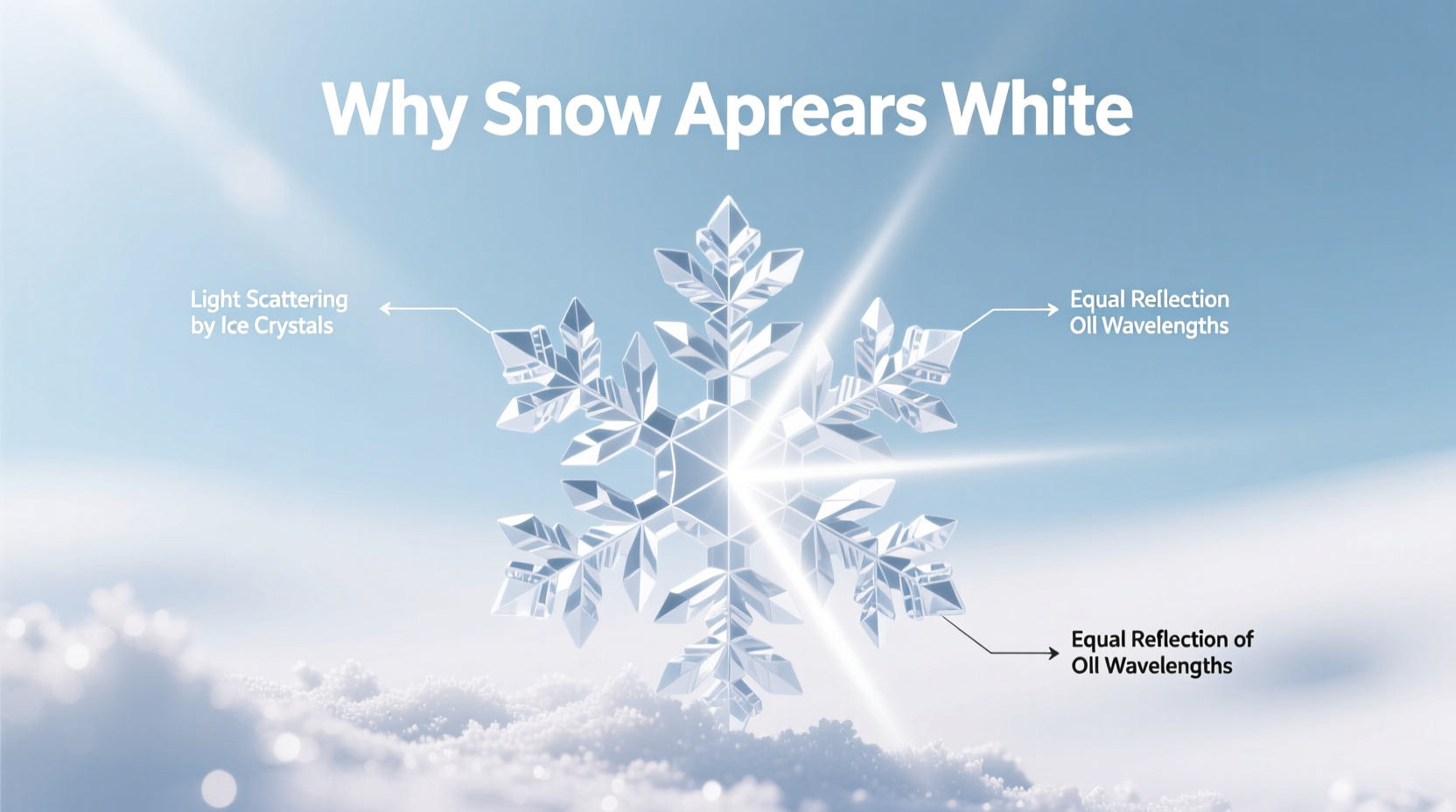
To understand why snow looks white, we must first consider how humans perceive color. Visible light is composed of a spectrum of wavelengths, each corresponding to a different color—from violet (short wavelength) to red (long wavelength). When sunlight reaches Earth, it contains all these wavelengths combined, which together appear white to our eyes.
Objects appear colored because they absorb certain wavelengths of light and reflect others. A red apple, for example, absorbs most wavelengths but reflects red light. In contrast, a white object reflects nearly all wavelengths of visible light equally. Snow behaves like such an object—but not because it contains any pigments. Instead, its whiteness emerges from the way light scatters within its intricate structure.
Structure of Snowflakes and Light Scattering
Snowflakes begin as tiny ice crystals formed around microscopic particles in clouds. These crystals grow into elaborate hexagonal shapes due to the molecular arrangement of water molecules in ice. When millions of these snowflakes accumulate, they form a porous, granular layer of snowpack.
Each snowflake has multiple surfaces—edges, facets, and air pockets—that interact with incoming light. When sunlight hits a snow surface, it doesn’t simply bounce off one smooth plane like a mirror. Instead, light enters the upper layers of snow and encounters countless ice-air interfaces. At each boundary between ice and air, light undergoes **scattering**—a redirection of photons in many directions.
This process is known as **Mie scattering**, which occurs when light interacts with particles roughly the same size as its wavelength (about 400–700 nanometers). Because snowflakes and their microstructures fall within this size range, they efficiently scatter all wavelengths of visible light equally. Unlike Rayleigh scattering (which favors shorter blue wavelengths and makes the sky blue), Mie scattering is non-selective—it treats red, green, and blue light almost identically.
Why Isn’t Snow Transparent Like Ice?
It’s natural to expect snow to be transparent since it’s made of frozen water. However, transparency depends on structural uniformity. A solid block of ice allows light to pass through with minimal internal disruption because it lacks internal boundaries. In contrast, snow is a composite material: a matrix of ice crystals separated by air gaps.
Every time light crosses from ice to air (or vice versa), some of it reflects back due to differences in refractive index—the measure of how much a material slows down light. Ice has a refractive index of about 1.31, while air is close to 1.00. This mismatch causes partial reflection at each interface. With hundreds of such interfaces per millimeter in fresh snow, light gets bounced around repeatedly before eventually exiting the surface—often from a different location than where it entered.
This repeated internal reflection and scattering diffuses the light thoroughly, blending all colors evenly. The result is a soft, matte white appearance across the entire snowfield.
“Snow acts like a natural diffuser. Its multi-layered crystalline network traps and redistributes sunlight in all directions, making it one of the most efficient natural reflectors on Earth.” — Dr. Lena Torres, Atmospheric Physicist, University of Colorado
Factors That Influence Snow’s Whiteness
While freshly fallen snow typically appears bright white, several environmental factors can alter its perceived color:
- Aging and Compaction: As snow ages, crystals metamorphose and bond together, reducing air pockets. This decreases scattering efficiency, leading to a duller, slightly grayish hue.
- Impurities: Dust, soot, or pollutants embedded in snow absorb light rather than scatter it, creating dark spots or overall graying.
- Algae Growth: In spring, certain cold-adapted algae (like Chlamydomonas nivalis) bloom in snow, producing red or pink pigments—commonly called “watermelon snow.”
- Depth and Density: Deep snowpacks appear bluer near crevices or holes because longer red wavelengths get absorbed slightly more over distance, leaving a faint blue tint—a phenomenon similar to why glaciers look blue.
| Condition | Effect on Appearance | Scientific Reason |
|---|---|---|
| Fresh powder | Bright white | High air-to-ice ratio maximizes scattering |
| Old, compacted snow | Gray or dull white | Reduced air pockets lower reflectivity |
| Polluted snow | Yellowish or brown | Particles absorb light, reduce albedo |
| Glacial ice | Blue tint | Longer light path absorbs red; blue scatters more |
Real-World Example: Urban vs. Mountain Snow
Consider two scenarios: snowfall in a bustling city versus a remote alpine valley. In downtown areas, snow often turns gray within hours of falling. This isn’t due to changes in the ice itself, but because vehicle exhaust, tire dust, and road salt mix into the top layer. These contaminants act as light absorbers, diminishing the snow’s ability to scatter light uniformly.
In contrast, high-altitude mountain snow remains dazzlingly white for days, even weeks. The air is cleaner, wind redistributes loose powder, and solar exposure slowly transforms crystals without introducing impurities. Skiers and mountaineers often remark on the intense brightness—sometimes requiring sunglasses even on cloudy days—due to the high albedo (reflectivity) of pristine snow, which can reflect up to 90% of incoming sunlight.
Step-by-Step: How Sunlight Becomes White Reflection in Snow
- Sunlight reaches the snow surface – Full-spectrum white light strikes the top layer.
- Light penetrates the snowpack – Photons enter through pores and crystal facets.
- Multipath scattering occurs – Light bounces between ice and air interfaces in random directions.
- All wavelengths scatter equally – No single color dominates due to non-selective Mie scattering.
- Diffuse reflection returns to observer – Mixed wavelengths exit the surface, appearing white to the human eye.
- Uniform brightness results – Across large areas, consistent structure leads to even illumination.
Frequently Asked Questions
Can snow ever be truly black?
No, pure snow cannot be black because it inherently reflects most light. However, heavily contaminated snow—such as that mixed with oil, soot, or volcanic ash—can appear nearly black due to extreme absorption. This drastically reduces its albedo and accelerates melting.
Why does snow sometimes look blue in shadows?
In shaded areas, direct sunlight is absent, but the sky provides indirect blue light. Snow scatters this ambient blue light efficiently, enhancing the perception of blueness. Additionally, deeper snow absorbs red wavelengths slightly more over distance, allowing blue to dominate in crevices or tunnels.
Is white snow colder than colored snow?
Not inherently, but white snow stays cooler because it reflects more solar energy. Darker snow absorbs more heat, leading to faster melting—a feedback loop known as the albedo effect, which plays a role in climate change dynamics.
Conclusion: Embracing the Science Behind Winter’s Glow
The whiteness of snow is not merely aesthetic—it’s a testament to the elegant interplay between light and matter. Far from being a passive blanket, snow actively manipulates sunlight through trillions of microscopic interactions, turning clarity into brilliance. This principle influences everything from climate modeling to photography in snowy environments.




 浙公网安备
33010002000092号
浙公网安备
33010002000092号 浙B2-20120091-4
Comments
No comments yet. Why don't you start the discussion?