
When you plug in your festive Christmas lights and only part of the strand flickers—or worse, nothing turns on—it’s easy to assume the whole set is broken. But often, the culprit isn’t a power issue or a faulty outlet. It’s something much smaller: one burned-out bulb, especially if it's near the beginning of the circuit. In many traditional Christmas light strands, the failure of the first bulb—or any single bulb—can shut down the entire string. This behavior puzzles homeowners every holiday season. Why does one tiny bulb have such a dramatic effect? The answer lies in the way these lights are wired: in series.
How Series Circuits Work in Christmas Lights
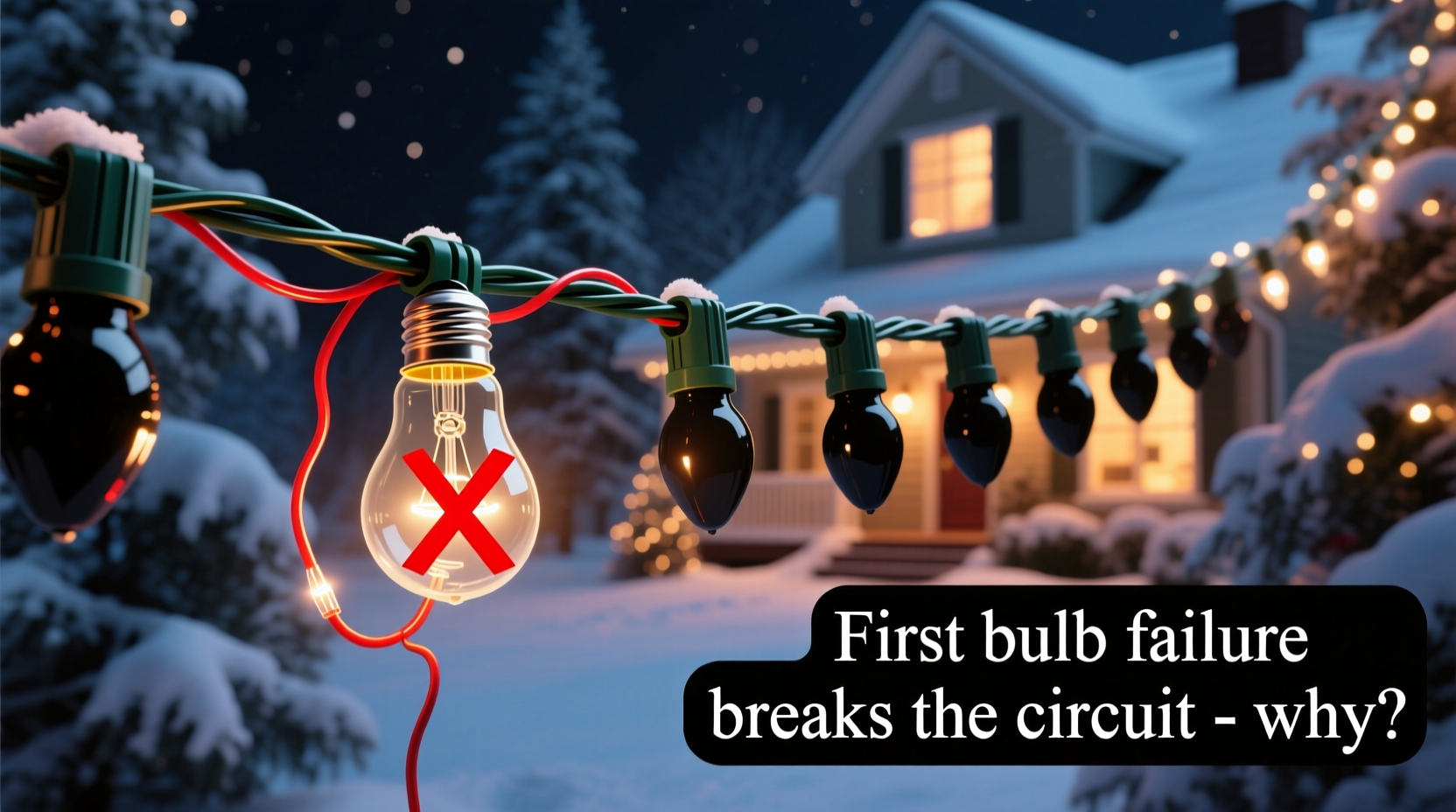
In a series circuit, electrical components are connected end-to-end in a single path. Current flows through each component in sequence, meaning that for electricity to complete its journey from the plug to the socket, it must pass through every bulb along the way. If any point in that chain breaks—such as a filament burning out—the circuit is interrupted, and current stops flowing entirely.
This is fundamentally different from parallel circuits, where each bulb has its own independent connection to the power source. In parallel setups, one failed bulb doesn’t stop others from lighting because the current has alternative paths. However, most older and budget-friendly Christmas light strands use series wiring due to lower manufacturing costs and simpler design.
The placement of the bulb matters less than the nature of the circuit itself. While people often say “the first bulb” affects the whole strand, technically, any open circuit in a series will halt operation. That said, the *first* bulb may seem more critical because it’s the initial link in the chain—if it fails, nothing downstream receives power.
Why Filament Failure Breaks the Circuit
Inside each incandescent Christmas light bulb is a thin tungsten filament. When electricity passes through it, the filament heats up and glows, producing light. Over time, thermal stress causes this delicate wire to weaken and eventually break. Once broken, the electrical continuity is lost.
In modern mini-light strands (typically 50 or 100 bulbs), each bulb receives about 2.5 volts when wired in series across a standard 120-volt outlet. This division of voltage relies on all bulbs being intact. Remove or burn out one bulb, and not only does that socket go dark—but the full voltage cannot distribute properly, halting the flow altogether.
Some newer light sets include shunt wires—tiny conductive pathways wrapped beneath the filament. When the filament burns out, the shunt activates, allowing current to bypass the dead bulb and keep the rest lit. However, shunts don’t always work reliably, especially after repeated burnouts or exposure to moisture.
“Series-wired lights are like a line of dominoes—one fall knocks over the rest unless there’s a detour built in.” — Dr. Alan Reeves, Electrical Engineer and Holiday Lighting Consultant
Troubleshooting a Dead Strand: A Step-by-Step Guide
Diagnosing and repairing a non-working Christmas light strand requires patience and a methodical approach. Follow this timeline to identify and resolve the issue efficiently:
- Unplug the strand – Always begin with safety. Never handle electrical components while powered.
- Inspect visually – Look for obvious signs: cracked bulbs, loose sockets, frayed wires, or discolored areas.
- Check the fuse – Many strands have small fuses located in the plug. Use a multimeter or replace with identical-rated fuses (usually 3–5A).
- Test each bulb – Starting from the plug end, remove and examine each bulb. Look for darkened glass or separated filaments.
- Use a light tester – Insert a non-contact voltage detector or dedicated Christmas light tester into each socket to find where power stops.
- Replace suspect bulbs – Even if a bulb looks fine, swap it with a known working one. Sometimes internal breaks aren’t visible.
- Reconnect and test – After replacements, plug in briefly to see if the strand lights. Repeat until full function returns.
Real Example: The Front Porch Standoff
Last December, Sarah in Denver strung up her family’s vintage icicle lights—used for over 15 years. Only half illuminated. She replaced the fuse, checked connections, even bought a new timer. Still no luck. Frustrated, she brought the strand inside and began pulling bulbs one by one. On the fifth bulb—the second from the plug—she spotted a nearly invisible gap in the filament. It looked intact at first glance, but under magnification, the break was clear. Replacing that single bulb restored the entire strand. Her lesson? “Don’t overlook the early ones just because they’re close to the plug.”
Series vs. Parallel: What’s Best for Holiday Lights?
Understanding the difference between series and parallel circuits helps explain why some strands fail completely while others stay lit despite missing bulbs. Here’s a comparison:
| Circuit Type | Voltage per Bulb | Failure Impact | Cost & Complexity | Common Usage |
|---|---|---|---|---|
| Series | Divided (e.g., 120V / 50 = 2.4V) | One failure kills entire strand | Low cost, simple wiring | Traditional mini-lights |
| Parallel | Full voltage (120V per bulb) | Only failed bulb goes dark | Higher cost, complex insulation | Larger decorative bulbs, commercial displays |
| Series with Shunts | Divided, with bypass capability | Often stays lit after single failure | Moderate cost, reliability varies | Newer consumer-grade strings |
While parallel circuits offer superior reliability, they require heavier gauge wiring and better insulation due to higher per-bulb voltage. For mass-market decoration, series remains dominant—especially in pre-lit trees and affordable string sets.
Modern Solutions and Prevention Tips
Technology has improved, but many consumers still rely on legacy designs. Fortunately, several strategies can reduce frustration and extend strand life.
- Invest in LED lights: LEDs consume less power, generate less heat, and last significantly longer than incandescents. Many are wired in series but with integrated resistors and better shunting.
- Look for \"lighted\" fuses: Some plugs include indicator lights that glow when the fuse is intact, helping diagnose issues faster.
- Use surge protectors: Voltage spikes during storms or grid fluctuations can prematurely kill filaments. Plug strands into surge-protected outlets.
- Store carefully: Wrap lights around a cardboard reel or use a storage reel to avoid crushing bulbs and damaging wires.
- Test before decorating: Check each strand indoors before hanging outdoors. Fix problems in warm, dry conditions rather than on a cold ladder.
Checklist: Maintaining Your Christmas Light Strands
Follow this checklist annually to keep your lights functional and safe:
- ✅ Unplug all strands after seasonal use
- ✅ Inspect for damaged wires or melted sockets
- ✅ Replace any missing or cloudy bulbs
- ✅ Test each strand individually before storage
- ✅ Store in labeled, ventilated containers away from rodents
- ✅ Keep original packaging or spare fuses for compatibility
- ✅ Consider upgrading sets older than 5 years to LED alternatives
Frequently Asked Questions
Does the position of the bulb really matter in a series strand?
No—not in terms of electrical theory. Any break in a series circuit stops current flow, regardless of location. However, since the first bulb is closest to the power source, it tends to experience slightly higher inrush current and may degrade faster. Its failure is often noticed first because no downstream bulbs receive power.
Can I convert a series strand to parallel wiring?
Technically yes, but it’s impractical for most users. Rewiring 50+ bulbs in parallel would require extensive modification, including individual hot and neutral connections for each socket—defeating the purpose of a plug-and-play system. Instead, consider purchasing professionally made parallel-wired or LED rope lights designed for durability.
Why do some strands stay lit even with a dead bulb?
These likely have functioning shunt wires. When the filament breaks, increased resistance causes the shunt to heat up and activate, creating a bypass. Not all shunts work perfectly, though—especially if corrosion or age interferes with conductivity.
Conclusion: Smart Lighting Starts with Understanding the Circuit
The reason the first bulb in a series can disable an entire Christmas light strand isn’t magic—it’s basic electrical engineering. Series circuits depend on unbroken continuity, making them vulnerable to single-point failures. While this design keeps production costs low, it demands greater user diligence in maintenance and inspection.
By understanding how these systems work, you gain control over their reliability. You can troubleshoot faster, store smarter, and make informed choices when buying new decorations. As LED technology becomes more affordable and resilient, the days of painstakingly checking every bulb may soon fade. Until then, knowing the science behind the sparkle makes all the difference.




 浙公网安备
33010002000092号
浙公网安备
33010002000092号 浙B2-20120091-4
Comments
No comments yet. Why don't you start the discussion?