
Every year, millions of households gather around their Christmas trees, ready to string lights, hang ornaments, and create a festive centerpiece for the holidays. Yet few pause to consider whether there’s a right—or wrong—way to layer these decorations. Does it really matter if you drape the lights before or after the ornaments? According to professional decorators, lighting technicians, and interior designers, the answer is a resounding yes. The sequence in which you apply lights and ornaments isn’t just about tradition—it affects safety, visual balance, structural integrity, and even how long your setup lasts through the season.
From avoiding tangled wires to maximizing glow distribution, the order of operations transforms a haphazard decoration session into a polished, efficient process. Industry experts agree: getting the sequence right saves time, reduces frustration, and elevates the final look of your tree.
The Logic Behind Lighting First
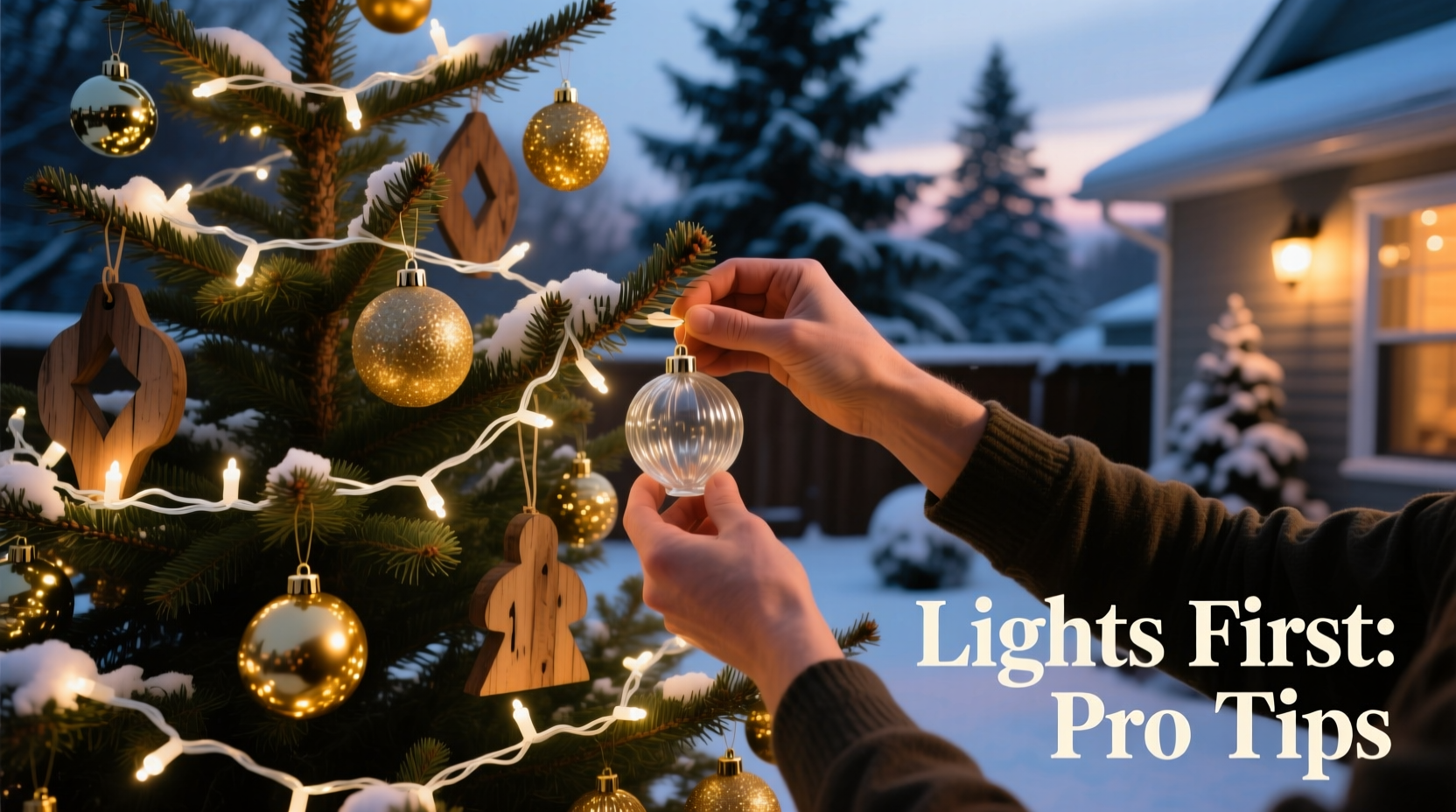
The overwhelming consensus among professional decorators is to install lights before hanging ornaments. This may seem like a minor detail, but it's rooted in both practicality and design principles. When lights go on first, they become the foundation of the tree’s ambiance—providing even illumination that enhances every subsequent decorative layer.
“Think of lights as the canvas,” says Laura Bennett, a certified interior stylist with over 15 years of holiday design experience. “You wouldn’t paint a mural over a finished sculpture. You start with light because it needs to weave through the branches without obstruction.”
“Lighting should be integrated into the depth of the tree, not just draped over the surface. That’s only possible when you work before ornaments block access.” — Michael Tran, Commercial Display Designer, Holiday Illuminations Inc.
When you begin with lights, you can tuck strands deep into the core of the tree, creating a three-dimensional glow. This internal lighting technique prevents the “halo effect”—where lights only appear on the outer edges—and ensures shadows are minimized from all viewing angles.
Safety and Accessibility: Why Sequence Prevents Problems
Beyond aesthetics, the order of decoration directly impacts safety. Attempting to install lights after heavy or fragile ornaments increases the risk of knocking items off, straining electrical cords, or even destabilizing the tree stand.
A 2022 consumer safety report from the National Fire Protection Association noted that nearly 20% of holiday decoration-related incidents involved tripped cords or damaged lighting caused during late-stage adjustments. Many of these could have been avoided by following a logical assembly sequence.
Working with lights first allows decorators to:
- Secure plug placements near outlets without repositioning decorated branches
- Route cords safely along the trunk and stand, reducing trip hazards
- Inspect each bulb and connection point without worrying about breaking nearby ornaments
- Ensure proper voltage load distribution across multiple strands
Once ornaments are hung, accessing inner branches becomes significantly harder—especially on full, dense trees. Reaching into tight spaces with sharp or bulky ornaments nearby raises the likelihood of damage. By contrast, installing lights first creates a clear workflow: light, then decorate, then finalize.
Visual Impact: How Layering Affects Perception
The human eye naturally follows light. In design theory, luminance dominates color and form—meaning glowing elements draw attention before static ones. When lights are applied last, they often compete with or get visually buried beneath ornament clusters.
Professional decorators use a method called “layered luminosity” to build depth:
- Base layer: White or warm-white lights evenly distributed from trunk to tips
- Middle layer: Ornaments placed to reflect and refract existing light
- Top layer: Specialty lighting (e.g., twinkle LEDs, color-changing bulbs) used sparingly for accent
This approach ensures that light isn't an afterthought but a structural component of the display. Ornaments then serve to amplify—not obstruct—the glow.
Consider tinsel or mirrored balls: their brilliance depends entirely on proximity to a light source. If lights are installed after such items, the reflective surfaces may face away from illumination, rendering them dull. But when lights come first, ornaments can be strategically positioned to catch and scatter light throughout the room.
| Aspect | Lights First | Ornaments First |
|---|---|---|
| Light Distribution | Even, multi-directional glow | Uneven, patchy brightness |
| Installation Safety | Low risk; unobstructed access | High risk; potential breakage |
| Time Efficiency | ~30–45 minutes (average) | ~60+ minutes with corrections |
| Ornament Placement Flexibility | High; can avoid glare or shadow zones | Low; limited by cord paths |
| Final Visual Depth | Rich, dimensional appearance | Flat, surface-level look |
Step-by-Step: The Professional Decorating Sequence
Following a structured process eliminates guesswork and delivers consistent results. Here’s the standard protocol used by commercial and residential stylists:
- Inspect and prepare the tree. Whether real or artificial, fluff branches outward to create volume. Rotate the tree so its fullest side faces primary viewing areas.
- Test all light strands. Plug in each set individually to identify dark sections or loose bulbs. Replace or repair as needed.
- Begin at the base, working upward. Start with the bottom third of the tree. Attach lights to the central pole or sturdiest branch supports, spiraling inward toward the trunk and outward to the tips.
- Distribute evenly by count, not sight. Use a consistent spacing—typically 100 lights per foot of tree height. For a 7-foot tree, that means roughly 700 bulbs.
- Weave deeply into the canopy. Push strands several inches into the interior to ensure core illumination. Avoid wrapping like a candy cane—this causes hotspots.
- Connect and conceal cords. Link strands using approved connectors. Tuck excess wiring behind branches and route down the trunk to hide from view.
- Hang ornaments by size and weight. Start with largest/heaviest ornaments near the base and inner branches. Place delicate or lightweight ones toward the ends.
- Balance color and theme. Distribute dominant colors evenly. Cluster complementary tones rather than scattering randomly.
- Add final lighting accents. Introduce specialty effects—like flickering candles or colored spotlights—only after main layers are secure.
- Step back and evaluate. View the tree from multiple angles and under different lighting conditions. Make micro-adjustments as needed.
Real-World Example: A Home Decorator’s Mistake Turned Lesson
Jessica M., a homeowner in Portland, OR, decided to reverse the typical order one December, hanging her family’s heirloom glass ornaments first out of sentimental excitement. She began carefully placing each piece, only to realize halfway through that she hadn’t yet installed lights.
“I thought I could just thread the lights over the top,” she recalls. “But every time I reached in, an ornament would swing and hit another. I ended up breaking two—one was a hand-blown snowman from my grandmother.”
Frustrated, she unplugged the half-lit strands, removed dozens of ornaments, installed the lights properly, and rehung everything. The second attempt took twice as long—but the result was dramatically better lit and more cohesive.
“Now I tell everyone: lights first. It’s not just a rule—it’s a way to protect what matters most on your tree.”
Common Exceptions and When They Apply
While lighting first is the gold standard, exceptions exist—particularly in themed displays or artistic installations.
- Narrative Trees: Some designers build scenes where ornaments form a story (e.g., a winter village). In these cases, lights may be added selectively after placement to spotlight key areas.
- Commercial Displays: Department stores sometimes install ornaments first to speed up photo shoots, then add temporary lighting rigs for evening visibility.
- LED Net Lights: Pre-strung net lights designed for easy coverage over bushes or slim trees can be laid over already-decorated surfaces, though this works best on sparse foliage.
However, even in these scenarios, professionals emphasize that the exception proves the rule: deviating from the standard sequence requires additional planning, support structures, and risk mitigation.
Checklist: Optimize Your Tree Decoration Order
Use this checklist to ensure you’re following best practices:
- ☐ Fluff and shape the tree before starting
- ☐ Test all light strings for functionality
- ☐ Start with lights—begin at the base and work upward
- ☐ Weave lights into the interior for 3D glow
- ☐ Conceal cords along the trunk and stand
- ☐ Hang largest ornaments first, closest to the center
- ☐ Balance colors and textures evenly around the tree
- ☐ Add smaller, delicate ornaments last
- ☐ Install specialty lighting accents only after main layers
- ☐ Evaluate from multiple angles and adjust as needed
Frequently Asked Questions
Can I use extension cords for tree lights?
Yes, but only indoor-rated cords rated for the total wattage of your light strands. Never daisy-chain more than three sets together unless labeled safe for it. Position the outlet side of the tree accordingly during setup.
What if I already hung ornaments first—can I still add lights safely?
You can, but proceed with extreme caution. Use flexible, thin-gauge mini-lights and gently drape them over outer branches. Avoid pushing deep into the tree to prevent dislodging ornaments. Consider using clip-on LED puck lights as a safer alternative.
How many lights do I need per foot of tree?
A general guideline is 100 mini lights per foot of tree height. For example, a 6-foot tree should have about 600 lights. For a fuller glow, increase to 150 lights per foot. Always check manufacturer recommendations for LED vs. incandescent power draw.
Conclusion: Let Light Lead the Way
The order in which you decorate your Christmas tree is far more than a matter of preference—it’s a strategic decision that shapes safety, efficiency, and beauty. By placing lights before ornaments, you lay the groundwork for a display that shines from within, withstands daily wear, and reflects thoughtful craftsmanship.
Seasoned decorators don’t follow this sequence out of habit alone; they do it because it works. It minimizes risks, maximizes visual impact, and honors the emotional significance of the traditions we uphold. Whether you’re dressing a tabletop spruce or a towering fir, letting light lead the way ensures your efforts culminate in a display that feels warm, balanced, and truly magical.




 浙公网安备
33010002000092号
浙公网安备
33010002000092号 浙B2-20120091-4
Comments
No comments yet. Why don't you start the discussion?