
Every year, as families gather to decorate their Christmas trees, a familiar frustration often arises: the once-proud treetop begins to droop or bend forward, spoiling the symmetry and elegance of the centerpiece. This subtle but noticeable tilt can be more than just cosmetic—it can affect ornament balance, light distribution, and even safety. While it might seem like an unavoidable flaw, especially with real trees, the truth is that this issue stems from identifiable causes and can be effectively prevented or corrected.
The good news is that whether you're using a fresh-cut evergreen, a potted living tree, or an artificial model, there are reliable strategies to maintain vertical integrity. From understanding tree biology to mastering support techniques, this guide explores the science behind the sag and offers actionable steps to ensure your tree stands straight through the holiday season.
Understanding Why Tree Tops Bend Forward
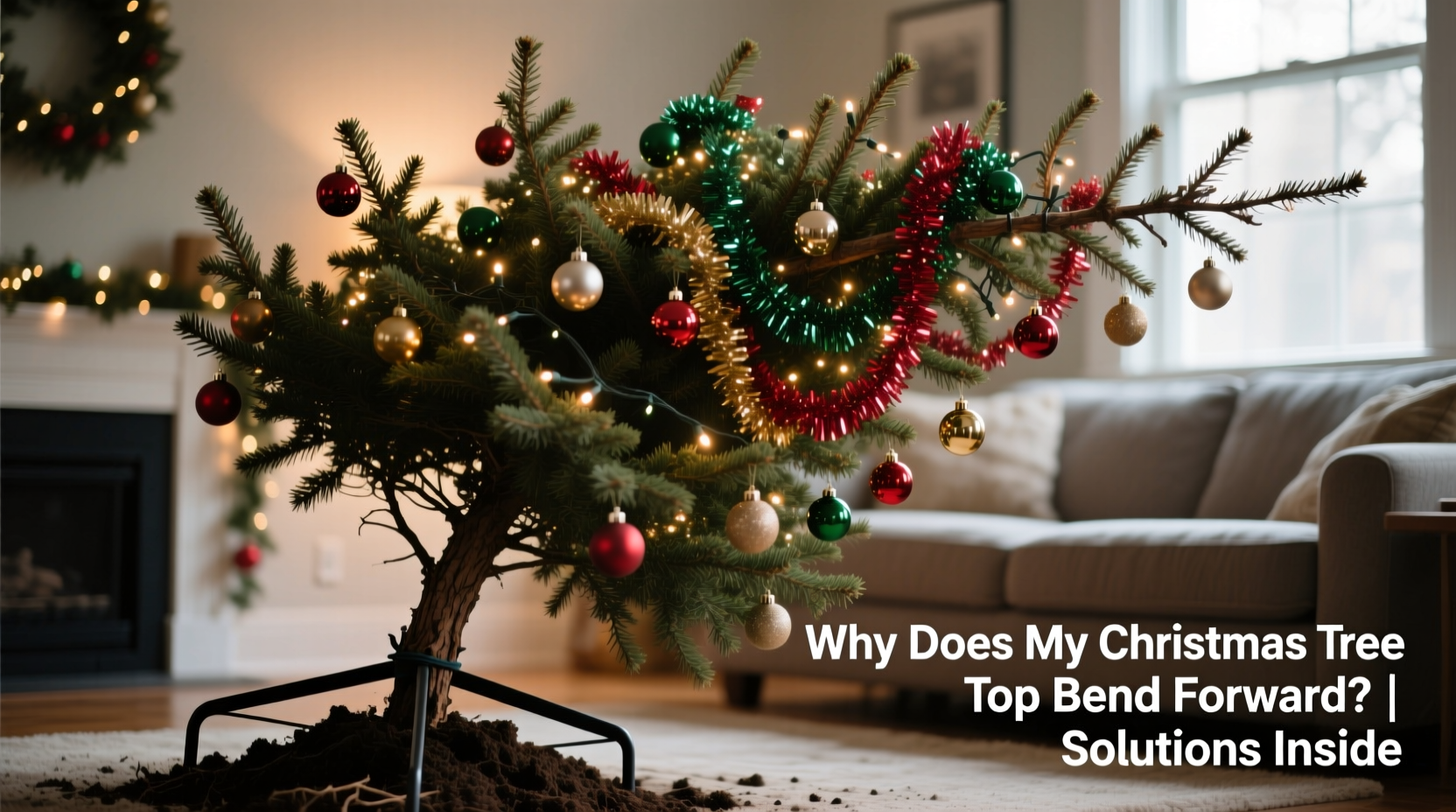
The tendency for a Christmas tree’s top to lean or droop isn’t random. It’s typically the result of a combination of biological, structural, and environmental factors. The most common causes include:
- Natural growth patterns: Trees in nature grow toward sunlight, often resulting in a slight upward curve at the tip. When cut and repositioned indoors, gravity and altered orientation can exaggerate this curvature.
- Moisture loss (in real trees): As a freshly cut tree dries out, its cells lose rigidity. The top, being the thinnest and least supported section, is most vulnerable to bending under its own weight.
- Uneven weight distribution: Overloading one side of the upper branches with heavy ornaments, garlands, or lights can pull the apex off-center.
- Poor trunk alignment in the stand: If the trunk isn’t centered or securely clamped in the stand, the entire tree may lean, with the top amplifying the angle.
- Artificial tree design flaws: Some pre-lit artificial trees have flexible central poles or loosely connected sections that bow easily if not assembled correctly.
Addressing the problem starts with identifying which factor—or combination—is at play in your home.
Step-by-Step Guide to Prevent and Fix a Bending Tree Top
Correcting a leaning treetop doesn’t require professional tools or expertise. With careful attention and a few household items, you can stabilize your tree efficiently. Follow this timeline-based approach:
- Day 1: Assess and Prepare
Before decorating, inspect the tree for natural bends. Rotate the tree in its stand to position the strongest, straightest side facing forward. For real trees, recut the base and fill the stand with room-temperature water immediately. - Day 2–3: Monitor Hydration (Real Trees)
Check water levels twice daily. A typical six-foot tree can drink over a quart per day initially. Low water leads to faster needle drop and stem weakening. - Day 4: Begin Decorative Balancing
Start hanging lights and garlands evenly. Use lightweight string lights and distribute them uniformly from bottom to top. Avoid clustering heavy items near the apex. - Day 5: Install Support Structures
If the top shows early signs of drooping, install a discreet support rod. Use a thin wooden dowel, metal stake, or even a sturdy curtain rod inserted into the trunk’s center and secured with floral wire or zip ties. - Ongoing: Daily Visual Checks
After installation, observe the tree each morning. Adjust decorations or supports if new imbalances appear.
This proactive routine ensures issues are caught early, minimizing visible damage and maximizing stability.
Solutions for Real vs. Artificial Trees
The approach to fixing a bent top varies depending on whether your tree is natural or synthetic. Each has unique vulnerabilities and repair methods.
| Issue | Real Tree Solution | Artificial Tree Solution |
|---|---|---|
| Drying-induced droop | Ensure consistent watering; mist branches lightly to retain moisture | Not applicable — artificial trees don’t dry out |
| Weak central leader | Insert a wooden or metal support stake into the trunk | Reinforce pole connections; use internal rod extensions |
| Improper assembly | N/A | Disassemble and reattach sections, ensuring tight locking mechanisms |
| Weight imbalance | Distribute ornaments evenly; avoid heavy toppers | Use lightweight star or angel; balance upper-tier decor |
| Base instability | Check stand tightness; refill water frequently | Level floor surface; use non-slip mat under stand |
For artificial trees, proper storage also plays a role. Crushing the top section during off-season storage can weaken internal rods. Always store in a dedicated tree bag with segment dividers to prevent deformation.
Expert Insight: What Arborists and Holiday Designers Recommend
Professionals who work with trees year-round emphasize prevention over correction. Their insights blend horticultural knowledge with decorative experience.
“The terminal leader—the main upward-growing shoot—is structurally weaker after harvest. Supporting it early prevents irreversible sag.” — Dr. Laura Nguyen, Urban Forester and Holiday Tree Consultant
“I never put anything heavier than 3 ounces on the top 18 inches of a tree. Gravity wins every time.” — Marcus Bell, Professional Holiday Stylist
Experts agree: the first 72 hours after setup are critical. During this window, real trees either establish strong water uptake or begin a decline that affects all structural components, including the top. For artificial models, correct assembly and alignment of the central pole determine long-term posture.
Mini Case Study: The Leaning Spruce of Maple Street
In December 2022, the Thompson family in Burlington, Vermont, faced a recurring issue with their eight-foot balsam fir. Each year, by mid-December, the top would bend forward about 15 degrees, forcing them to hide it behind a tall candleholder. Frustrated, they consulted a local nursery.
The arborist discovered two problems: the tree stand was too small, allowing lateral movement, and the family waited three days before cutting the trunk and adding water. By then, the vascular tissues had sealed, limiting hydration.
The following year, they upgraded to a larger stand with adjustable screws, made a fresh cut within an hour of bringing the tree indoors, and installed a bamboo stake tied gently to the upper trunk. They also switched to LED mini-lights, reducing top-heavy strain. Result: the tree stood perfectly straight until January 6.
This case illustrates how small adjustments—especially in timing and support—can yield dramatic improvements.
Checklist: How to Keep Your Christmas Tree Top Straight
Use this actionable checklist before, during, and after setup:
- ☐ Choose a tree with a straight central leader when purchasing
- ☐ Recut the trunk at a 45-degree angle before placing in stand
- ☐ Fill the stand with water immediately and check levels twice daily
- ☐ Position the tree away from heat sources (vents, fireplaces, electronics)
- ☐ Use a support rod if the top shows any bend
- ☐ Distribute lights and ornaments evenly—start from the bottom up
- ☐ Limit top ornament weight to under 3 oz (85g)
- ☐ Ensure the tree stand is level and tightly secured
- ☐ For artificial trees: verify pole sections are fully locked and aligned
- ☐ Store artificial tree vertically in segments with protective caps
Following this list significantly reduces the risk of drooping and extends the visual life of your tree.
Frequently Asked Questions
Can I fix a bent tree top after it’s already drooping?
Yes. Gently straighten the top and secure it with a hidden support rod. Use soft ties like cloth strips or twist ties to anchor it to the rod without damaging branches. For real trees, improved hydration may help restore some rigidity within 24–48 hours.
What’s the best material for a support stake?
Wooden dowels (½ inch diameter) work well for real trees. For taller or heavier artificial models, consider a threaded steel rod or telescoping aluminum pole. Avoid brittle materials like plastic tubes, which can snap under pressure.
Does temperature affect tree stiffness?
Absolutely. Warm indoor temperatures accelerate moisture loss in real trees, making them more pliable and prone to bending. Keeping the tree in a cooler room (ideally below 70°F / 21°C) helps maintain structural integrity.
Final Tips for a Picture-Perfect Tree
Preventing a forward-bending top isn’t just about aesthetics—it reflects thoughtful care and attention to detail. Whether your tree is a cherished artificial heirloom or a sustainably sourced evergreen, treating it with structural respect ensures it remains a proud symbol of the season.
Remember, the top of the tree draws the eye. A straight, upright peak creates balance and harmony, enhancing the overall display. Combine proper hydration, even decoration, and smart support to achieve that flawless silhouette seen in holiday magazines.
Conclusion
The question “why does the top of my Christmas tree always bend forward?” has practical answers—and equally practical solutions. From understanding the impact of gravity and dehydration to implementing simple support systems, maintaining a straight treetop is within reach for every household.
This holiday season, take a few extra minutes during setup to assess alignment, prepare supports, and plan your decoration strategy. Your efforts will pay off in a tree that stands tall, balanced, and beautiful—a true centerpiece of celebration.




 浙公网安备
33010002000092号
浙公网安备
33010002000092号 浙B2-20120091-4
Comments
No comments yet. Why don't you start the discussion?