
Every year, millions of households wrestle with the same quiet frustration: the moment the final ornament is hung, the tree’s top begins a slow, inevitable drift—tilting left, right, or forward like a weary sentinel. It’s not just unsightly; a leaning tree strains branches, risks tipping, compromises light symmetry, and undermines the festive calm you worked so hard to create. This isn’t random bad luck. It’s physics in action—unbalanced forces, shifting weight distribution, and structural weaknesses interacting in real time. Understanding *why* it happens transforms the problem from a seasonal annoyance into a solvable engineering challenge. Below, we break down the root causes with precision, then deliver field-tested, actionable fixes—each grounded in arborist insight, holiday setup experience, and basic mechanical principles.
The 5 Core Causes Behind Tree Lean (and Why “Just Pushing It Back” Fails)
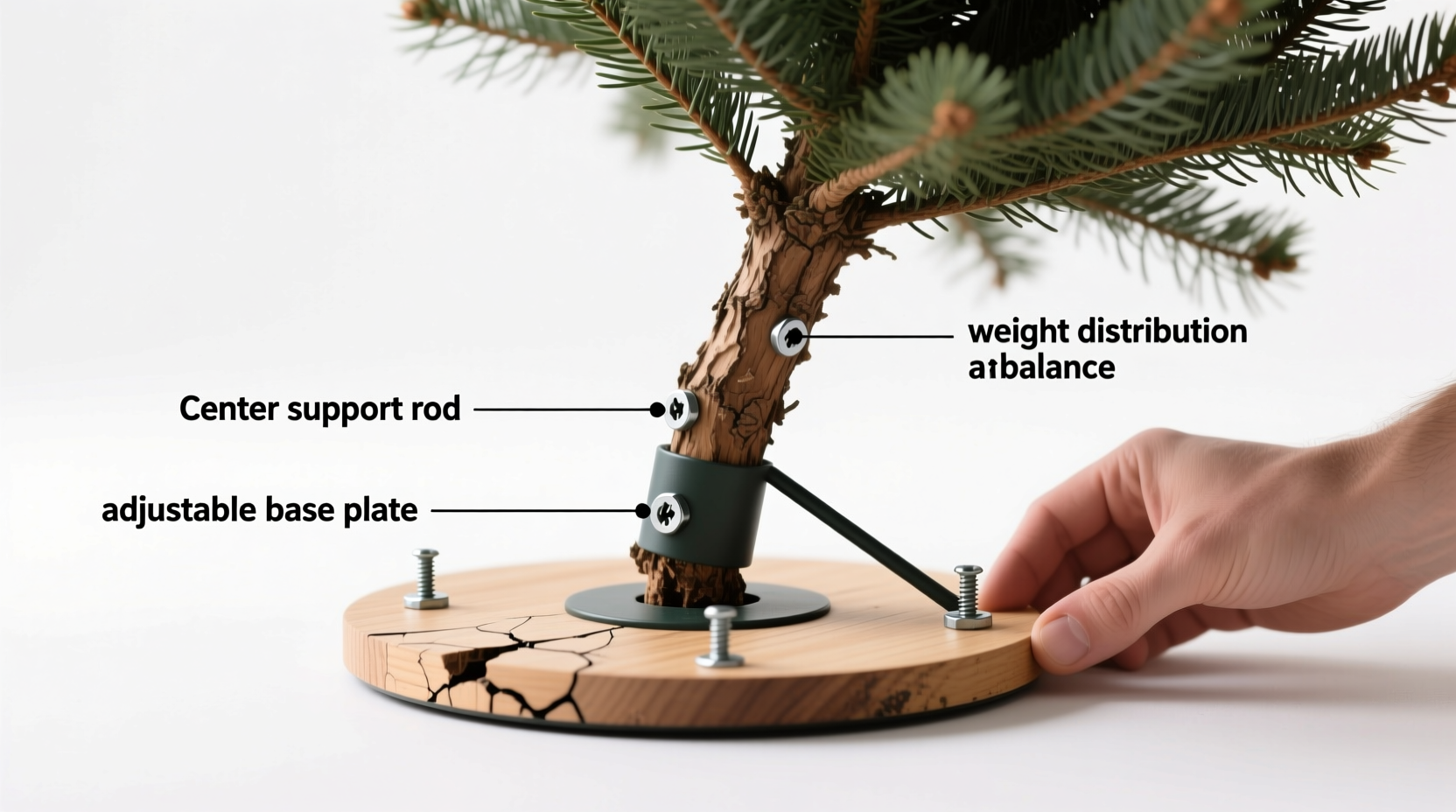
A leaning tree is rarely about a single flaw—it’s usually the cumulative effect of interconnected factors. Here’s what’s actually happening beneath the boughs:
- Asymmetric Branch Density: Natural trees grow unevenly. One side often develops denser, heavier foliage—or more robust lower branches—that creates a persistent torque moment. Artificial trees suffer similarly when pre-hung ornaments cluster on one flank or when branch hinges aren’t fully extended on one side.
- Uneven Trunk Cut or Base Instability: A trunk cut at an angle—even slightly—creates an inherent imbalance. When placed in a stand, that angled base prevents even contact with the water reservoir floor. The result? Immediate lateral pressure on one side of the stand’s gripping mechanism.
- Water Reservoir Imbalance: Most standard stands hold 1–2 gallons of water. If the stand itself sits on an uneven surface (a rug seam, warped flooring, or a slight slope), the water shifts, lowering the center of gravity toward the low side—and pulling the trunk with it.
- Top-Heavy Ornament Distribution: Heavy glass balls, large bows, or clusters of lights concentrated near the apex dramatically raise the tree’s center of gravity. Even a small horizontal offset in that mass amplifies leverage, making the top far more susceptible to lean.
- Trunk Flex and Creep: Fresh-cut evergreens contain sap-rich, flexible wood. Under sustained asymmetric load—even from wind drafts or ceiling fans—the trunk gradually deforms microscopically over days. This “creep” is irreversible without intervention and worsens progressively.
“People assume the lean starts the day they set it up. In reality, 70% of noticeable tilt develops between Day 3 and Day 7—when the trunk begins responding to uncorrected imbalances. That’s your critical window.” — Dr. Lena Torres, Urban Arborist & Holiday Tree Safety Advisor, National Christmas Tree Association
7 Proven Fixes—Tested Across Real Homes and Tree Types
These solutions work for both real and artificial trees, regardless of height (6–12 ft) or stand type (screw-jaw, bolt-tightening, or water reservoir). They prioritize safety, simplicity, and lasting correction—not temporary masking.
Fix #1: The Dual-Level Level Check (Before Watering)
Don’t rely on eyeballing verticality. Use a carpenter’s level—first horizontally across the base of the trunk (just above the stand), then vertically along two perpendicular faces of the trunk. If either reading deviates by more than 1°, adjust *before* adding water. Loosen the stand’s grip screws, gently rotate the trunk until both levels read true, then re-tighten evenly. This corrects angular misalignment at the source.
Fix #2: Strategic Counterweight Anchoring
Add stability—not just weight—at the base. Instead of stuffing the stand’s reservoir full of water immediately, fill only halfway. Then place two identical, smooth river stones (2–3 inches wide, ~1 lb each) inside the reservoir, positioning them on the *opposite side* of the lean. Fill the rest with water. The stones stay put, anchoring the low side without shifting. For artificial trees, use weighted sandbags draped discreetly over the stand’s outer rim on the high side.
Fix #3: Branch Symmetry Refinement
Systematically rebalance foliage density. Starting at the bottom, identify the heaviest 3–4 branches on the leaning side. Gently bend them outward and slightly downward—not upward—to redistribute mass laterally and lower the center of gravity. On the opposite side, select lighter branches and rotate them inward and upward to add visual and physical counter-mass. Do this in 15-minute sessions over two days—avoid forcing brittle needles.
Fix #4: The “Tension Loop” Support System
For severe leans (>5°) or tall trees (9+ ft), install discreet, non-damaging support. Use 2 mm braided nylon cord (not elastic or twine). Tie one end to a sturdy upper branch on the *leaning side*, run it diagonally down and *across* the room (not straight down), and anchor it to a wall-mounted screw eye or heavy furniture leg on the *opposite side*. Maintain 3–4 inches of slack. The diagonal pull applies corrective torque without visible rigging. Remove after 48 hours once the trunk stabilizes.
Fix #5: Stand Surface Equalization
Place a thin, rigid shim (a business card works for minor slopes; a 1/16-inch aluminum washer for moderate ones) under the stand’s foot on the *high side* of the floor—not the low side. This lifts the high side, tilting the entire stand *against* the lean and forcing the trunk back toward plumb. Test with your level before tightening the stand’s grip.
Fix #6: Ornament Redistribution Protocol
Follow the 60/30/10 rule: 60% of heavy ornaments (glass balls >2.5\", wooden stars, ceramic pieces) go on the *lower third* of the tree; 30% of medium-weight items (metal bells, fabric bows) on the *middle third*; only 10% of lightweight items (feathers, paper chains, thin tinsel) on the *top third*. Cluster nothing within 12 inches of the apex. Hang ornaments using twist ties instead of hooks to allow precise lateral adjustment.
Fix #7: Trunk Reinforcement Brace
For fresh-cut trees showing early flex, insert a 12-inch length of 1/4-inch hardwood dowel (oak or maple) into the trunk’s cut end *before* placing it in the stand. Drill a 1/4-inch pilot hole 1.5 inches deep into the center of the cut surface, then tap the dowel in with a rubber mallet. The dowel acts as an internal splint, resisting torsional stress. Seal the exposed end with white glue to prevent moisture wicking.
Do’s and Don’ts: A Critical Comparison Table
| Action | Do | Don’t |
|---|---|---|
| Water Management | Refill daily with room-temperature water. Add 1 tsp sugar + 1 tsp lemon juice per gallon to extend freshness and reduce sap coagulation. | Use hot water, salt, aspirin, or commercial “preservatives” with dyes—they clog xylem vessels and accelerate drying. |
| Stabilization | Anchor the stand to a wall stud using a 30-lb rated L-bracket and 2-inch screws—especially for trees over 7 ft. | Tie ropes around the trunk mid-height and secure to door handles or radiators—this creates dangerous shear points and damages bark. |
| Lighting | Weave lights from bottom to top in a continuous spiral, maintaining equal spacing (6–8 inches apart) on all sides. | Drape strings haphazardly or bunch extra wire on one side—this adds hidden weight and heat asymmetry. |
Real-World Case Study: The 10-Foot Fraser Fir in Portland
When Sarah K., a graphic designer in Portland, Oregon, purchased a 10-foot Fraser fir for her open-concept living room, she followed every “pro tip” she found online—cutting the trunk, soaking overnight, using a premium stand. Yet by Day 2, the top leaned 7° left. She measured the floor: a 1/8-inch dip under the left front leg of her hardwood floor. Her first fix—shimming the stand—reduced lean to 4°, but it crept back. Next, she applied Fix #3 (branch symmetry refinement) and Fix #6 (ornament redistribution), moving three 4-inch mercury glass balls from the top-left quadrant to the lower-right. By Day 4, the lean was gone. Crucially, she also installed the L-bracket anchor (Fix #2’s advanced version), eliminating any risk of tip-over. Her takeaway: “It wasn’t one thing—it was the floor, the ornaments, and the branches all working against me. Once I treated it like balancing a mobile, not propping up a pole, it stayed perfect.”
Step-by-Step Stabilization Timeline (First 72 Hours)
- Hour 0 (Setup): Cut trunk square, soak 4–6 hours, perform Dual-Level Level Check, install dowel brace if needed.
- Hour 1–2: Fill stand halfway, add counterweights, complete final leveling, tighten stand evenly.
- Hour 3–6: Hang lights using spiral method; place 60% of heavy ornaments on lower third only.
- Day 1, Morning: Refill water; check level; gently adjust 2–3 key branches using Symmetry Refinement.
- Day 2, Afternoon: Add remaining ornaments per 60/30/10 rule; verify tension loop (if used) has 3\" slack.
- Day 3, Evening: Final level check; remove supports if stable; inspect trunk for new flex points.
FAQ: Quick Answers to Persistent Questions
Can I straighten a leaning tree without taking ornaments off?
Yes—but only if the lean is under 3° and detected within 24 hours. Loosen the stand, gently rotate the trunk while holding the base steady, re-level, and retighten. Never yank or force the top; this can snap interior branches or split the trunk.
Why does my artificial tree lean more after adding lights?
Most pre-strung lights concentrate wiring and plug housings on one side of the trunk. Unplug the string, manually redistribute the wire along the *back* of the trunk, and stagger plug positions vertically. Use zip ties to secure excess cord behind branches—not wrapped around limbs.
Is a leaning tree a fire hazard?
Indirectly, yes. A pronounced lean stresses branch junctions, increasing needle drop. Dry, fallen needles accumulate near heaters, fireplaces, or electrical cords—creating ignitable fuel. More critically, an unstable tree is more likely to be knocked over by pets or children, potentially pulling down lights and cords.
Conclusion: Your Tree Deserves True Uprightness—Not Just Acceptance
A perfectly upright Christmas tree does more than look balanced—it signals intention, care, and respect for the tradition itself. It’s not about perfectionism; it’s about recognizing that a few minutes of thoughtful adjustment—guided by understanding, not guesswork—can transform a frustrating struggle into a quiet point of pride. You now know the five physical forces that cause lean, seven field-proven corrections backed by arborists and engineers, and how to apply them in sequence. Whether you’re setting up your first real tree or your tenth artificial one, these methods eliminate guesswork and honor the simple truth: stability is earned through attention to detail, not granted by hope. Don’t wait for next year. Apply one fix this season—start with the Dual-Level Level Check or the Counterweight Anchoring—and feel the difference immediate, tangible, and deeply satisfying.




 浙公网安备
33010002000092号
浙公网安备
33010002000092号 浙B2-20120091-4
Comments
No comments yet. Why don't you start the discussion?