
Every year, thousands of households wrestle with the same quiet frustration: the tree stands tall in the stand—then, within hours, its crown begins to tilt. Not dramatically, not catastrophically—but just enough to draw stares, disrupt garland flow, and undermine the festive symmetry you spent an hour perfecting. This isn’t a sign of poor taste or bad luck. It’s a predictable consequence of physics, biology, and common setup oversights. Real Christmas trees are living, respiring structures—even after harvest—and their behavior reflects moisture loss, structural asymmetry, uneven weight distribution, and subtle shifts in base support. Understanding *why* the top leans—not just how to prop it up—is the first step toward a stable, centered, and truly joyful centerpiece.
The Core Causes: Why Physics and Biology Work Against Perfect Uprightness
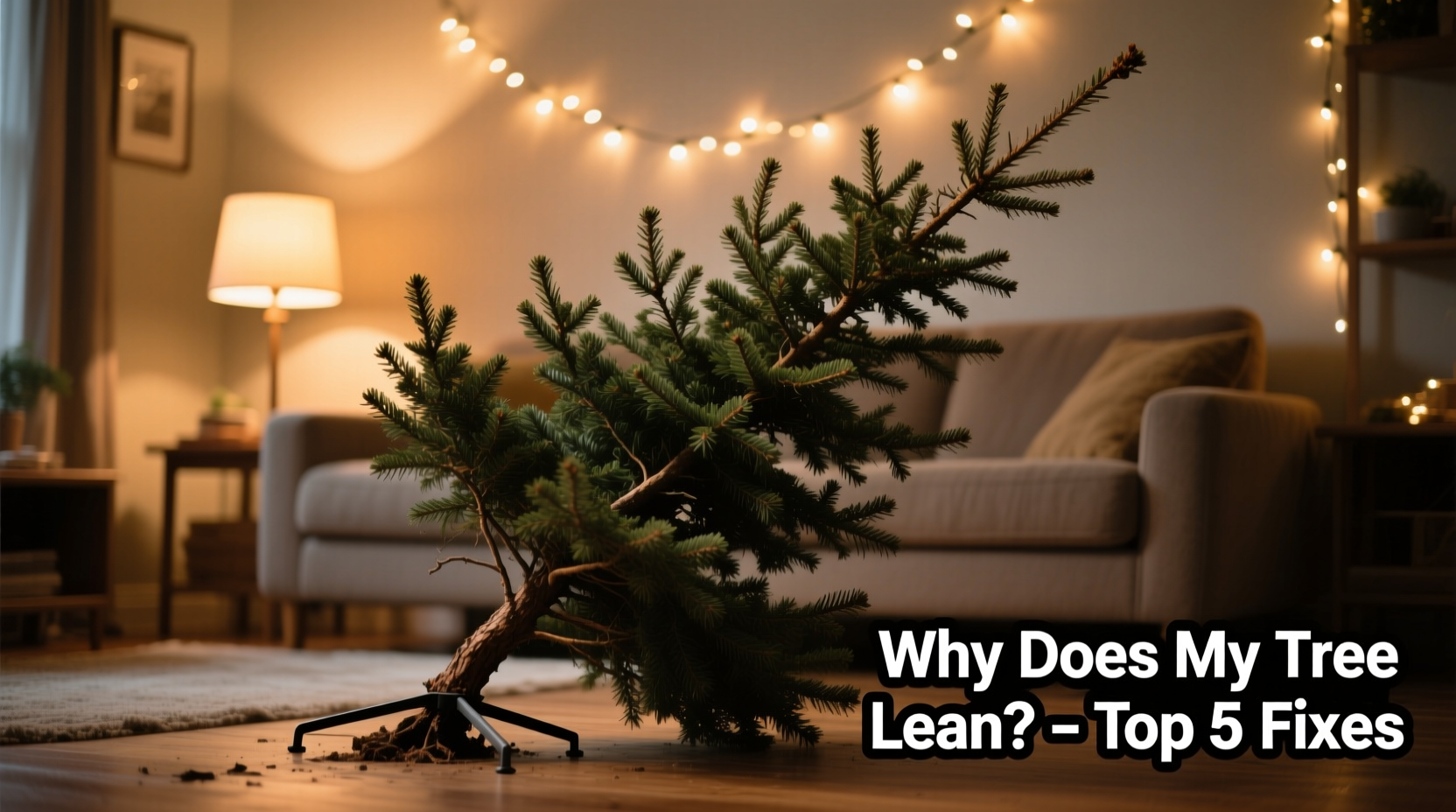
A leaning treetop rarely stems from one single flaw. Instead, it emerges from the cumulative effect of interrelated factors. At its root is the tree’s natural growth pattern: most conifers develop dominant leaders (central stems), but environmental stressors—wind, shade competition, or branch damage—can cause lateral dominance or leader bifurcation. When harvested, that inherent asymmetry becomes magnified as the tree dehydrates. Needles lose turgor pressure, branches soften, and heavier limbs sag downward. If those heavier limbs cluster on one side—especially near the upper third—the resulting torque pulls the flexible leader off-center. Simultaneously, the trunk base may settle unevenly in the stand due to bark compression, sap exudation, or minor warping, shifting the fulcrum point. Add decorative weight—bulky ornaments, heavy garlands, or clustered lights—and the imbalance compounds exponentially. As arborist Dr. Lena Torres explains:
“A cut Fraser fir loses 40–60% of its needle moisture in the first 72 hours indoors. That’s not just drying—it’s structural relaxation. The leader becomes pliable, and gravity finds the path of least resistance.” — Dr. Lena Torres, Senior Arborist, North American Christmas Tree Association
Troubleshooting Checklist: Diagnose Before You Adjust
Before reaching for duct tape or extra stakes, run this five-point diagnostic checklist. Each item targets a distinct failure point:
- Stand fit: Is the trunk seated fully and evenly in the stand’s gripping mechanism? Can you rotate the trunk freely without binding?
- Water level: Is the reservoir consistently filled above the cut surface? Has the cut been re-trimmed within 6–8 hours of purchase?
- Branch density: Are more than 60% of the heaviest ornaments placed on one side of the upper third? Do large, dense boughs extend significantly farther on one flank?
- Trunk integrity: Is there visible cracking, splitting, or soft rot at the base? Does the trunk feel spongy or yield under gentle lateral pressure near the stand?
- Room environment: Is the tree positioned near a heat vent, fireplace, or direct sunlight? Is there consistent air movement (e.g., ceiling fan or draft) hitting one side more intensely?
If three or more items raise concern, address those first—adjustments made without diagnosis often worsen instability.
Proven Stabilization Techniques (Not Just Quick Fixes)
Temporary props—like leaning a ladder against the trunk or wedging books beneath the stand—mask symptoms. True stabilization addresses the source. Here’s what works, ranked by reliability and longevity:
- Re-cut and re-seat with precision: Use a handsaw to make a fresh, straight, ¼-inch-thick cut perpendicular to the trunk. Immediately submerge the base in water for 30 minutes before placing it in the stand. Ensure the stand’s screws or clamps engage the trunk at least 2 inches below the cut surface—not just the outer bark.
- Counterbalance upper-weight distribution: Identify the heaviest cluster of ornaments or garland on the leaning side. Remove half of them and redistribute *evenly* across the opposite upper quadrant—not just the “lighter” side, but the mirror-image position. Prioritize lightweight ornaments (wood, felt, paper) near the tip; reserve glass or metal for lower, sturdier branches.
- Internal trunk reinforcement (for severe lean): Drill two ⅛-inch pilot holes 4 inches apart, 18 inches up the trunk, angled slightly inward. Insert 3-inch galvanized finish nails—do not hammer fully; leave ½ inch exposed. Loop a 2mm nylon cord around both nails, pull taut, and secure with a surgeon’s knot. Attach the cord’s midpoint to a small, discreet hook screwed into the wall stud behind the tree (not drywall). This creates gentle, upward-directed tension—not pulling sideways—that encourages leader realignment over 24–48 hours.
- Base-level leveling: If the stand rocks or tilts, don’t shim only one leg. Place thin, rigid shims (e.g., folded cardboard or plastic washers) under *all four* legs, adjusting incrementally until the stand sits flush and level on the floor. Then tighten the trunk clamp gradually while checking vertical alignment with a smartphone bubble level app held against the trunk.
Do’s and Don’ts: A Comparative Guide to Tree Stability
| Action | Do | Don’t |
|---|---|---|
| Cutting the trunk | Make a fresh, straight cut with a sharp handsaw; submerge immediately in water | Cut at an angle (reduces water uptake); delay placement >4 hours after cutting |
| Water management | Maintain water level 2 inches above the cut; check twice daily | Add aspirin, sugar, or commercial additives (no proven benefit; plain water is optimal) |
| Ornament placement | Follow the 30/40/30 rule: 30% of weight in lower third, 40% in middle, 30% in upper third | Cluster all large ornaments at the top; hang heavy items on thin, flexible upper branches |
| Stand selection | Choose a stand rated for 25% more than your tree’s height/weight; verify grip mechanism engages wood, not just bark | Use a stand with rubber-lined jaws only (slips when wet); reuse a cracked or warped plastic stand |
| Environmental control | Keep ambient temperature between 62–68°F; maintain humidity at 40–50% with a humidifier | Place tree near heating vents, radiators, or south-facing windows |
Real-World Case Study: The 7-Foot Balsam Fir Fix
In December 2023, Sarah M., a schoolteacher in Portland, Maine, purchased a 7-foot Balsam fir. By noon on Day One, the top leaned 8 degrees left. She tried tightening the stand, adding water, and moving ornaments—nothing held. On Day Two, she consulted a local tree farm owner who diagnosed two issues: first, the trunk had been cut at a slight angle during harvest, reducing vascular contact with the stand’s water reservoir; second, her vintage glass icicles—dense and heavy—were concentrated on the left upper third, creating 1.2 lbs of asymmetric torque. Sarah followed the protocol: she re-cut the trunk square, let it hydrate for 45 minutes, then redistributed the icicles using the 30/40/30 rule. She added two lightweight wooden stars to the right upper quadrant for counterbalance. Within 18 hours, the lean reduced to 1.5 degrees. By Day Four, with consistent watering and no further adjustments, the tree stood perfectly vertical. Her key insight? “I thought the problem was the tree. It was really about how I loaded it—and how little water it was actually drinking.”
Step-by-Step: Restoring Vertical Alignment in Under 20 Minutes
When the lean appears mid-season, follow this precise sequence:
- Assess (2 min): Use a phone level app against the trunk. Note the degree and direction of lean. Check water level and trunk base for visible settling or cracking.
- Hydrate (3 min): If water is low or the cut looks dry, remove the tree carefully. Re-cut ¼ inch off the base. Submerge fully in a bucket of cool water for 5 minutes.
- Re-seat (5 min): Place the tree back in the stand. Tighten the clamp *just enough* to hold—do not overtighten. Gently rotate the trunk to find the orientation where the lean is minimized (often reveals natural trunk curvature).
- Redistribute (7 min): Remove 3–5 heaviest ornaments from the leaning side’s upper third. Replace them with lighter alternatives on the opposite side, matching height and branch density. Avoid hanging anything directly on the leader.
- Verify & Monitor (3 min): Check alignment with the level app. Mark the floor position of the stand legs with masking tape. Recheck alignment every 6 hours for the next 24 hours.
FAQ: Addressing Common Misconceptions
Can I straighten a severely leaning tree without removing ornaments?
No—not safely or effectively. Attempting to force the leader upright while ornaments are attached risks snapping brittle branches or dislodging the trunk from the stand. Always remove upper ornaments before intervention. The time saved skipping removal usually costs more time in cleanup and repair.
Does drilling into the trunk harm the tree?
Minimal, controlled drilling (as described in stabilization techniques) does not compromise structural integrity. Christmas trees are harvested—no living tissue remains beyond the outer cambium layer, which dries rapidly indoors. Galvanized nails prevent rust-related staining, and the small entry points seal naturally within hours. This method is endorsed by the National Christmas Tree Association for trees exhibiting >10-degree lean.
Will a taller tree always lean more?
Height alone isn’t the culprit—height *combined with inadequate base support* is. A well-hydrated, properly cut 9-foot tree in a heavy-duty stand with even weight distribution will outperform a poorly supported 6-foot tree every time. The critical ratio is trunk diameter to stand capacity: aim for a stand rated for at least 1 inch of trunk diameter per foot of tree height.
Conclusion: Stability Starts Long Before the First Ornament
A perfectly upright Christmas tree isn’t the result of luck or last-minute heroics. It’s the outcome of informed preparation—choosing a tree with a strong, undamaged leader; cutting it correctly; selecting a stand engineered for its dimensions; managing indoor climate; and distributing weight with intention. The lean isn’t a flaw in your tree; it’s feedback. It tells you where hydration lags, where weight accumulates, where support falters. Every adjustment you make—every re-cut, every redistributed ornament, every checked water level—is an act of attentive stewardship. That care transforms a seasonal decoration into a quiet ritual of observation and response. So this year, resist the urge to prop and patch. Instead, diagnose, balance, and align. Let your tree stand not just tall—but true.




 浙公网安备
33010002000092号
浙公网安备
33010002000092号 浙B2-20120091-4
Comments
No comments yet. Why don't you start the discussion?