
Many people report that childhood summers seemed endless, while years in adulthood blur into one another with alarming speed. It’s not just a poetic observation—this sensation is widespread and deeply rooted in neuroscience, psychology, and cognitive development. The perception that time accelerates with age isn’t an illusion, but rather a product of how our brains process experiences, form memories, and interpret change. Understanding this phenomenon can help us reclaim a sense of presence and intentionality in our lives.
The Psychological Basis of Time Perception
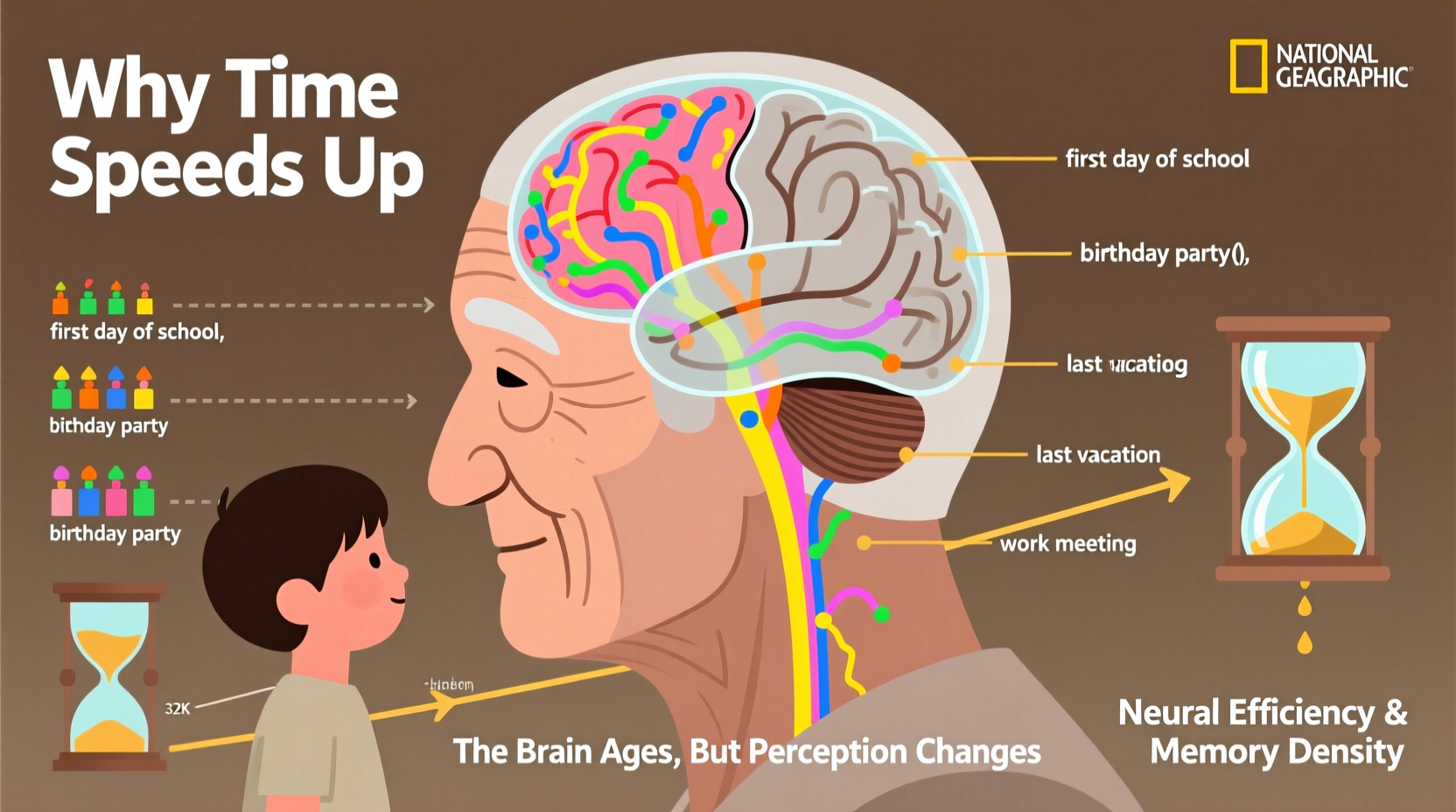
Time, as we experience it, is not measured by clocks alone. Our internal clock—a complex network involving the prefrontal cortex, basal ganglia, and hippocampus—creates a subjective timeline based on attention, emotion, and novelty. When we are young, nearly every experience is new: first day of school, learning to ride a bike, tasting ice cream. These novel events demand more cognitive processing, which leads to richer memory encoding. As a result, early life feels longer in retrospect because it is densely packed with memorable moments.
As we grow older, routines dominate. Commuting, working, household chores—these repetitive activities require less mental engagement. Because they don’t stand out, fewer distinct memories are formed. In hindsight, periods with low novelty compress into what feels like “nothing happened.” This is why a year at 40 may seem to vanish compared to a single summer at age 10.
“Time perception is not about time itself, but about how much we remember. The more new experiences we have, the longer a period feels in retrospect.” — Dr. Warren Meck, Cognitive Neuroscientist, Duke University
Biological Factors That Influence Time Sensitivity
Our biological rhythms also shift over time. Studies suggest that the brain's internal pacemaker—driven by dopamine production—slows with age. Dopamine levels peak in youth and gradually decline, affecting how frequently the brain \"ticks\" when marking intervals. With fewer neural markers per second, older adults may literally perceive fewer moments within the same objective timeframe.
This effect has been tested in laboratory settings. Participants across age groups are asked to estimate when 60 seconds have passed without looking at a clock. On average, older adults let more actual time elapse before responding, indicating their internal clock runs slower. However, this doesn’t mean time feels slower in the moment—it means fewer temporal markers are stored, leading to a retrospective feeling that time flew by.
The Role of Memory and Proportionality in Time Perception
One of the most compelling theories explaining why time feels faster with age is the proportional theory, first proposed by French philosopher Paul Janet. According to this idea, each passing year represents a smaller fraction of your total life. When you’re five years old, one year is 20% of your entire existence. At 50, it’s only 2%. This shrinking proportion makes each unit of time subjectively shorter.
Memory density reinforces this effect. Childhood and adolescence are filled with “firsts”—first kiss, first job, first travel abroad—all of which create strong episodic memories. Adulthood, especially midlife, often lacks such milestones. Without these anchor points, years blend together. A vacation to a new country might be remembered clearly, but 50 identical workdays will collapse into a vague recollection of “that busy season.”
| Age | One Year as % of Life | Typical Memory Density |
|---|---|---|
| 5 | 20% | Very High (many \"firsts\") |
| 15 | 6.7% | High (school, social changes) |
| 30 | 3.3% | Moderate (routine-heavy) |
| 60 | 1.7% | Low (fewer novel events) |
How Modern Life Accelerates the Feeling of Speed
While aging plays a central role, modern lifestyle habits amplify the sensation that time is slipping away. Constant digital stimulation, multitasking, and information overload fragment attention. We spend hours scrolling through content that leaves no lasting memory trace. Psychologists call this “temporal poverty”—being busy yet feeling like nothing meaningful occurred.
Consider how many evenings end with no clear memory of what was watched or read. These unmarked hours contribute to the eerie sense that weeks vanish without notice. Additionally, the lack of seasonal or ritual-based markers in urban life removes natural pacing cues. Farmers once marked time by planting and harvest; today, many people experience little variation between January and July.
A Real Example: Maria’s Midlife Reflection
Maria, a 48-year-old project manager, recently realized she couldn’t recall anything specific from the previous March. She remembered deadlines and meetings, but no personal moments stood out. In contrast, she can vividly describe her eighth birthday party—the cake, the laughter, the red bicycle. After reading about time perception, she began scheduling monthly “novelty days”: visiting a new museum, trying a cooking class, or hiking an unfamiliar trail. Within months, she reported feeling more grounded and noticed that her months now had clearer contours. “I finally feel like I’m living, not just surviving,” she said.
Strategies to Slow Down Your Perception of Time
Although we can’t stop aging, we can influence how we experience time. By increasing novelty, deepening attention, and creating memory anchors, it’s possible to make life feel fuller and longer in retrospect.
Step-by-Step Guide to Enhance Time Awareness
- Introduce Novelty Weekly: Try a new route to work, eat at an unfamiliar restaurant, or learn a few phrases in a foreign language.
- Practice Mindful Attention: Dedicate 10 minutes daily to focused awareness—notice sounds, textures, and breath without distraction.
- Create Rituals and Markers: Celebrate small transitions—start a journal for each season or host a monthly theme dinner.
- Limits on Digital Consumption: Designate screen-free hours to reduce cognitive fragmentation.
- Reflect Weekly: Spend 15 minutes every Sunday recalling key moments. This strengthens memory encoding and creates narrative continuity.
Checklist: Build a Time-Rich Life
- ✅ Schedule at least one new experience per month
- ✅ Keep a brief daily journal (3 sentences minimum)
- ✅ Reduce passive screen time by 30%
- ✅ Practice mindfulness or meditation 3x per week
- ✅ Review photos or notes from the past month quarterly
- ✅ Attend live events (concerts, lectures, markets) regularly
Frequently Asked Questions
Does stress make time feel faster?
Yes. Chronic stress narrows attention to immediate threats or tasks, reducing awareness of surroundings and diminishing memory formation. This leads to “lost” periods where time feels like it disappeared. Managing stress through rest, reflection, and breaks can restore a sense of temporal depth.
Can children’s perception of time be different from adults’?
Absolutely. Children often feel time moves slowly in the moment—especially when waiting—but remember those periods as long stretches later. Their high novelty exposure and rapid learning mean their brains encode more data per unit of time, making early years feel expansive in memory.
Is there a way to reverse the feeling that time is speeding up?
You can’t reverse aging, but you can counteract its perceptual effects. Introducing structured novelty, deepening engagement with experiences, and reflecting on your days all strengthen memory traces. Over time, this builds a richer personal timeline, making life feel more substantial and less fleeting.
Conclusion: Reclaiming Your Relationship with Time
The belief that time accelerates with age is more than a cliché—it’s a measurable psychological phenomenon shaped by biology, memory, and lifestyle. But it’s not inevitable. By understanding the mechanisms behind time perception, we gain power over it. Each new experience, each mindful moment, each deliberate choice adds texture to the fabric of our lives.
Rather than passively watching years slip by, you can actively shape how they are remembered. Start small: take a different path, talk to someone new, sit quietly and observe. These acts don’t just fill time—they expand it. In a world obsessed with productivity and speed, the true luxury is presence. Make time feel longer not by adding more days, but by filling them with meaning.




 浙公网安备
33010002000092号
浙公网安备
33010002000092号 浙B2-20120091-4
Comments
No comments yet. Why don't you start the discussion?