
Most people, at some point in adulthood, have paused and thought: “Where did the time go?” Birthdays arrive quicker, holidays blur together, and years seem to vanish. It’s not your imagination—time doesn’t actually accelerate, but your perception of it certainly changes. As we grow older, time appears to pass at an ever-increasing speed. This phenomenon is deeply rooted in psychology, neuroscience, and cognitive development. Understanding why this happens can help us reclaim a sense of presence, slow down our subjective experience of time, and live more intentionally.
The Psychological Basis of Time Perception
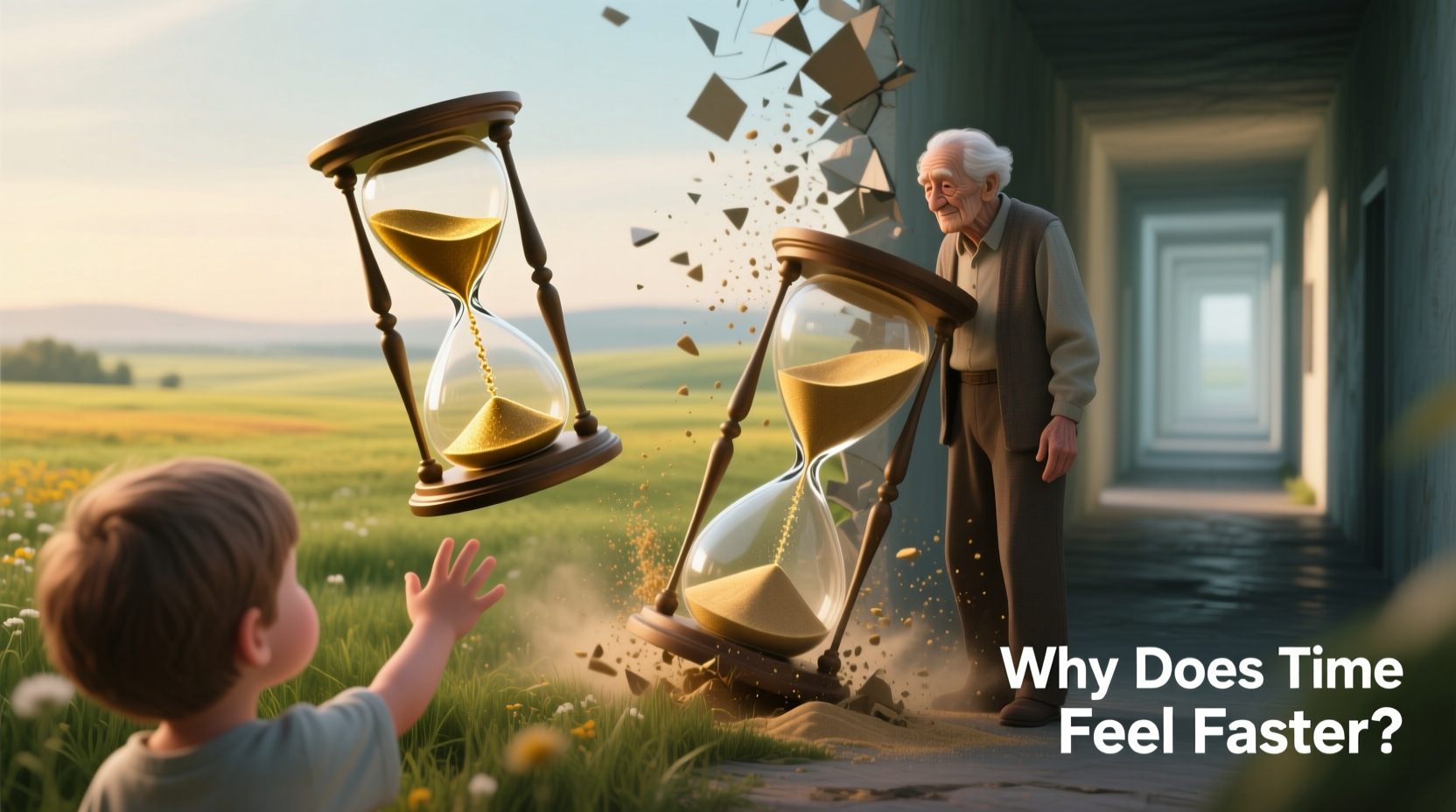
Time perception is not governed by a single clock in the brain but rather by a complex network of processes involving memory, attention, and emotional context. Unlike physical time—which ticks forward uniformly—our internal sense of time is elastic. It stretches and compresses based on what we’re doing, how we feel, and how much new information we’re processing.
In childhood, nearly every experience is novel. First days of school, learning to ride a bike, family vacations—these events are rich with sensory detail and emotional weight. Because they stand out in memory, they create dense mental markers. When we look back, these moments make time feel expansive. In contrast, adult life often follows predictable routines: commute, work, dinner, sleep. Fewer new memories are formed, so when we reflect, the weeks blend into one another.
“Time seems to pass more quickly because we encode less new information as adults. Familiarity breeds temporal compression.” — Dr. Warren Meck, Cognitive Neuroscientist, Duke University
Proportional Theory: The Mathematical Lens
One of the oldest explanations for why time feels faster with age comes from 19th-century philosopher Paul Janet, known as the \"proportionality theory.\" According to this idea, each passing year represents a smaller fraction of your total life.
For a 5-year-old, one year is 20% of their entire existence—a massive chunk. For a 50-year-old, one year is just 2% of their life. Because each unit of time becomes proportionally smaller relative to your lifespan, it feels subjectively shorter.
This isn't just philosophical—it aligns with how our brains process change. We judge duration by how much has changed around us or within us. Rapid growth in youth makes time feel longer; stability in adulthood makes it feel fleeting.
Illustrating Proportional Time Perception
| Age | One Year as % of Life | Subjective Weight of One Year |
|---|---|---|
| 5 | 20% | Extremely significant |
| 10 | 10% | Very noticeable |
| 25 | 4% | Moderate impact |
| 50 | 2% | Feels short |
| 80 | 1.25% | Almost imperceptible |
The diminishing percentage mirrors our lived experience: early years feel long and formative, while later decades rush by.
Memory Density and the Role of Novelty
Our brain uses memory as a proxy for time. Periods packed with memorable events feel longer in retrospect because we have more data points to recall. This is known as the \"holiday paradox\": a two-week vacation may feel short while it's happening, but months later, it looms large in memory because it was filled with new experiences—new places, tastes, sounds.
Adults, especially those in stable jobs and relationships, tend to fall into routines. Routines are efficient, but they’re also cognitively invisible. You don’t remember your 37th Tuesday of commuting the same way you remember your first day at a new job. Without distinct memories, time collapses.
How Memory Formation Changes with Age
- Childhood: High neuroplasticity, rapid learning, constant novelty → rich memory encoding.
- Adolescence: Identity formation, social exploration, emotional peaks → emotionally charged memories.
- Adulthood: Routine dominance, fewer first-time experiences → sparse memory landmarks.
- Late Adulthood: Reflection increases, but if life lacks variation, retrospective time feels compressed.
Attention and Cognitive Load
Another factor shaping time perception is where we direct our attention. When you're deeply focused—say, working on a project or scrolling through social media—your brain isn’t actively tracking time. Minutes slip away unnoticed. Conversely, when you're bored or waiting, attention turns inward, and time feels drawn out.
Modern adult life is saturated with distractions. Work demands, digital notifications, multitasking—all pull focus and fragment attention. This creates a double bind: time flies during the day because you’re absorbed, yet you feel like you’ve accomplished little because your attention was scattered.
Neurologically, dopamine plays a role too. Higher dopamine levels speed up the brain’s internal clock, making external time seem slower in the moment—but ironically, overstimulation leads to fewer consolidated memories, so in hindsight, time feels like it vanished.
Mini Case Study: Sarah’s Midlife Realization
Sarah, a 42-year-old marketing director, began noticing that summers no longer felt like extended breaks but blinked by in a haze of deadlines and school drop-offs. She realized she couldn’t recall specific moments from the previous June. Alarmed, she started a simple experiment: each weekend, she committed to one novel activity—a pottery class, a hike in a new park, visiting a museum. Within months, her journal overflowed with vivid recollections. Looking back, that summer didn’t feel short at all. It felt full. Her subjective experience of time had expanded simply by increasing experiential variety.
Strategies to Slow Down Your Perception of Time
You can’t stop aging, but you can influence how time feels. By understanding the mechanisms behind accelerated time perception, you can take deliberate steps to enrich your experience and create a sense of spaciousness in daily life.
Step-by-Step Guide to Reclaiming Time
- Break Routines Weekly: Change one habit—take a different route, eat lunch outside, try a new podcast. Novelty triggers memory formation.
- Practice Mindful Awareness: Spend 5–10 minutes daily observing your surroundings without distraction. Notice colors, sounds, textures. This anchors you in the present.
- Create Memory Landmarks: Plan small adventures—a day trip, a themed dinner, a photography walk. These become mental signposts.
- Limit Passive Consumption: Reduce aimless screen time. Replace it with active engagement like reading, crafting, or learning.
- Reflect Regularly: Keep a weekly journal. Writing about experiences strengthens memory and gives time a narrative structure.
Checklist: Daily Habits to Expand Time Perception
- ✅ Start the day with intention (e.g., “Today I’ll notice three new things”)
- ✅ Engage in one conversation without checking your phone
- ✅ Do one thing differently than yesterday
- ✅ End the day by recalling one meaningful moment
- ✅ Schedule one novelty-based activity per week
Frequently Asked Questions
Does everyone feel time speeding up as they age?
While not universal, the vast majority of adults report this sensation, especially after age 30. Cultural factors, lifestyle, and personality influence the degree, but the trend is widespread across demographics.
Can mindfulness really make time feel slower?
Yes. Studies show that mindfulness practices increase present-moment awareness and reduce automatic pilot behavior. This leads to richer memory encoding and a stronger sense of time depth. Even brief daily meditation can improve time perception over weeks.
Is there a biological reason, like brain aging, that causes this?
Partly. As we age, changes in dopamine production, neural processing speed, and memory consolidation affect time judgment. However, psychological factors—like reduced novelty and increased routine—are more influential than pure biology.
Conclusion: Living Deeper, Not Faster
The feeling that time accelerates with age isn’t a flaw—it’s a signal. It tells us that life has become too predictable, too automatic. Our brains evolved to notice change, not repetition. When everything feels familiar, time collapses.
But you have agency. By intentionally introducing novelty, deepening attention, and creating meaningful memories, you can stretch your subjective experience of time. You won’t add years to your life, but you can add life to your years—and make each one feel fuller, richer, and more substantial.




 浙公网安备
33010002000092号
浙公网安备
33010002000092号 浙B2-20120091-4
Comments
No comments yet. Why don't you start the discussion?