
Anyone who has sat through a long meeting, waited at a quiet bus stop, or endured a monotonous task knows the sensation: time crawls. Seconds stretch into minutes, and minutes feel like hours. This isn’t just a subjective complaint—it’s a measurable phenomenon rooted in the brain’s intricate machinery. The neuroscience behind why time feels slower when bored reveals that our perception of time is not governed by a single internal clock but by dynamic interactions between attention, memory, and neural processing speed.
Unlike physical time, which ticks forward uniformly, psychological time is elastic. It expands during moments of boredom and contracts during excitement or engagement. Understanding this requires delving into how the brain encodes duration, processes sensory input, and allocates cognitive resources. When stimulation is low, the brain doesn’t switch off—it becomes hyper-aware of its own lack of activity, amplifying the passage of each moment.
The Brain’s Internal Clock Isn’t a Single Mechanism
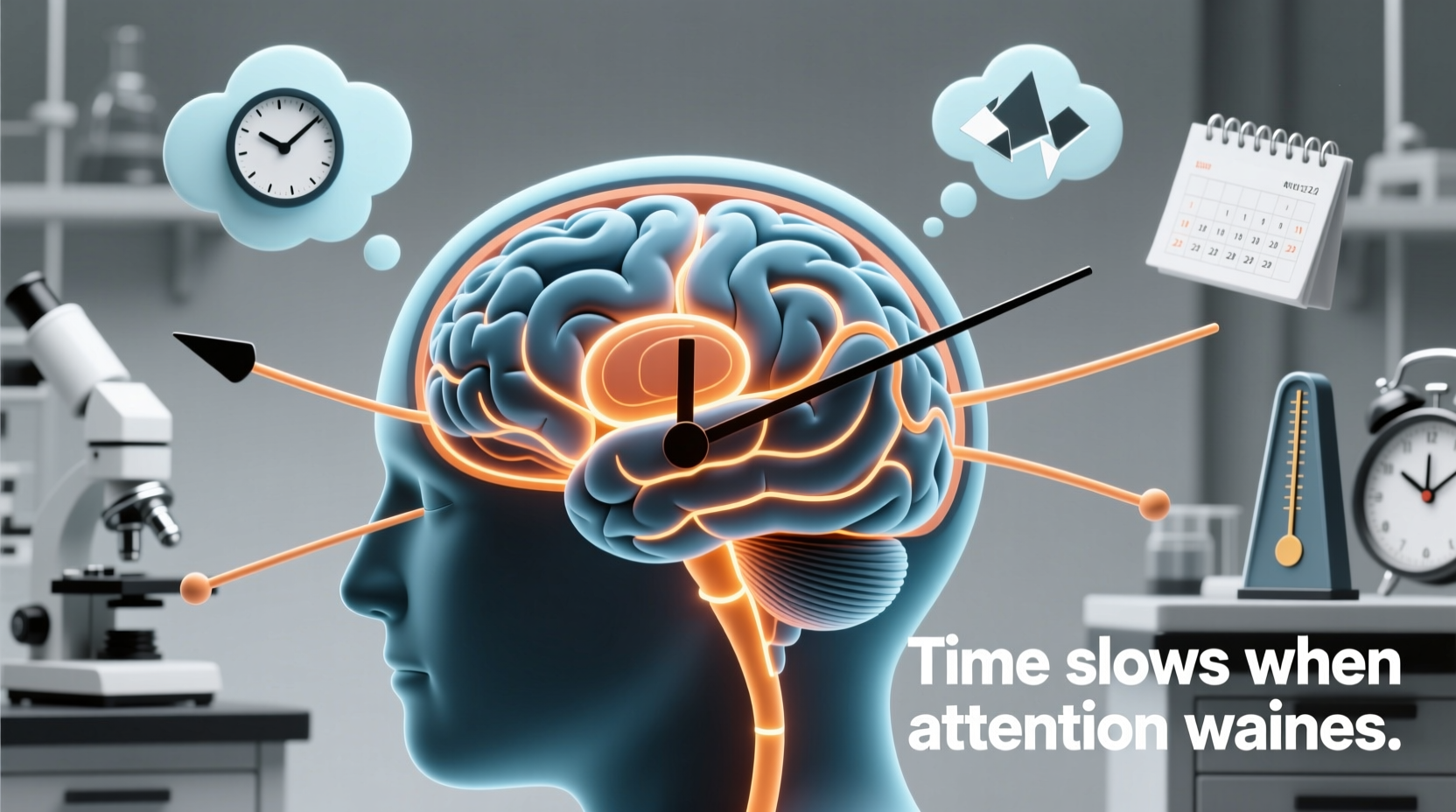
For decades, scientists searched for a central “timekeeper” in the brain—something akin to a biological stopwatch. Instead, research now shows that time perception emerges from distributed networks across the cortex and subcortical regions. Key areas involved include the prefrontal cortex (involved in attention and decision-making), the basal ganglia (linked to motor control and reward), and the insula (which integrates bodily sensations).
One leading model, the striatal beat frequency model, proposes that neurons in the striatum fire at different frequencies, creating overlapping patterns that the brain interprets as intervals. These patterns are influenced by dopamine levels, which fluctuate based on novelty, expectation, and arousal. When dopamine is high—such as during exciting or novel experiences—the brain records more “ticks,” making time seem to pass quickly in retrospect. Conversely, low dopamine states, common in boredom, result in fewer neural markers of time, stretching the subjective experience.
“Time perception is not about measuring seconds, but about tracking change. No change means time drags.” — Dr. David Eagleman, neuroscientist and author of *Brain Time*
Attention and the Amplification of Boredom
Attention plays a critical role in distorting time. When you're engaged in a complex or absorbing task—like reading a gripping novel or playing a video game—your attention is fully occupied. You’re not monitoring the clock; your brain is too busy processing incoming stimuli. As a result, time seems to vanish.
In contrast, boredom occurs when there’s a mismatch between required stimulation and actual input. The brain, designed to seek novelty and predict outcomes, finds itself underutilized. With little external data to process, attention turns inward. You begin to notice your breathing, the ticking of a clock, or the discomfort of sitting still. Each of these micro-sensations becomes a data point, increasing the density of conscious experience per unit of time.
This effect is supported by fMRI studies showing heightened activity in the default mode network (DMN) during low-stimulation tasks. The DMN, active during mind-wandering and self-referential thought, becomes dominant when external input is minimal. As introspection increases, so does the subjective length of time.
Memory Encoding and Retrospective Judgment
Our perception of time isn’t only shaped in the moment—it’s reconstructed later through memory. Two distinct modes govern this: prospective timing (estimating duration as it happens) and retrospective timing (judging how long something felt after it ended).
During boredom, prospective time slows because attention is focused on the passage of time itself. But retrospectively, boring periods often feel short. Why? Because they lack memorable events. The brain relies on the number of new memories formed to estimate duration. A vacation packed with novel experiences feels long in hindsight, even if it was only a week. A week of routine work may fly by prospectively but collapse into a blur afterward.
This paradox explains why a dull two-hour lecture might feel endless while happening but shrink to nothing in memory. Few unique details were encoded, so the brain infers it couldn’t have lasted long. In contrast, an emergency or intense event—rich in sensory detail and emotional weight—leaves a dense memory trail, making it feel longer in retrospect.
| Situation | Prospective Duration (during) | Retrospective Duration (after) | Reason |
|---|---|---|---|
| Boring meeting | Feels very long | Feels short | Few new memories formed |
| Vacation with new experiences | Flies by | Feels long | High memory density |
| Car accident | Slows down | Feels extended | Hyper-alertness, vivid encoding |
| Meditative state | Variable | May feel timeless | Reduced self-monitoring, low memory tagging |
Neurochemical Influences: Dopamine and Cortisol
Dopamine is one of the most significant neurotransmitters regulating time perception. It modulates the firing rate of neurons involved in interval timing. High dopamine levels—triggered by rewards, anticipation, or novelty—speed up the internal pacemaker, leading to an overestimation of time elapsed. This is why time seems to fly when you're having fun.
Boredom, on the other hand, is associated with reduced dopamine release. Without the signal that something important is happening, the brain’s timing circuits slow down. Additionally, prolonged boredom can elevate cortisol, the stress hormone. While mild cortisol increases keep the brain alert, chronic elevation leads to mental fatigue and hypervigilance to time, further distorting perception.
A study published in *Neuropsychologia* (2016) found that participants given dopamine agonists overestimated time intervals, while those with dopamine antagonists underestimated them. This pharmacological evidence reinforces the idea that our sense of time is chemically malleable.
Real-World Example: The Prisoner’s Dilemma of Time
In solitary confinement, inmates often report that time stretches unbearably. One former prisoner described his experience: “The first week felt like a year. I counted ceiling tiles, listened to dripping water, and broke days into rituals just to mark progress.” His account aligns perfectly with neuroscience: minimal sensory input, no novelty, and constant focus on time created a distorted, elongated experience.
Psychologists working with incarcerated individuals use structured routines and cognitive exercises to mitigate this effect. By introducing predictable yet engaging activities—reading, journaling, mental puzzles—they help restore a sense of temporal flow. This case illustrates how environmental design can directly influence neural timekeeping.
Strategies to Regain Control Over Time Perception
While we can’t eliminate boredom entirely, we can reshape how we experience it. The goal isn’t to avoid downtime but to modulate attention and engagement to prevent time from dragging. Below is a practical checklist based on cognitive neuroscience principles.
Checklist: Reducing the Drag of Boredom
- Introduce micro-challenges: Count backward from 100 by 7s or recall all countries in Europe. Mental effort engages the prefrontal cortex and distracts from time monitoring.
- Change sensory input: Shift lighting, play ambient noise, or adjust temperature. Novel stimuli reactivate attention networks.
- Practice mindfulness: Instead of resisting boredom, observe it without judgment. This reduces the anxiety that amplifies time distortion.
- Break time into segments: Use mental markers (“I’ll sit here until the next song ends”) to create mini-goals and a sense of progression.
- Engage in light physical movement: Stretch, tap fingers rhythmically, or walk briefly. Motor activity stimulates the basal ganglia and resets timing circuits.
Step-by-Step Guide: Resetting Your Temporal Focus
- Pause and acknowledge boredom. Labeling the emotion reduces its power and activates higher-order thinking.
- Shift attention outward. Focus on ambient sounds, textures, or visual details in your environment.
- Set a 5-minute challenge. Memorize a short poem, sketch a nearby object, or plan a future meal.
- Move your body. Even small motions increase blood flow and dopamine release.
- Reflect afterward. Notice whether time felt different. This builds metacognitive awareness over time.
Frequently Asked Questions
Can meditation make time feel slower?
Yes, especially in beginners. Meditation often heightens awareness of the present moment, including breath and bodily sensations, which increases the density of experience. Over time, experienced meditators may report a sense of timelessness due to reduced self-referential thought and DMN activity.
Why do children feel like time moves slower?
Children encounter far more novel experiences than adults. Each new event—first day of school, learning to ride a bike—creates rich memories. Since retrospective time depends on memory density, childhood years feel longer in hindsight. Additionally, their developing brains process information more slowly, contributing to a stretched present.
Does aging make time feel faster?
Subjectively, yes. As we age, life becomes more routine, reducing novel stimuli. Fewer new memories are formed, so years seem to blur together. Also, metabolic rate decreases with age, potentially slowing the brain’s internal pacemaker. The combination makes time appear to accelerate.
Conclusion: Reclaiming Your Experience of Time
The sensation that time slows when bored is not a flaw—it’s a feature of a brain finely tuned to detect change and seek meaning. When stimulation drops, the brain doesn’t shut down; it turns its lens inward, magnifying every passing second. This sensitivity once helped our ancestors survive by detecting subtle environmental shifts. Today, it manifests in waiting rooms and traffic jams.
By understanding the neuroscience behind time perception, we gain tools to reshape our experience. Whether through attention redirection, memory enrichment, or simple behavioral tweaks, we can soften the drag of boredom and reclaim a more balanced sense of time. The key lies not in escaping downtime, but in engaging with it differently.




 浙公网安备
33010002000092号
浙公网安备
33010002000092号 浙B2-20120091-4
Comments
No comments yet. Why don't you start the discussion?