
Earthquakes are among the most powerful and unpredictable natural phenomena on Earth. Despite decades of research and advances in seismology, scientists still cannot reliably predict when or where a major earthquake will strike. While early warning systems can provide seconds to minutes of notice after a quake begins, true prediction—forecasting the exact time, location, and magnitude before it happens—remains out of reach. The reasons are deeply rooted in the complexity of Earth’s crust, the limitations of current technology, and the chaotic nature of tectonic processes.
The Nature of Tectonic Forces
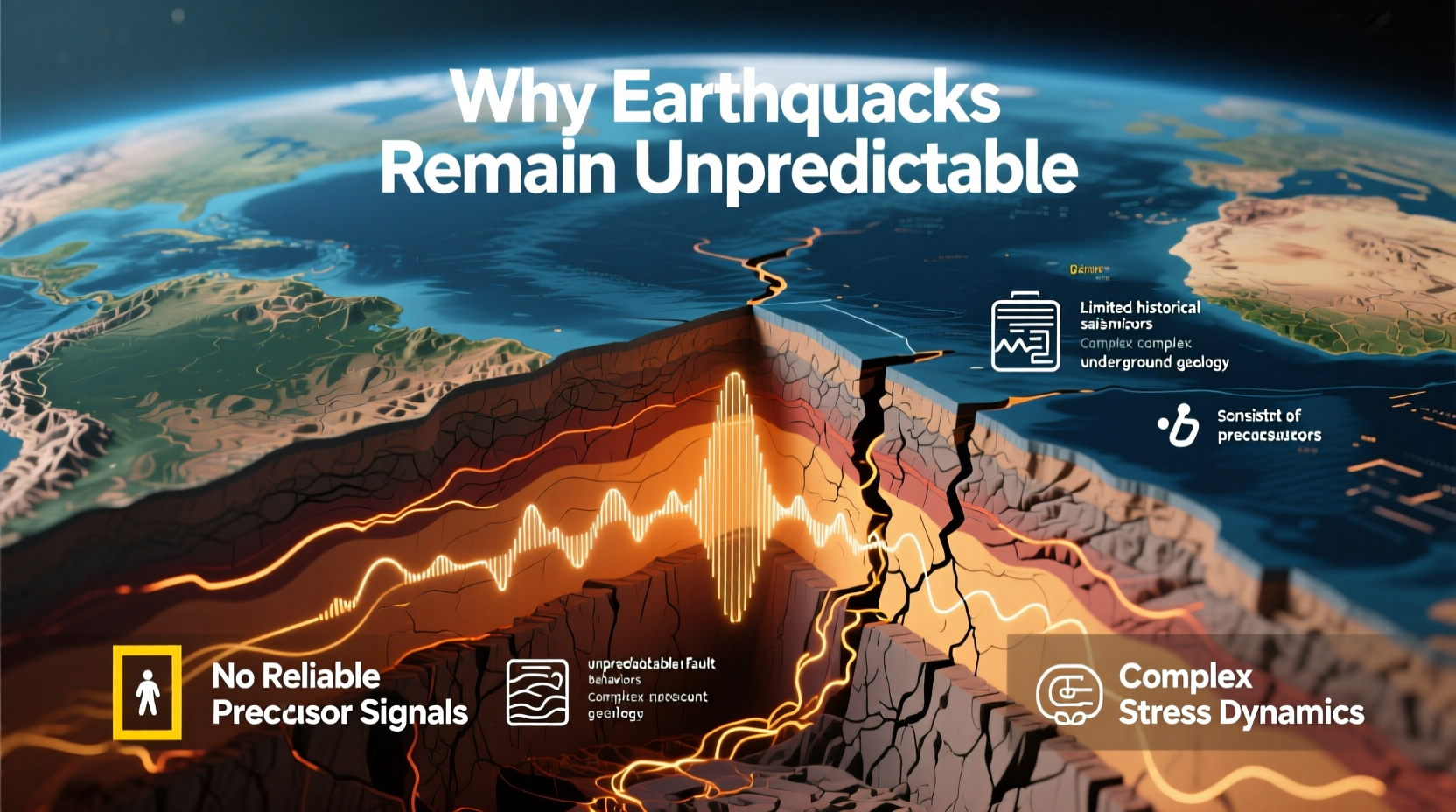
Earthquakes occur when accumulated stress along geological fault lines is suddenly released. This stress builds over years, decades, or even centuries due to the slow but relentless movement of tectonic plates. When the stress exceeds the strength of the rock, it fractures, sending seismic waves through the ground. The problem lies in the fact that this process is neither uniform nor linear.
Faults vary widely in structure, depth, and behavior. Some faults creep slowly and release energy gradually, while others remain locked for long periods before rupturing catastrophically. Even well-studied faults like California’s San Andreas exhibit irregular patterns, making it difficult to establish reliable precursors to rupture.
“Earthquakes don’t follow a schedule. They’re governed by complex physical interactions deep underground that we’re only beginning to understand.” — Dr. Lucy Jones, Seismologist and Science Advisor for Risk Reduction
Why Prediction Is Not Like Weather Forecasting
Unlike meteorology, where atmospheric conditions can be monitored in real time with satellites, radar, and global sensor networks, earthquake forecasting lacks comparable observational depth. The Earth’s crust is opaque and inaccessible; sensors sit on the surface or in shallow boreholes, capturing effects rather than causes.
Weather systems operate in a fluid medium governed by relatively well-understood physics and observable dynamics. In contrast, earthquakes originate in brittle rock under extreme pressure and temperature, where small-scale variations in mineral composition, pore pressure, and friction can drastically alter outcomes. These micro-level differences make large-scale predictions unreliable.
Failed Attempts and False Alarms
Over the years, researchers have explored numerous potential earthquake precursors: changes in groundwater levels, unusual animal behavior, electromagnetic signals, and radon gas emissions. While some anomalies have coincided with quakes, none have proven consistent or repeatable across different regions.
One notable case occurred in 1975 in Haicheng, China, where officials evacuated the city based on foreshocks and other signs. A major earthquake followed, leading to widespread belief that prediction was possible. However, the 1976 Tangshan earthquake—also in China, killing over 240,000 people—occurred without any clear warning, demonstrating how unreliable such signals can be.
In the U.S., the Parkfield experiment in California monitored a segment of the San Andreas Fault expected to rupture regularly. Although six moderate quakes occurred between 1857 and 1966 at roughly 22-year intervals, the next anticipated event did not happen until 2004—11 years late. This undermined confidence in periodicity models and highlighted the unpredictability of fault behavior.
Technological and Data Limitations
Modern seismometers are highly sensitive and can detect even the smallest tremors. Networks like the Advanced National Seismic System (ANSS) in the U.S. provide rapid detection and location of earthquakes. However, detecting a quake after it starts is not the same as predicting it.
To predict an earthquake, scientists would need to measure the actual stress buildup along a fault—a task currently beyond our capabilities. Stress cannot be directly observed; it must be inferred from indirect measurements such as GPS data showing ground deformation, strain meters, and historical seismic records. But these data reflect long-term trends, not imminent failure.
| Monitoring Method | What It Measures | Limitations for Prediction |
|---|---|---|
| Seismometers | Ground motion during and after quakes | Reactive, not predictive |
| GPS Stations | Surface deformation over time | Shows slow strain, not immediate risk |
| Strain Meters | Local rock deformation underground | Highly localized, expensive to deploy |
| Satellite InSAR | Ground displacement via radar | Infrequent passes, weather interference |
Step-by-Step: How Scientists Assess Earthquake Risk
While precise prediction remains impossible, experts use probabilistic forecasting to estimate long-term risks. Here’s how it works:
- Map Active Faults: Geologists identify known faults using aerial surveys, trenching, and LiDAR imaging.
- Analyze Historical Activity: Paleoseismology examines sediment layers to determine past earthquake timing and magnitude.
- Monitor Current Deformation: GPS and satellite data track how fast plates are moving and where strain is accumulating.
- Model Stress Accumulation: Computer simulations project how stress might evolve over decades.
- Issue Probabilistic Forecasts: Agencies like the USGS publish 30-year probability maps (e.g., “31% chance of a M≥6.7 quake in the Bay Area by 2050”).
This approach informs building codes, emergency planning, and insurance policies—but it does not offer short-term warnings.
Mini Case Study: The 2011 Tohoku Earthquake
The magnitude 9.0 Tohoku earthquake in Japan shocked scientists because it exceeded expectations. Japan has one of the world’s most advanced seismic monitoring systems and strict building codes. Yet, the event revealed critical gaps in understanding.
Prior models assumed the offshore fault segment responsible for the quake could produce only magnitude 7–8 events. The actual rupture was far larger and shallower than predicted, triggering a devastating tsunami. Post-event analysis showed that stress had been underestimated, and the potential for multi-segment rupture was poorly understood. This underscored that even in technologically advanced nations, earthquake behavior can defy established models.
Checklist: What You Can Do to Stay Safe
- Know your regional seismic risk using official hazard maps.
- Secure heavy furniture and appliances to wall studs.
- Create an emergency kit with water, food, flashlight, radio, and first aid supplies.
- Practice “Drop, Cover, and Hold On” drills at home and work.
- Ensure your home meets local earthquake-resistant building standards.
- Consider retrofitting older structures with foundation bolting and shear walls.
- Sign up for local alert systems like ShakeAlert (available in parts of the U.S.).
FAQ
Can animals predict earthquakes?
There are anecdotal reports of pets acting strangely before quakes, but no scientific evidence confirms that animals can reliably sense impending seismic events. Observed behaviors may result from detecting faint foreshocks or environmental changes, but these are inconsistent and not predictive in practice.
Will we ever be able to predict earthquakes accurately?
Most experts believe true short-term prediction is unlikely in the foreseeable future. Instead, progress is being made in early warning systems that detect the first seismic waves and send alerts seconds before shaking arrives. Long-term risk assessment and resilience planning remain the most effective strategies.
What’s the difference between earthquake prediction and forecasting?
Prediction implies specifying the exact time, location, and magnitude of a future quake—something currently impossible. Forecasting, on the other hand, estimates the probability of an earthquake occurring within a certain timeframe and region, based on historical and geological data. This is what scientists currently provide.
Conclusion
Earthquake prediction remains elusive because the forces driving seismic events operate deep beneath the surface, hidden from direct observation and governed by chaotic, nonlinear systems. Despite impressive technological advances, we lack the tools to measure the critical variables—like subsurface stress and friction—at the scale and precision needed for reliable forecasts.
Rather than waiting for a breakthrough in prediction, societies must focus on what works: strengthening infrastructure, improving public education, and investing in early warning systems. Preparedness, not prophecy, is the key to reducing earthquake risk.




 浙公网安备
33010002000092号
浙公网安备
33010002000092号 浙B2-20120091-4
Comments
No comments yet. Why don't you start the discussion?