
Writing is often seen as a solitary act of creation—putting words on the page, shaping ideas, and building arguments. But what separates competent writing from truly effective communication isn’t just the first draft; it’s what happens after. Editing transforms raw expression into clarity, coherence, and impact. It’s not merely about fixing grammar or spelling; it’s a critical phase where structure is refined, tone is sharpened, and purpose is clarified. Many writers treat editing as an afterthought, but in reality, it’s where most of the real writing happens.
The Role of Editing in Achieving Clarity
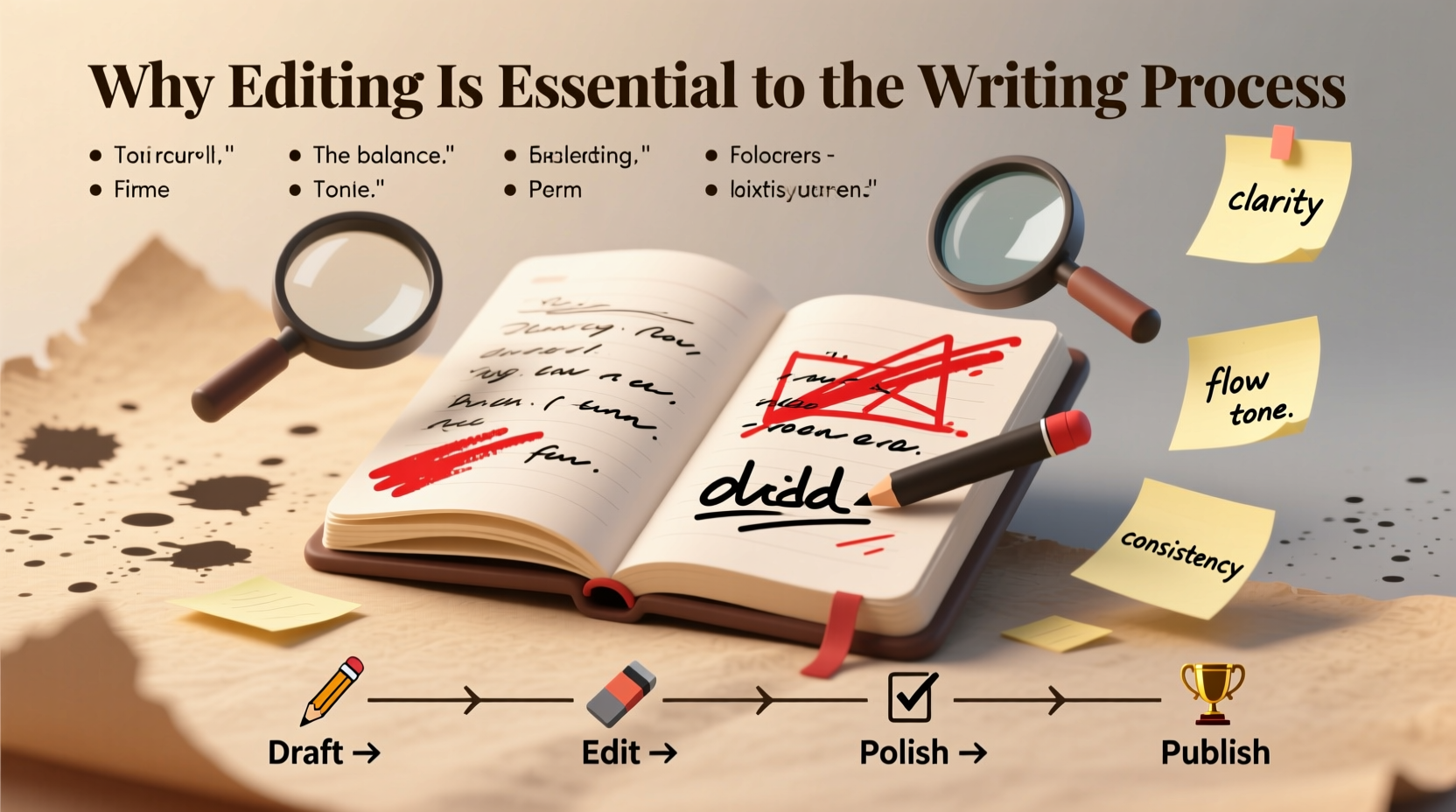
First drafts are rarely clear. They’re exploratory, emotional, and often disorganized. Ideas may be buried under redundant phrases, jargon, or vague language. Editing allows writers to step back and assess whether their message is actually being communicated. Is the argument logical? Are the transitions smooth? Can a reader follow the thread without confusion?
Clarity doesn’t mean simplifying complex ideas—it means presenting them in a way that respects the reader’s time and intelligence. During editing, sentences can be restructured for better flow, ambiguous terms replaced with precise ones, and tangents removed to maintain focus. This stage ensures that the final piece conveys exactly what the writer intends, nothing more, nothing less.
Improving Structure and Flow Through Revision
A strong piece of writing doesn’t just contain good ideas—it presents them in a logical sequence. Editing enables structural refinement: moving paragraphs, rewriting introductions, strengthening conclusions, and ensuring each section builds on the last.
Many writers discover during editing that their strongest point belongs at the beginning, not the end. Or that two related sections should be merged for greater impact. These decisions can’t always be made during drafting because they require perspective—the kind only gained after stepping away and reviewing the full scope of the work.
| Draft Stage | Editing Focus | Outcome |
|---|---|---|
| Initial idea generation | Clarify main argument | Sharper thesis statement |
| Disjointed sections | Reorganize for logic | Smoother narrative progression |
| Overly long paragraphs | Break up and simplify | Better readability |
| Inconsistent tone | Adjust voice and style | More professional or engaging presence |
Eliminating Errors and Enhancing Credibility
Even the most insightful content loses authority when riddled with errors. Typos, grammatical mistakes, and punctuation issues distract readers and undermine trust. Editing catches these flaws before publication, preserving the writer’s credibility.
But beyond correctness, editing polishes style. It removes passive constructions, eliminates wordiness (“in order to” becomes “to”), and ensures consistent verb tense and point of view. These subtle improvements accumulate into a cleaner, more confident voice.
“Drafting is magic. Editing is craftsmanship. One gets the words down; the other makes them matter.” — Sarah Chen, Literary Editor at The Atlantic
Step-by-Step Guide to Effective Self-Editing
Professional editors bring objectivity, but most writers must self-edit. A structured approach increases effectiveness. Follow this timeline to refine your work systematically:
- Take a break. Step away for at least a few hours—or ideally a day—after finishing your draft. Distance improves objectivity.
- Read for big-picture issues. Ask: Does the argument hold together? Is anything missing? Are there unnecessary sections?
- Reorder and revise structure. Move paragraphs, rewrite weak openings, strengthen transitions between ideas.
- Edit for clarity and conciseness. Cut filler words, simplify complex sentences, define technical terms.
- Proofread meticulously. Focus solely on grammar, spelling, punctuation, and formatting consistency.
- Get feedback (if possible). Share with a peer or use text-to-speech tools to hear how it sounds.
- Make final adjustments. Incorporate insights and prepare for publication.
Real Example: From Confusing Draft to Clear Article
Consider a blogger writing about sustainable fashion. Her first draft jumps between fast fashion statistics, personal anecdotes, ethical sourcing, and consumer tips—with no clear order. Readers get lost.
During editing, she identifies her core message: “Consumers can drive change by making informed choices.” She restructures the article to open with a compelling statistic, follows with a relatable story, then breaks down actionable steps. She cuts tangential data and moves technical sourcing details to a sidebar.
The revised version flows logically, supports its central claim, and ends with a call to action. What was once scattered becomes persuasive. That transformation didn’t happen during drafting—it emerged through deliberate editing.
Checklist: Essential Editing Actions Before Publishing
- ✅ Confirm the main point is clear in the introduction and conclusion
- ✅ Ensure each paragraph supports the central argument
- ✅ Remove redundant words and phrases (e.g., “very unique,” “end result”)
- ✅ Check for consistent tone (formal, conversational, etc.) throughout
- ✅ Verify grammar, spelling, and punctuation accuracy
- ✅ Improve sentence variety—mix short and long sentences for rhythm
- ✅ Test readability: Would someone unfamiliar with the topic understand this?
- ✅ Run spellcheck—and then read manually (tools miss context errors)
Frequently Asked Questions
How many times should I edit my writing?
Most professional writers go through at least three rounds: one for structure, one for clarity and style, and one for proofreading. Complex pieces may require more. The key is layering edits—don’t try to fix everything at once.
Can I skip editing if I’m confident in my writing?
No. Confidence doesn’t eliminate blind spots. Even experienced writers misjudge pacing, over-explain points, or overlook typos. Editing is not a sign of weakness—it’s a standard practice among all skilled communicators.
Is editing the same as proofreading?
No. Proofreading is the final pass focused on surface errors. Editing includes higher-level tasks like reorganizing content, refining arguments, and improving flow. Think of proofreading as the last polish; editing is the entire renovation.
Conclusion: Make Editing a Non-Negotiable Habit
Writing begins with inspiration, but it reaches excellence through discipline. Editing is not a secondary task—it’s integral to the creative process. It turns rough thoughts into powerful messages, confusion into clarity, and good writing into great writing. Whether you're crafting an email, blog post, academic paper, or novel, the difference between forgettable and memorable often lies in the quality of revision.
Treat editing not as a chore, but as an opportunity to elevate your voice and serve your audience better. Every cut, every rephrased sentence, every structural tweak brings you closer to writing that informs, persuades, and endures.




 浙公网安备
33010002000092号
浙公网安备
33010002000092号 浙B2-20120091-4
Comments
No comments yet. Why don't you start the discussion?