
For centuries, scientists believed that all waves required a physical medium to travel—like sound needing air or water. But when it came to light and other forms of radiation, observations didn’t fit. In the late 19th and early 20th centuries, a revolutionary idea emerged: electromagnetic waves can move through empty space. Unlike mechanical waves such as sound or ocean ripples, they do not rely on atoms or molecules to propagate. This concept is not only foundational to modern physics but also essential to understanding how we communicate with satellites, see stars, and use wireless technology every day.
The Nature of Wave Propagation
Waves are disturbances that transfer energy from one point to another. Mechanical waves—such as seismic waves, sound, or water ripples—require particles to bump into each other, passing along the disturbance. Without a medium like air, water, or rock, these waves cannot exist. For example, in outer space, no one can hear you scream because there’s no air to carry the sound vibrations.
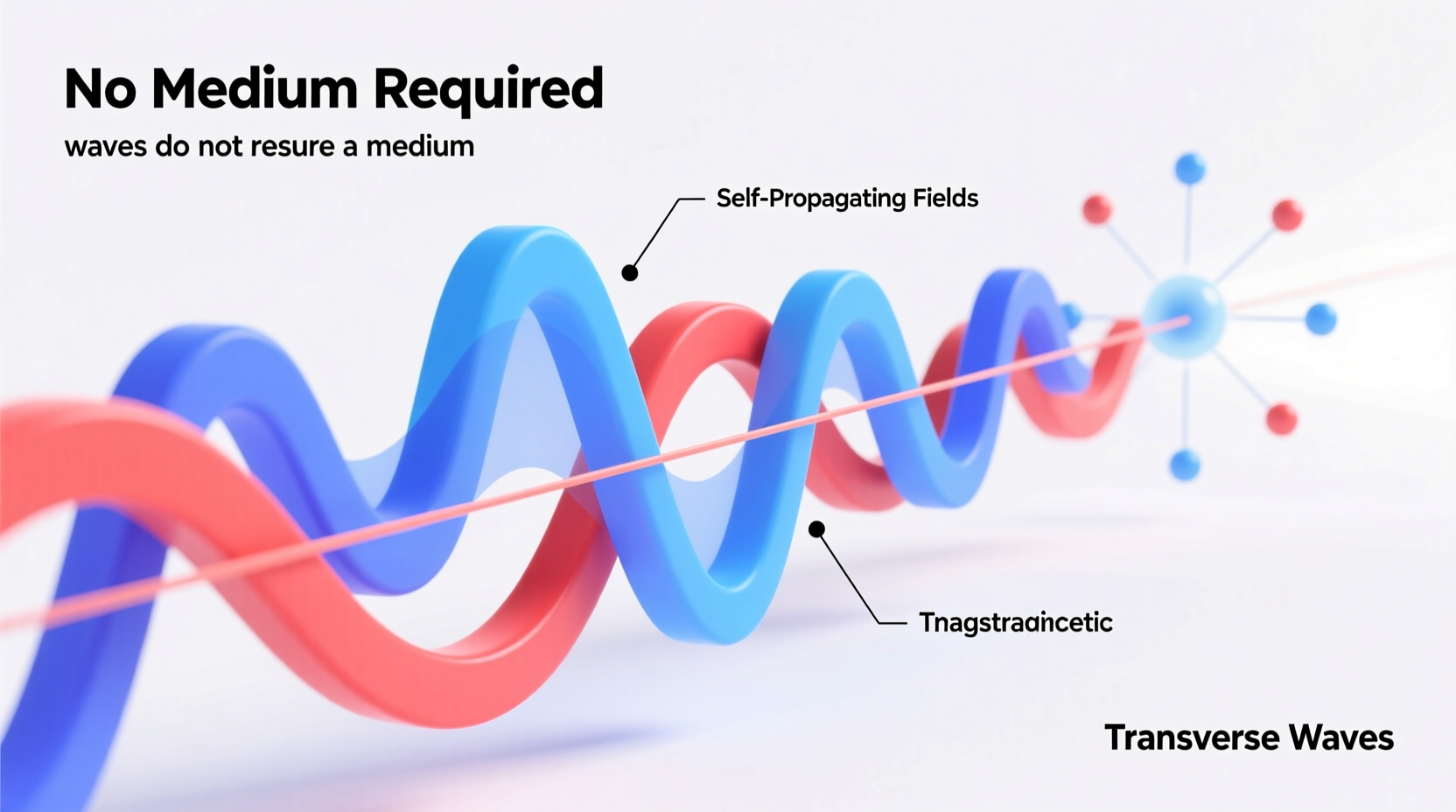
Electromagnetic (EM) waves behave fundamentally differently. They consist of oscillating electric and magnetic fields that generate each other in a self-sustaining cycle. When an electric field changes, it creates a magnetic field; when that magnetic field changes, it regenerates an electric field. This mutual induction allows the wave to sustain itself without requiring matter to move along with it.
Historical Shift: From Aether to Relativity
In the 1800s, physicists assumed light must also travel through a medium, which they called \"luminiferous aether.\" It was imagined as an invisible, massless substance filling all space, allowing light waves to ripple through it much like sound moves through air. However, experiments failed to detect any evidence of this aether.
The most famous of these was the Michelson-Morley experiment in 1887. Scientists attempted to measure differences in the speed of light depending on Earth’s direction of motion through the supposed aether. No such difference was found. Light always traveled at approximately 299,792 kilometers per second—regardless of direction or observer motion.
“Light requires no medium. Its constant speed in vacuum upended classical mechanics and led directly to Einstein’s theory of relativity.” — Dr. Alan Reyes, Theoretical Physicist
This constancy of the speed of light became a cornerstone of Albert Einstein’s special theory of relativity in 1905. He proposed that electromagnetic waves, including visible light, radio waves, and gamma rays, are governed by the laws of electromagnetism described by James Clerk Maxwell’s equations—and those laws predict that EM waves propagate at a fixed speed in vacuum, independent of any medium.
How Electromagnetic Fields Work in Vacuum
Maxwell’s equations unified electricity and magnetism into a single framework. One of their most profound predictions is that changing electric fields produce magnetic fields, and vice versa. When an accelerating charged particle—like an electron in an antenna—moves, it disturbs the surrounding electromagnetic field. This disturbance doesn’t need atoms to spread; instead, it radiates outward as a self-propagating wave.
The key lies in the nature of fields. An electric field extends through space around any charged object. Similarly, a magnetic field surrounds magnets and moving charges. These fields are not made of matter—they are fundamental properties of space itself. When disturbed in the right way, they oscillate and transfer energy across vast distances, even through interstellar voids.
This explains why sunlight reaches Earth after traveling 150 million kilometers through near-perfect vacuum. Radio signals from distant spacecraft like Voyager 1 still reach us despite being over 24 billion kilometers away. There's no air, no water, no material bridge—just fluctuating fields carrying information and energy across emptiness.
Comparison: Mechanical vs. Electromagnetic Waves
| Feature | Mechanical Waves | Electromagnetic Waves |
|---|---|---|
| Requires Medium? | Yes (solid, liquid, gas) | No (can travel through vacuum) |
| Speed Depends On | Density and elasticity of medium | Permittivity and permeability of space |
| Examples | Sound, seismic waves, water ripples | Light, microwaves, X-rays, radio waves |
| Energy Transfer Mechanism | Particle collisions/vibrations | Oscillating electric and magnetic fields |
| Can Travel Through Space? | No | Yes |
Real-World Implications and Applications
The fact that electromagnetic waves don’t need a medium isn’t just theoretical—it powers modern life. Consider satellite communications. Signals sent from ground stations travel upward through the atmosphere and into space, where they’re received by orbiting satellites. Those same signals then beam back down to different parts of the globe. All of this happens across regions where air pressure drops to nearly zero. If EM waves needed a medium, GPS, weather forecasting, and global internet connectivity would be impossible.
Astronomy also depends on this principle. Every photon arriving from distant galaxies has crossed millions—or billions—of light-years of vacuum. Telescopes capture these photons not because some invisible “stuff” fills space, but because light propagates via its intrinsic field dynamics.
Mini Case Study: Mars Rover Communication
NASA’s Perseverance rover operates on the surface of Mars, over 200 million kilometers from Earth at times. Commands are sent via radio waves from deep-space antennas. These signals take between 4 and 24 minutes to reach Mars, traveling entirely through vacuum. Once there, the rover sends back images and data using the same method. No cables, no atmosphere bridge—just pure electromagnetic transmission. This would fail utterly if EM waves behaved like sound or required a continuous material medium.
Common Misconceptions Clarified
One common confusion arises from analogies comparing light to water or sound waves. While useful for basic visualization, these comparisons break down in space. People often ask, “If nothing is waving, how can light be a wave?” The answer lies in redefining what “waving” means. In EM waves, it’s not matter that oscillates—it’s the strength and direction of electric and magnetic fields at each point in space.
Another misconception is that space is truly “empty.” Even in vacuum, quantum fields permeate the universe. However, these aren’t materials in the traditional sense. They don’t resist motion or provide a mechanical scaffold for waves. Instead, they allow for the existence and propagation of fundamental forces, including electromagnetism.
Checklist: Understanding EM Wave Propagation
- Recognize that EM waves are field-based, not matter-based.
- Understand that changing electric fields create magnetic fields and vice versa.
- Remember that Maxwell’s equations predict EM wave speed in vacuum.
- Accept that experimental evidence (e.g., Michelson-Morley) disproved the need for aether.
- Apply this knowledge to real systems like satellite communication and astronomy.
Frequently Asked Questions
Why can light travel through space but sound cannot?
Light is an electromagnetic wave that propagates via oscillating fields, which exist in vacuum. Sound is a mechanical wave that relies on particle collisions—there are too few particles in space to transmit sound effectively.
If EM waves don’t need a medium, why do they slow down in glass or water?
When EM waves enter materials like glass, the electric field interacts with electrons in atoms, causing delays in the wave’s progression. This interaction reduces the effective speed of light in that medium, but the underlying mechanism remains field-based, not dependent on bulk motion of the material.
Does quantum mechanics change this explanation?
No—quantum electrodynamics (QED) refines our understanding by describing light as photons, but even photons exhibit wave-like behavior in vacuum without a medium. The field-based nature of electromagnetism remains central.
Conclusion
The realization that electromagnetic waves require no medium was one of the most transformative insights in scientific history. It dismantled outdated models, enabled technologies we now take for granted, and reshaped our understanding of space and time. From your Wi-Fi router to the glow of distant quasars, the silent, invisible dance of electric and magnetic fields connects us across emptiness. Embracing this concept opens the door to deeper appreciation of both natural phenomena and human innovation.




 浙公网安备
33010002000092号
浙公网安备
33010002000092号 浙B2-20120091-4
Comments
No comments yet. Why don't you start the discussion?