
When people hear that evolution is “just a theory,” they often misunderstand what scientists mean by the word \"theory.\" This misconception leads to confusion about the strength and validity of evolutionary science. In everyday language, calling something a “theory” might imply uncertainty or speculation. But in science, a theory is not a guess—it’s a well-substantiated explanation of natural phenomena supported by vast evidence. Evolution is one of the most robust theories in all of science, backed by over 150 years of research across multiple disciplines.
This article clarifies what it means for evolution to be a scientific theory, how it differs from casual use of the term, and why its status as a theory actually underscores its credibility rather than diminishes it.
What Does “Theory” Mean in Science?
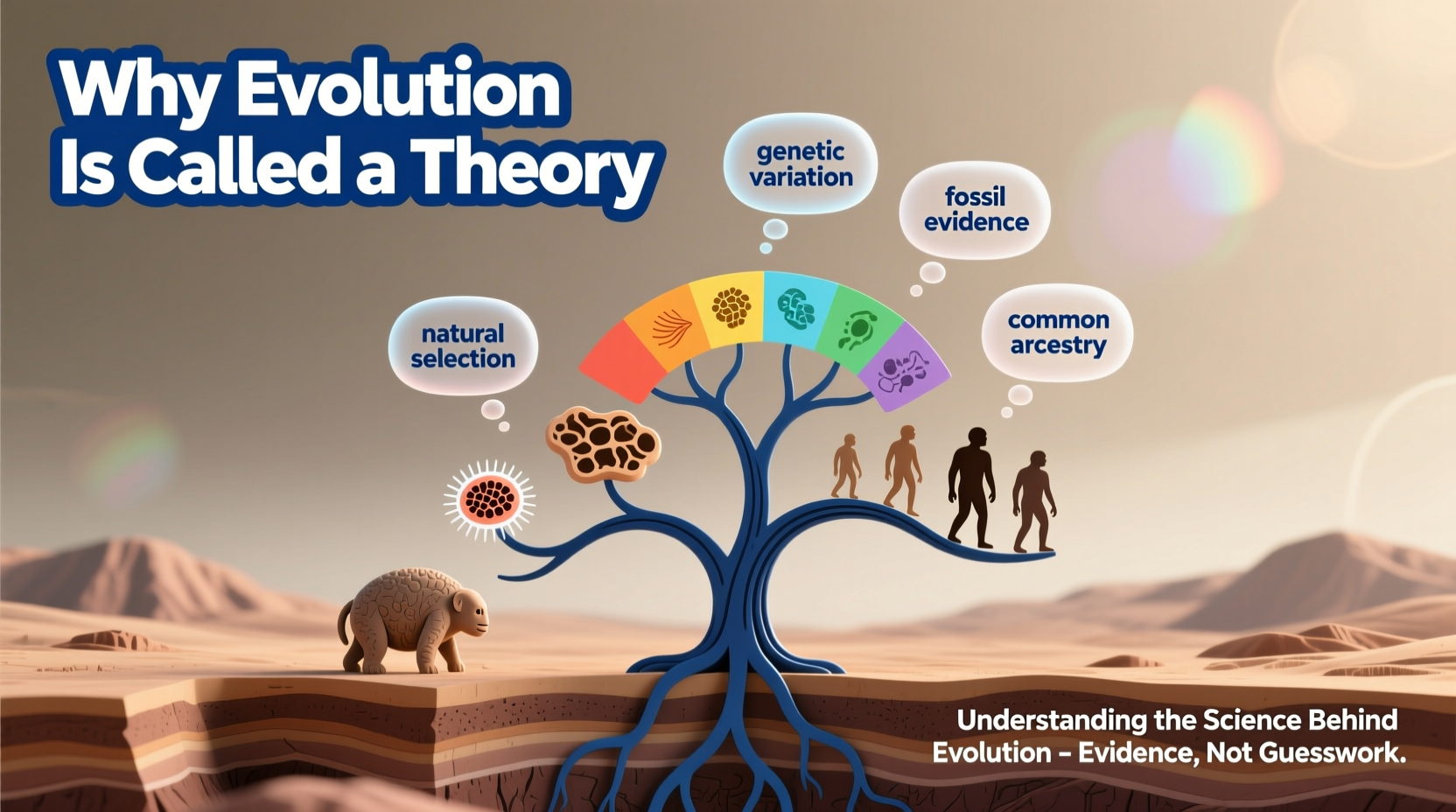
In scientific terminology, a theory is a comprehensive explanation of some aspect of the natural world that has been repeatedly confirmed through observation and experimentation. It integrates facts, laws, inferences, and tested hypotheses into a coherent framework. Unlike a hypothesis—which is a tentative, testable prediction—a theory explains why things happen the way they do.
For example:
- Cell Theory explains that all living organisms are composed of cells.
- Atomic Theory describes how matter is made up of atoms.
- Gravitational Theory accounts for how masses attract each other.
None of these are considered “unproven” simply because they’re called theories. The same applies to evolution: being a theory reflects its explanatory power and scientific acceptance, not doubt about its accuracy.
The Evidence Behind Evolutionary Theory
Evolutionary theory rests on an extensive foundation of evidence from diverse fields such as genetics, paleontology, biogeography, comparative anatomy, and molecular biology. Scientists have observed evolutionary changes in real time—from antibiotic resistance in bacteria to shifts in beak size among Galápagos finches during droughts.
Key lines of evidence include:
- Fossil Record: Shows transitional forms linking ancient species to modern ones (e.g., Tiktaalik between fish and amphibians).
- DNA Similarities: Humans share approximately 98.8% of their DNA with chimpanzees, reflecting common ancestry.
- Homologous Structures: Limbs in mammals like bats, whales, and humans follow the same bone pattern despite different functions.
- Biogeography: Species distribution aligns with geological history; marsupials dominate Australia due to isolation.
- Observed Natural Selection: Peppered moths darkened during the Industrial Revolution in response to pollution.
This convergence of independent data streams reinforces the validity of evolution as both a fact (change occurs) and a theory (natural selection and other mechanisms explain how).
Why Is Evolution Called a Theory? A Clarification
Calling evolution a “theory” does not mean scientists are unsure. Rather, it signifies that we have a powerful, predictive model explaining how life diversifies over time. The full name—the theory of evolution by natural selection—was first articulated by Charles Darwin and Alfred Russel Wallace in the 19th century. Since then, advances in genetics and genomics have only strengthened the framework.
Consider this analogy: if gravity were doubted every time someone said “it’s just a theory,” airplanes couldn’t fly. Yet gravitational theory isn’t questioned because objects fall predictably. Similarly, evolution is observable, testable, and foundational to modern biology.
“Evolution is a theory in the same sense that germ theory explains disease or heliocentric theory explains planetary motion. It's not a hunch—it's the best explanation we have, based on mountains of evidence.” — Dr. Niles Eldredge, Paleontologist, American Museum of Natural History
Common Misconceptions About Evolution as a Theory
Misunderstandings often arise from conflating colloquial and scientific meanings of “theory.” Below is a table contrasting public perception with scientific reality.
| Common Belief | Scientific Reality |
|---|---|
| “It’s just a theory” implies it’s unproven or speculative. | A scientific theory is a well-tested explanation confirmed by repeated evidence. |
| Theory and fact are mutually exclusive. | Evolution is both a fact (organisms change over time) and a theory (we explain how via natural selection). |
| If new evidence emerges, the entire theory could collapse. | Like all scientific theories, evolution evolves with new data—but core principles remain robust. |
| Lack of “missing links” disproves evolution. | Thousands of transitional fossils exist; gaps are expected due to fossilization rarity. |
How Scientific Theories Are Built: A Step-by-Step Process
Understanding how evolution became a theory helps illustrate why it holds such weight in science. Here’s how scientific theories generally develop:
- Observation: Scientists notice patterns in nature (e.g., similar bone structures across species).
- Hypothesis Formation: Propose a possible explanation (e.g., shared ancestry).
- Prediction & Testing: Design experiments or gather data to test predictions (e.g., search for transitional fossils).
- Data Collection: Accumulate evidence from multiple sources (genetics, embryology, geology).
- Peer Review & Replication: Findings are scrutinized and independently verified.
- Theory Development: Once consistently supported, the explanation becomes a widely accepted theory.
Evolution followed this exact path. From Darwin’s initial insights to modern genomic analysis, each step reinforced the conclusion that life on Earth shares common descent and adapts through natural processes.
Mini Case Study: Antibiotic Resistance as Real-Time Evolution
In hospitals worldwide, doctors face a growing crisis: bacteria that no longer respond to antibiotics. This isn’t random chance—it’s evolution in action.
When a patient takes antibiotics, most bacteria die. However, a few may carry genetic mutations that allow them to survive. These resistant microbes reproduce, passing the trait to offspring. Over time, the population shifts from susceptible to resistant. This process—natural selection—is precisely what evolutionary theory predicts.
Public health agencies now rely on evolutionary principles to design treatment protocols, rotate drugs, and slow resistance. If evolution were merely speculative, such strategies wouldn’t work. But they do—because evolution is real, observable, and predictable.
Frequently Asked Questions
Does calling evolution a theory mean scientists aren't confident in it?
No. In science, confidence increases with the amount of supporting evidence. Evolution is labeled a theory because it meets the highest standard of scientific validation—an explanation grounded in facts, repeatedly tested, and capable of making accurate predictions.
Can a theory become a law?
Not exactly. Scientific laws describe *what* happens (e.g., Newton’s Law of Gravity), while theories explain *why* it happens (e.g., Einstein’s Theory of General Relativity). Laws and theories serve different purposes. Evolution explains biodiversity; there’s no “law of evolution” because biological change involves complex, variable mechanisms.
Has the theory of evolution changed since Darwin?
Yes—and that’s a strength, not a weakness. Modern evolutionary synthesis combines Darwin’s idea of natural selection with genetics, mutation, gene flow, and epigenetics. Science welcomes refinement. Updating a theory with new evidence shows intellectual honesty and progress.
Conclusion: Embracing Scientific Literacy
Understanding why evolution is called a theory is essential to appreciating how science works. It’s not a placeholder for truth waiting to be upgraded—it is the pinnacle of scientific understanding. To dismiss evolution because it’s “only a theory” is to misunderstand the very nature of science itself.
From medicine to agriculture, evolutionary theory informs critical decisions that affect our lives. Recognizing its legitimacy empowers us to engage with science more thoughtfully, support evidence-based education, and make informed choices in a rapidly changing world.




 浙公网安备
33010002000092号
浙公网安备
33010002000092号 浙B2-20120091-4
Comments
No comments yet. Why don't you start the discussion?