
Many English learners—and even some native speakers—struggle to distinguish between \"haven't\" and \"hasn't.\" Though both are contractions of the auxiliary verb \"have\" used in the present perfect tense, their correct application depends on subject-verb agreement. Misusing them can lead to awkward phrasing or unintended meaning. This guide breaks down the grammatical logic, common errors, and real-world applications so you can use these contractions accurately and confidently.
The Core Difference: Subject Agreement
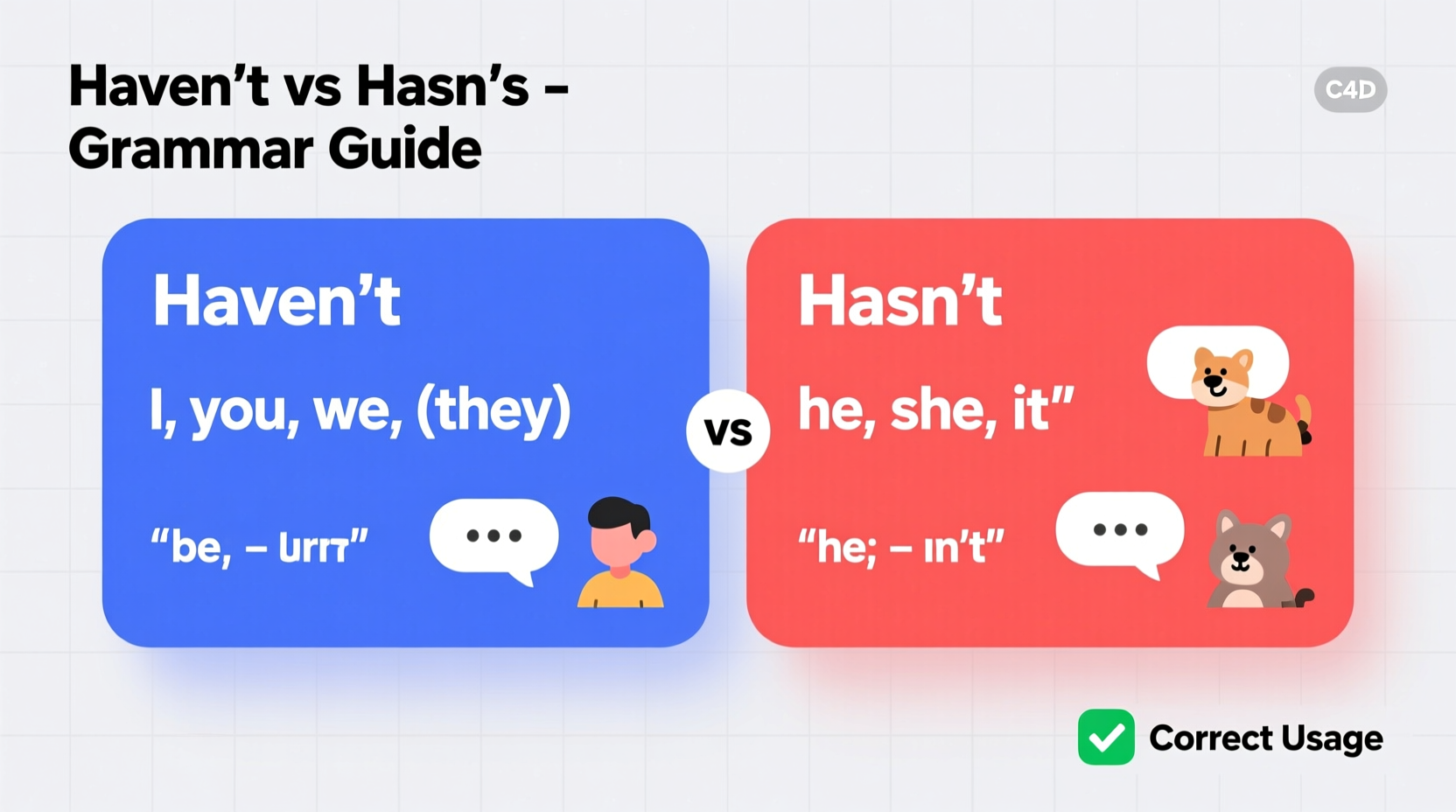
The fundamental rule separating \"haven't\" and \"hasn't\" lies in the subject of the sentence. \"Haven't\" is the contraction of \"have not,\" while \"hasn't\" stands for \"has not.\" Their usage follows standard subject-verb agreement in the present perfect tense:
- Haven't (have not) – used with plural subjects and first- and second-person singular (I, you, we, they).
- Hasn't (has not) – used with third-person singular subjects (he, she, it, John, the dog, etc.).
This distinction mirrors how \"have\" and \"has\" function in positive sentences. For example:
| Subject | Correct Form | Example Sentence |
|---|---|---|
| I / You / We / They | haven't | I haven't finished my homework yet. |
| He / She / It / Maria / The team | hasn't | She hasn't called me today. |
| You (plural) | haven't | You haven't responded to the group message. |
| The project | hasn't | The project hasn't started on schedule. |
Common Errors and Why They Happen
Mistakes often arise from rapid speech, regional dialects, or overgeneralization. One frequent error is using \"hasn't\" with plural subjects:
\"They hasn't arrived yet.\"
This is incorrect. The subject \"they\" requires \"haven't\": \"They haven't arrived yet.\" Similarly, saying \"She haven't seen the movie\" violates subject-verb agreement. The correct version is \"She hasn't seen the movie.\"
Another source of confusion comes from collective nouns. Words like \"team,\" \"family,\" or \"group\" may feel plural but are grammatically singular when referring to the unit as a whole:
- Correct: \"The team hasn't won a game this season.\" (singular entity)
- Also correct: \"The team haven't agreed on a strategy.\" (if emphasizing individual members, especially in British English)
In American English, singular treatment dominates; British English allows more flexibility with collective nouns, making \"the team haven't\" acceptable in informal contexts.
Real-World Usage: A Mini Case Study
Consider Sarah, a non-native English speaker working in international marketing. During a client call, she says:
\"Our campaign hasn't reached all target markets yet.\"
This is grammatically correct—“campaign” is singular, so “hasn’t” applies. But later, when discussing her team’s progress, she says:
\"My colleagues hasn't completed their reports.\"
Here, the error undermines her professionalism. The subject “colleagues” is plural, requiring “haven’t.” The corrected sentence should be:
\"My colleagues haven't completed their reports.\"
After receiving feedback, Sarah begins checking each subject before speaking. She practices by writing short summaries daily, reinforcing correct usage. Within weeks, her confidence—and accuracy—improve significantly.
Expert Insight on Language Evolution
While grammar rules provide structure, language naturally evolves through usage. Still, clarity remains essential in professional and academic settings. Linguist Dr. Alan Reed notes:
“Contractions like 'haven’t' and 'hasn’t' are deeply embedded in spoken and written English. While informal speech may blur distinctions, precision matters in formal communication. Understanding the rules allows speakers to choose when—or whether—to bend them.”
This highlights that mastering standard usage empowers intentional choices rather than accidental errors.
Step-by-Step Guide to Choosing Correctly
Follow this five-step process to determine whether to use \"haven't\" or \"hasn't\":
- Identify the subject of the sentence (e.g., I, you, he, they, the company).
- Determine number and person: Is it singular or plural? First, second, or third person?
- Recall the base form: Do you need \"have\" or \"has\" in the positive present perfect?
- Apply the contraction: Use \"haven't\" if the base is \"have\"; use \"hasn't\" if the base is \"has.\"
- Double-check by expanding the contraction: Does \"have not\" or \"has not\" sound right?
For instance:
- Sentence: \"___ your parents heard about the event?\"
- Subject: \"your parents\" (plural)
- Base verb: \"have\" (because plural subjects take \"have\")
- Contraction: \"haven't\"
- Final sentence: \"Haven't your parents heard about the event?\"
Do’s and Don’ts Table
| Scenario | Do | Don't |
|---|---|---|
| Talking about yourself | I haven't eaten lunch. | I hasn't eaten lunch. |
| Referring to a friend | James hasn't replied to my text. | James haven't replied to my text. |
| Group action | We haven't decided where to go. | We hasn't decided where to go. |
| Negative question with \"he\" | Hasn't he finished his work? | Haven't he finished his work? |
| With \"it\" | It hasn't rained all week. | It haven't rained all week. |
Frequently Asked Questions
Can \"haven't\" and \"hasn't\" be used interchangeably in casual speech?
While some dialects allow mixing, standard English maintains a clear distinction based on subject agreement. Interchanging them may be understood contextually but is considered incorrect in formal writing and speech.
Is it ever correct to say \"hasn't they\"?
No. \"They\" always takes \"have,\" so the correct negative is \"haven't they.\" However, questions like \"Hasn't he?\" follow inversion rules correctly because \"he\" is third-person singular. So: \"They haven't left, have they?\" is correct—not \"hasn't they.\"
What about \"haven't I\"? Isn't that irregular?
Yes, \"haven't I?\" is an accepted alternative to the archaic \"have I not?\" Although \"I\" usually pairs with \"have,\" the tag question \"haven't I?\" has become standard despite not following the typical pattern seen in other negatives. It's a rare exception rooted in historical usage.
Final Checklist for Confident Usage
- ✅ Identify the subject clearly before choosing the verb.
- ✅ Remember: \"I, you, we, they\" → \"haven't\"; \"he, she, it\" → \"hasn't.\"
- ✅ Expand contractions mentally to verify correctness.
- ✅ Be cautious with collective nouns—know your audience’s dialect norms.
- ✅ Practice aloud with varied subjects to build fluency.
Conclusion: Clarity Starts with Correct Contraction Use
Mastering the difference between \"haven't\" and \"hasn't\" isn't just about grammar—it's about being understood clearly and taken seriously. Whether you're writing an email, giving a presentation, or chatting with colleagues, accurate verb usage strengthens your credibility. These small linguistic details shape how others perceive your attention to detail and command of language.




 浙公网安备
33010002000092号
浙公网安备
33010002000092号 浙B2-20120091-4
Comments
No comments yet. Why don't you start the discussion?