
Since the first humans gazed up at the night sky, the cosmos has stirred something deep within us—not just wonder, but a relentless desire to understand, explore, and dream. What transforms distant stars and silent galaxies into sources of profound inspiration? It is not merely data or discovery that captivates us, but the power of imagination. Our ability to envision the unseen, to project ourselves beyond Earth’s bounds, and to conceive of life among the stars lies at the heart of our cosmic fascination. Imagination does not distract from scientific inquiry; it propels it.
The Cosmic Spark: How Imagination Ignites Curiosity
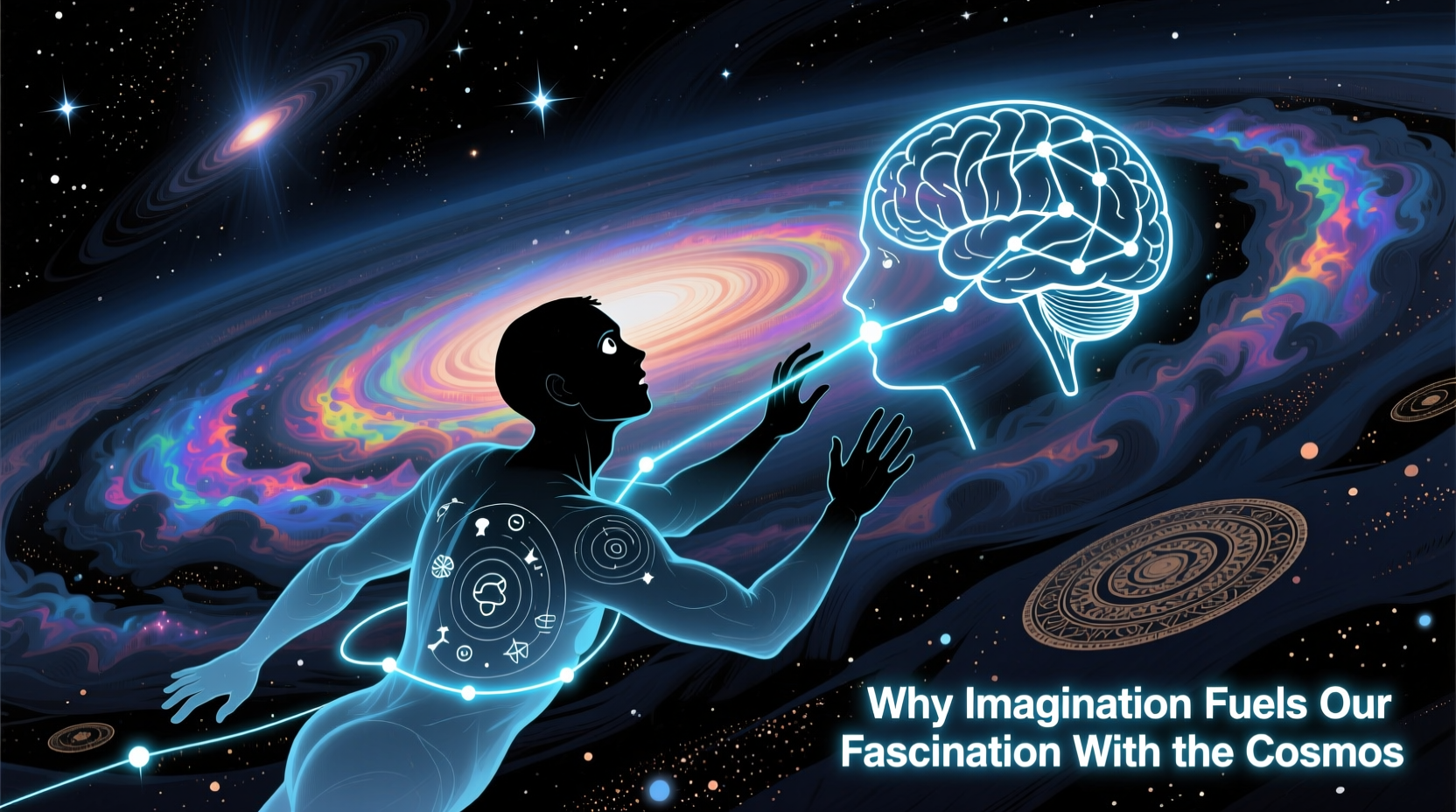
Long before telescopes or spacecraft, early civilizations mapped constellations and wove myths around celestial bodies. The Greeks saw gods in the stars; Indigenous cultures traced ancestral stories through the Milky Way. These narratives were not primitive misunderstandings—they were acts of imaginative reasoning, attempts to make sense of an infinite universe with limited tools.
Imagination bridges the gap between observation and understanding. When we look at a star, we don’t just see a point of light—we imagine its age, its distance, its possible planets. We ask: Could someone be looking back? Was this star born alongside Earth? Will it outlive us all? These questions arise not from cold calculation, but from a deeply human impulse to connect, to belong in a vast and often indifferent expanse.
“Imagination will often carry us to worlds that never were. But without it, we wouldn’t go anywhere.” — Carl Sagan
From Myth to Science Fiction: Stories That Shape Discovery
Science fiction has long served as both mirror and engine for space exploration. Jules Verne imagined lunar travel in 1865; a century later, Apollo astronauts followed trajectories eerily similar to his fictional capsule. Arthur C. Clarke envisioned geostationary satellites in 1945—years before they became reality. More recently, films like *Interstellar* and *The Martian* have sparked public interest in relativity, orbital mechanics, and Mars colonization.
These stories do more than entertain—they normalize the idea of space travel, making it feel inevitable rather than impossible. They inspire engineers, physicists, and astronauts by offering vivid, emotionally resonant visions of what could be. Elon Musk has cited Isaac Asimov and Robert Heinlein as influences on his vision for interplanetary civilization. NASA scientists often trace their career paths back to childhood encounters with *Star Trek* or *2001: A Space Odyssey*.
The Role of Imagination in Scientific Breakthroughs
Scientific progress relies on hypothesis—on imagining possibilities before proving them. Einstein famously conducted “thought experiments,” visualizing himself riding alongside light beams, which led to the theory of relativity. When Vera Rubin observed anomalies in galaxy rotation, she imagined invisible mass holding galaxies together—dark matter, a concept now central to cosmology.
Imagination allows scientists to leap beyond current data. Consider the search for exoplanets: astronomers cannot yet see most of these worlds directly. Instead, they infer their existence through tiny dips in starlight—then imagine their atmospheres, climates, and potential for life. Without creative thinking, such indirect evidence would remain mere noise.
| Scientific Concept | Imaginative Leap Required | Real-World Impact |
|---|---|---|
| Black Holes | Objects so dense light cannot escape | Confirmed via Event Horizon Telescope (2019) |
| Multiverse Theory | Infinite parallel universes | Drives research in quantum mechanics and inflation |
| Wormholes | Shortcuts through spacetime | Guides theoretical models of general relativity |
A Mini Case Study: The Mars Rover Naming Contest
In 2020, NASA invited U.S. students to name its next Mars rover. Among thousands of entries, “Perseverance” was chosen—a name submitted by Alexander Mather, a seventh grader from Virginia. His essay described perseverance as the quality that drives humanity to explore despite obstacles.
This contest exemplifies how imagination fuels public connection to space. Children didn’t just learn about Mars—they imagined themselves contributing to its exploration. Schools reported increased interest in STEM subjects afterward. One teacher noted, “Students weren’t just memorizing facts; they were writing letters to a robot they helped name.”
The rover itself carried more than instruments—it carried dreams. Attached to it were over 10 million names submitted by the public, etched onto silicon chips. This symbolic gesture transformed abstract exploration into personal participation, made possible only through collective imagination.
Cultivating Cosmic Wonder: A Practical Guide
Fostering imagination about the cosmos isn’t reserved for scientists or writers. Anyone can deepen their connection to the universe through intentional practices. Here’s how:
- Stargaze regularly: Even in cities, visible planets and constellations offer entry points. Use apps like SkySafari to identify objects and learn their stories.
- Read speculative science: Books like *Packing for Mars* by Mary Roach or *Astrophysics for People in a Hurry* by Neil deGrasse Tyson blend facts with narrative flair.
- Ask “what if?” questions: What if Jupiter had rings like Saturn? What if time flows differently near black holes? These questions train the mind to think beyond the known.
- Engage with art inspired by space: Listen to Holst’s *The Planets*, view Hubble imagery, or watch documentaries with poetic narration.
- Keep a cosmic journal: Record observations, sketches, and reflections. Note how your understanding evolves over time.
Checklist: Building Your Cosmic Imagination Toolkit
- ✅ Dedicate 15 minutes per week to stargazing or space-related reading
- ✅ Visit a planetarium or virtual observatory tour
- ✅ Follow real-time missions (e.g., James Webb updates, Mars rovers)
- ✅ Discuss space with others—share wonders, not just facts
- ✅ Create something inspired by the cosmos—a poem, drawing, or model
FAQ: Common Questions About Imagination and the Cosmos
Isn’t imagination the opposite of scientific thinking?
No. While science demands rigor, imagination provides the initial spark—the hypothesis, the analogy, the vision. All major discoveries begin with someone asking, “What if?” Imagination and logic are complementary, not opposing forces.
Can children benefit from cosmic imagination even without formal knowledge?
Absolutely. Early exposure to space through imaginative play builds curiosity and cognitive flexibility. Studies show that kids who engage with space-themed activities score higher in problem-solving and spatial reasoning, regardless of immediate factual retention.
Does daydreaming about space have any real-world value?
Yes. Daydreaming fosters creativity, emotional resilience, and long-term goal setting. Many astronauts report that childhood fantasies of flying to Mars directly influenced their career choices. Imagination plants seeds that may take decades to grow.
Conclusion: Dare to Imagine Beyond the Horizon
The cosmos does not yield its secrets to those who merely calculate. It reveals itself to those who dare to dream—to those who look up and see not just stars, but stories, possibilities, and futures not yet written. Imagination is the original telescope, allowing us to peer beyond the limits of technology, culture, and time.
Every mission launched, every theory tested, every child who says, “I want to be an astronaut,” begins not with a rocket, but with a thought. In a universe defined by scale and silence, imagination is our loudest, most enduring voice.




 浙公网安备
33010002000092号
浙公网安备
33010002000092号 浙B2-20120091-4
Comments
No comments yet. Why don't you start the discussion?